


- Russia Moves to Sign Security Pact with ECOWAS as Moscow Courts Both Sides of Sahel Divide
Russia says it is preparing to sign a security cooperation agreement with the Economic Community of West African States, potentially expanding Moscow’s influence beyond its established military relationships with Mali, Burkina Faso and Niger into West Africa’s principal political and economic bloc.
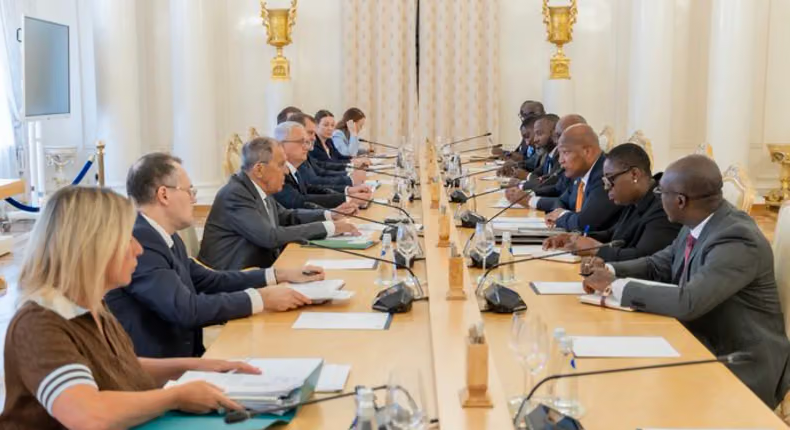
Russian Foreign Minister Sergey Lavrov disclosed the planned memorandum following talks in Moscow with Ghana’s Foreign Minister Samuel Okudzeto Ablakwa, saying the agreement would include cooperation in the area of regional security. He did not disclose when the agreement would be signed or the precise obligations that would be created under it.
“Russia will sign a memorandum of cooperation with ECOWAS, including in the field of security,” Lavrov said, according to a statement cited by Business Insider Africa. The report noted, however, that ECOWAS has not issued a corresponding public announcement detailing the proposed memorandum, meaning the scope and current status of the arrangement remain based on Moscow’s account.
If concluded, the agreement would place Russia in an unusual strategic position because Moscow is already one of the closest security partners of the three military-led Sahel states that withdrew from ECOWAS. Mali, Burkina Faso and Niger formally ceased to be members of the regional bloc on January 29, 2025, before consolidating their cooperation through the Alliance of Sahel States.
Russia has supplied equipment, training and personnel to the three countries and has pledged continued assistance to their joint military force.
In July, Moscow and the Sahel states agreed to deepen military and military-technical cooperation, including support involving the Russian Africa Corps, strengthening Russia’s role in the alternative security architecture emerging across the central Sahel.
Lavrov is now offering Russia as a potential bridge between the two sides. He said Moscow was prepared to support efforts to rebuild relations between ECOWAS and Mali, Burkina Faso and Niger, arguing that cooperation remains necessary because security threats do not stop at political borders.
That argument reflects a significant security concern for the wider region. The separation of the three Sahel countries from ECOWAS has complicated intelligence sharing, border management and coordination against armed groups operating across national frontiers, while insecurity has increasingly threatened coastal states further south.
The strategic question is whether Russia can credibly operate as both a security partner to the breakaway Sahel alliance and a formal security interlocutor with ECOWAS. That dual position could give Moscow an unusual role in attempts to reconnect the two blocs, but it could equally expand Russia’s leverage across both sides of West Africa’s emerging geopolitical divide.
The development comes as Ghana is also exploring deeper bilateral cooperation with Moscow. During the discussions, Lavrov said Ghana was moving towards completing the ratification of an intergovernmental agreement on military-technical cooperation, although no detailed terms or parliamentary timetable were announced.
Energy also featured in the talks, including possible cooperation on nuclear power. Russia indicated that discussions were progressing, but no contract, financing arrangement or final decision selecting Moscow as Ghana’s nuclear partner was announced, leaving the project within a wider competition involving several potential international partners.
Commercial relations are also expected to deepen, with Ghana and Russia preparing for the fifth meeting of their intergovernmental commission on trade, economic, scientific and technical cooperation before the end of 2026.
Geological exploration, agriculture, fertiliser supplies and information technology were identified as potential areas for cooperation, though no investment values or completed projects were disclosed.
The two countries also signed a visa-waiver agreement covering holders of diplomatic and service passports during the visit. The arrangement does not extend visa-free travel to ordinary Ghanaian or Russian passport holders.
For ECOWAS, Russia’s proposal arrives at a difficult moment. The withdrawal of Mali, Burkina Faso and Niger reduced the organisation from 15 to 12 member states and weakened the regional framework for coordinated responses to terrorism and political instability, even though trade and free-movement arrangements have temporarily been maintained for citizens and goods from the three former members.
For Moscow, the proposed agreement would signal a further evolution of its West African strategy. Russia’s regional engagement would no longer be concentrated mainly on bilateral military relationships with governments in the central Sahel, but would extend towards formal cooperation with the institution representing many of the coastal democracies surrounding them.
The unanswered question is whether that expanded role will help restore practical security cooperation across the region or simply give Russia greater strategic influence over competing political blocs.
Much will depend on the final provisions of the proposed memorandum, the response from ECOWAS itself and whether Moscow’s relationship with the Sahel alliance can be reconciled with the interests of ECOWAS member states.

