

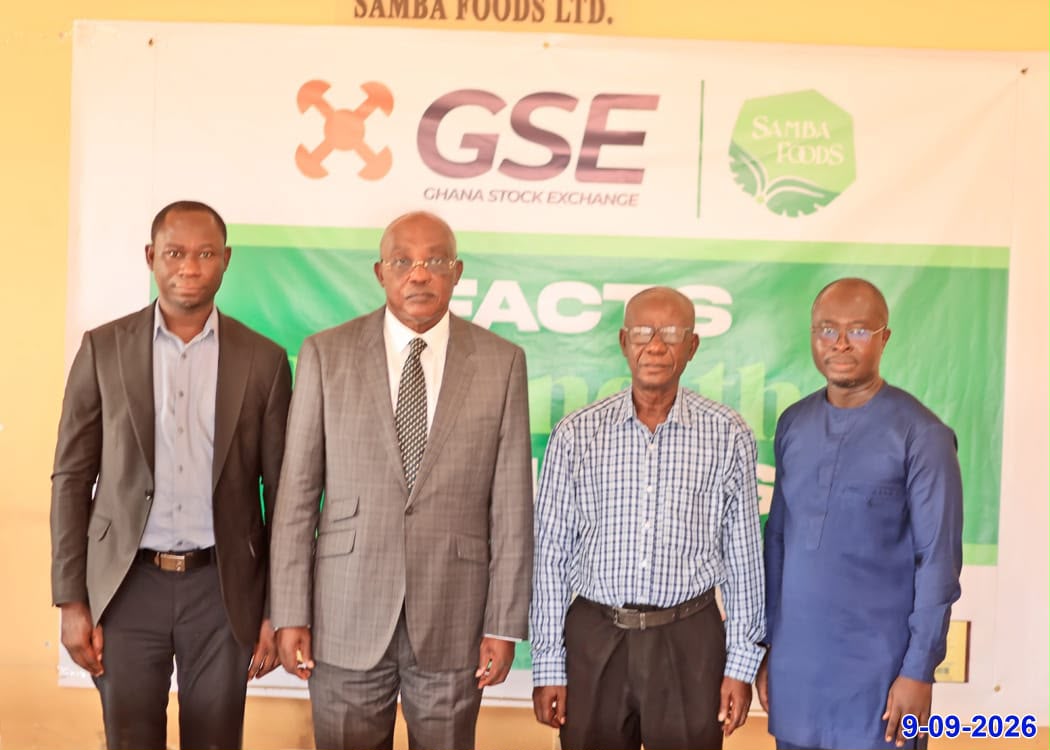

- Samba Foods Rebuilds Margins and Cash Flow as Partnership Restores Production
Samba Foods Limited has returned to profitability after a period of operational disruption and financial strain, with management describing the 2025 performance as the beginning rather than the completion of a turnaround.
Total income more than doubled from about GH¢802,000 in 2024 to GH¢1.62 million in 2025, while the company swung from a GH¢245,000 loss after tax to a GH¢265,000 profit.
“These are substantial improvements,” management said, arguing that the results show the company can generate meaningful returns when production inputs, machinery, working capital and labour are properly aligned.
The operational recovery was underpinned by a sharp increase in production under Samba’s arrangement with Unifa Brothers.
The company manufactured approximately 11 million sachets during 2025, providing clear evidence that its factory and workforce can operate at substantially higher volumes when capital and inputs are available.
The improvement also helped lift gross-profit margin from about 7.00% to 42.00%, a gain of roughly 35 percentage points.
The central question for investors, however, is whether Samba can turn a partnership-assisted rebound into a durable business model. Approximately two-thirds of reported 2025 income was linked to the Unifa arrangement, creating significant concentration risk despite the benefits of the partnership. The document therefore frames the challenge as whether the company can build growth without becoming excessively dependent on a single commercial relationship.
The Unifa partnership addressed two of Samba’s biggest operational constraints: unreliable packaging machinery and inadequate working capital.
Samba contributed its manufacturing facility, technical expertise, production oversight, food-processing capability, quality assurance and regulatory compliance, while Unifa provided funding and support for raw materials, packaging, machinery, working capital and agreed production expenses.
The arrangement also supported additional staffing, helping restore production continuity.
Management has stressed that the commercial partnership did not amount to a change in ownership. “Unifa is a strategic commercial partner. It has not acquired an equity interest in Samba Foods through this arrangement.
There has been no dilution of the ownership interests of existing shareholders,” management said. That clarification is important for investors assessing whether the turnaround came at the cost of existing shareholder control.
The more significant achievement may be operational rather than purely accounting-based. Samba’s longstanding challenge was not simply demand, but its inability to maintain reliable machinery and finance raw materials and packaging at sufficient scale, which meant existing orders could not always be converted into revenue.
The Unifa arrangement effectively bridged that gap and allowed the company to use its productive assets more intensively.
That greater utilisation also improved the economics of production. Income rose by approximately 102.00% in one year, while the gross margin expansion suggests fixed and operating costs were being spread across substantially higher production volumes.
“The company did not merely become busier. The increased production also improved the economics of the business,” management said.
The quality of the recovery is also supported by cash-flow indicators. The company reported positive operating cash generation, reduced outstanding payables and ended 2025 with a stronger cash position, suggesting the improvement was not confined to reported profit alone. Management nevertheless remains cautious, saying:
“The proper question is whether we can sustain this performance, reduce our vulnerabilities and create a broader platform for growth.”
That vulnerability is most obvious in customer concentration. A major reduction in orders, renegotiation of terms, supplier changes or financial difficulties at Unifa could have a material effect on Samba’s production and revenue.
Management is therefore seeking to consolidate the Unifa relationship while expanding direct customers, contract manufacturing and export business.
Samba already has a direct relationship with GB Foods and wants to deepen that business while turning intermittent export orders into more predictable recurring demand. “A strong partnership should provide a platform for growth.
It should not prevent the company from building a broader and more resilient business around that platform,” management said. The strategic test is whether Samba can reproduce the economics achieved under Unifa across a broader customer portfolio.
The decision not to recommend a dividend for 2025 reflects that caution. Despite the return to profitability, the board believes retained earnings are needed to strengthen working capital, support production and consolidate the recovery. “A premature distribution would weaken the very recovery upon which future shareholder returns must depend,” management said.
For shareholders, retaining earnings only creates value if the capital produces stronger profits and cash flows in subsequent years. Management has therefore proposed monitoring production consistency, capacity utilisation, gross margins, operating cash conversion, repeat customers and the proportion of income generated outside its largest commercial relationship.
Those metrics will be more useful than headline revenue growth in determining whether the turnaround is becoming structurally durable.
The Unifa relationship was extended in February 2026 for a further three months to March 31, preserving operational support and supply continuity. That reinforces both sides of the investment case: the partnership has been central to restoring production, but Samba still needs to diversify its revenue base if the recovery is to become less vulnerable.
The company now has to prove that its improved margins and cash generation can continue beyond a single partnership-led cycle.
Management itself has set the appropriate benchmark for judging progress. “One year of profit can demonstrate recovery. Several years of disciplined and repeatable performance will be required to establish resilience,” it said.
For Samba Foods, 2025 was therefore an important proof of concept; the real verdict will depend on whether the company can convert that recovery into sustained profitability, broader customer relationships and dependable cash generation.

