


- Shell And Chevron Return to Ghana’s Upstream as South Deepwater Tano Deal Advances
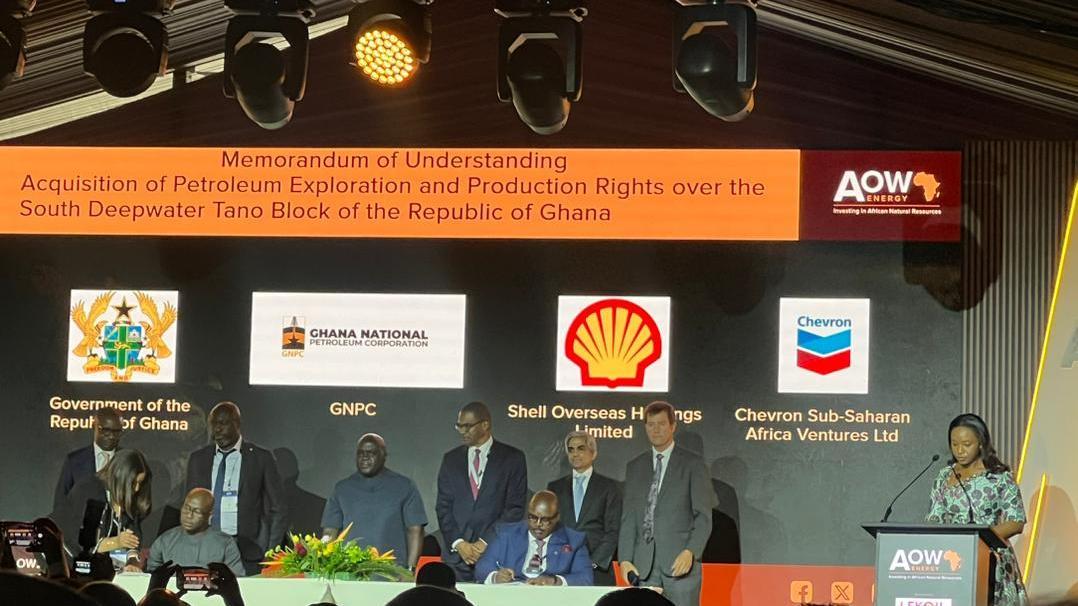
Ghana is seeking to revive its deepwater petroleum ambitions through the return of two of the world’s largest energy companies, signing a memorandum of understanding with Shell and Chevron over exploration and production rights in the South Deepwater Tano block.
The agreement, involving the Government of Ghana, Ghana National Petroleum Corporation, GNPC Explorco, Shell Overseas Holdings Limited and Chevron Sub-Saharan Africa Ventures Limited, was signed in Accra during Africa Oil Week 2026. It follows earlier confirmation that Shell and Chevron intended to jointly pursue opportunities in the acreage.
The significance goes beyond the block itself. Ghana is attempting to convince international oil companies that the country remains commercially attractive at a time when global energy groups are more selective about large, capital-intensive exploration projects and increasingly disciplined about where they deploy upstream capital.
South Deepwater Tano covers about 3,482 square kilometres in the Tano Basin, with water depths reaching almost 3.5 kilometres. Estimates associated with the acreage put its potential hydrocarbon resources at more than 3 billion barrels, although that figure should not be confused with proven commercial reserves.
That distinction is critical. The memorandum does not represent an oil discovery and does not guarantee eventual production, with exploration drilling, appraisal, development planning, regulatory approvals and a final commerciality decision still required before geological potential can be converted into recoverable barrels.
The participation of Shell and Chevron nevertheless improves the credibility of the exploration proposition. Both companies have the technical capability, balance sheets and deepwater experience needed to undertake projects whose costs can run into hundreds of millions of dollars before commercial viability is established.
Their interest also arrives as the government seeks to reshape the economics of Ghana’s upstream petroleum industry. Energy and Green Transition Minister John Abdulai Jinapor has announced reforms including a reduction in GNPC’s initial carried interest from 15.00% to 10.00%, an extension of petroleum agreements from 25 to 30 years, changes to the signature-bonus structure and an extension of the loss-carried-forward period from five to 10 years.
The policy logic is that Ghana may ultimately earn more from a larger volume of successful petroleum investment than from demanding a bigger state share in projects that investors consider commercially unattractive. It is a calculated shift from maximising the state’s contractual percentage towards maximising the overall value created by exploration, development and production.
That trade-off will be closely watched. Deepwater exploration is inherently risky, and investors will judge Ghana not simply on headline incentives but on geological probability, expected recovery rates, oil-price assumptions, development costs, fiscal stability and the speed with which commercially viable discoveries can be moved towards production.
South Deepwater Tano will therefore test both Ghana’s geology and the credibility of its revised investment framework. If exploration succeeds, the country could secure an additional source of production at a time when maintaining output from mature fields is becoming increasingly important; if it fails, the process will still reveal whether policy reform is sufficient to attract serious exploration capital.
The timing is strategic because Ghana’s petroleum industry faces a structural problem shared by many producing countries: existing fields decline while replacing them requires long lead times and substantial investment. The country cannot depend indefinitely on Jubilee, TEN and other existing offshore assets to sustain petroleum output and revenues.
Government has consequently sought to reopen Ghana’s exploration frontier, pointing to opportunities in the Voltaian Basin, Eastern Basin, Outer Continental Shelf and Keta Basin, alongside discoveries such as Eban and Akoma around Cape Three Points. The emerging strategy is to combine international capital and technical expertise with continued participation by GNPC and its subsidiaries.
The larger economic question, however, is what Ghana does if exploration is successful. Chief of Staff Julius Debrah captured the government’s broader ambition when he argued that “the true value of a barrel of oil or a molecule of gas lies in what it creates above the ground.”
That principle matters because Ghana’s petroleum challenge has never been limited to finding hydrocarbons. The deeper test is whether production can support refinery activity, petrochemicals, engineering, maritime services, logistics, gas processing, electricity generation and local manufacturing rather than remaining primarily an export industry.
The government has also linked upstream investment to its broader energy-security strategy. Mr Jinapor has argued that greater reliance on domestic natural gas could generate annual savings of about US$500.00 million compared with heavier dependence on more expensive liquid fuels for power generation.
If the South Deepwater Tano acreage eventually delivers commercially viable gas as well as oil, the economics could therefore extend beyond petroleum exports. Domestic gas could strengthen power-sector fuel security, reduce foreign-exchange expenditure and support industrial activity, depending on development costs and available infrastructure.
The strategy nevertheless contains an unavoidable energy-transition tension. Ghana is seeking significant new hydrocarbon investment at a time when some global investors and governments are reassessing long-term exposure to fossil fuels and international oil companies are balancing upstream spending against transition objectives.
Ghana’s position is that Africa’s circumstances differ from those of mature industrial economies, given persistent deficits in electricity access, clean cooking and industrial energy. Mr Jinapor has argued that the continent’s energy transition cannot simply mean replacing one source of energy with another without accounting for development needs.
That argument does not eliminate the long-term risk. Any new petroleum development would still have to compete for capital in a world where project economics, carbon exposure and expected demand increasingly influence investment decisions.
It also strengthens the case for Ghana to treat petroleum as a means of financing wider economic transformation rather than an end in itself. Stronger revenue management, transparent petroleum governance and investment in productive infrastructure will determine whether future discoveries leave a lasting economic legacy.
For now, the signing of the memorandum is only the opening stage. The more difficult work involves converting it into a robust petroleum agreement, mobilising exploration capital, drilling prospects, establishing commercially recoverable resources and financing whatever infrastructure a successful discovery would require.
Ghana has offered investors a clearer message: it is willing to adjust its upstream framework to compete for global capital while retaining a meaningful national interest. Shell and Chevron have responded by returning to the table.
The next verdict will come from exploration itself. South Deepwater Tano is therefore more than another offshore block; it is a test of whether Ghana can rebuild its petroleum investment case, attract sophisticated deepwater capital and ultimately turn any resources discovered beneath the Atlantic into broader economic value.

