

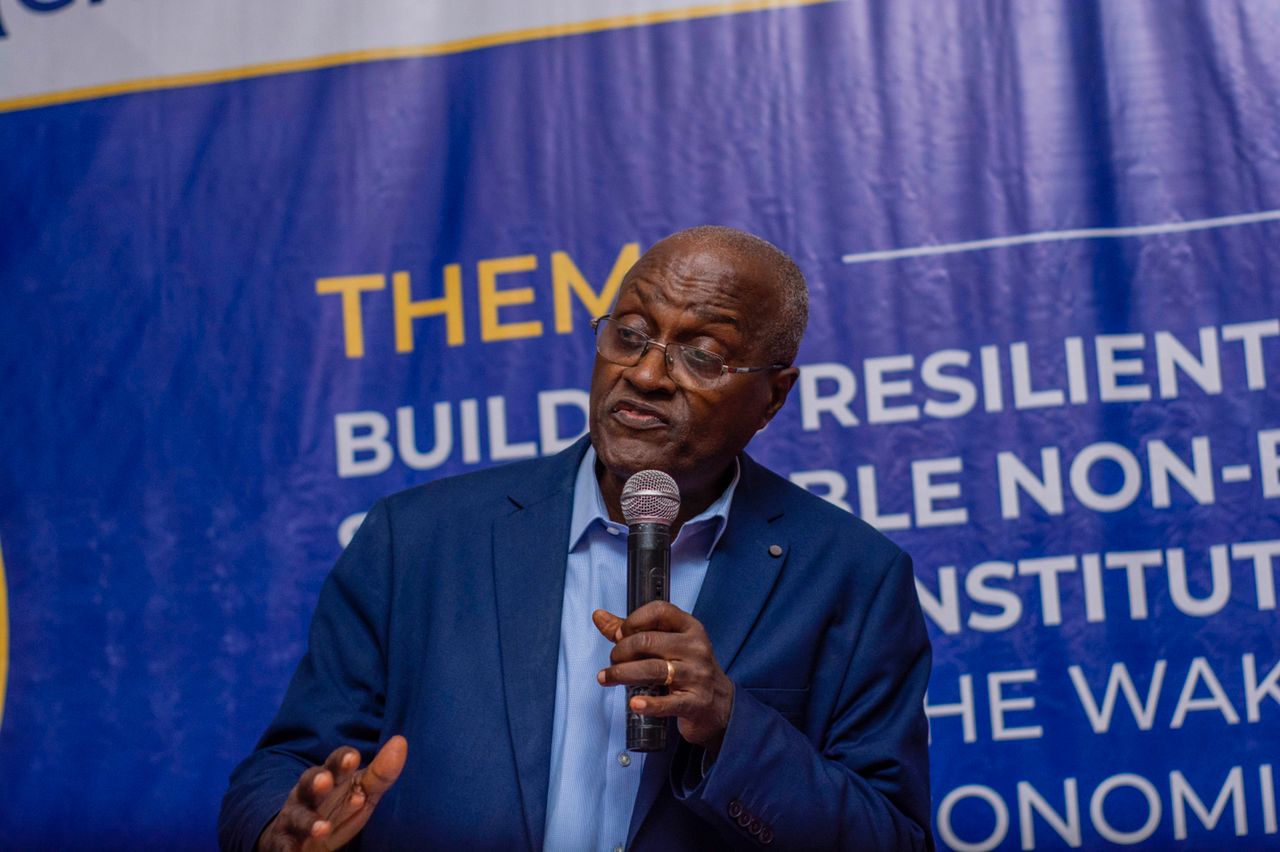

- SIM Swaps, Social Engineering and Fake Wallets: Dr Atuahene Exposes Ghana’s Digital Fraud Crisis
Ghana’s celebrated mobile money revolution is facing its most serious credibility test yet, as rising digital fraud threatens to erode consumer trust, weaken financial inclusion gains and expose regulatory gaps in one of West Africa’s fastest-growing digital payment ecosystems.
In a detailed paper titled “Combating Mobile Money/Digital Fraud in Ghana: Strategies for Securing Digital Payments,” banking consultant and financial sector analyst Dr Richmond Atuahene warns that Ghana’s rapid digital finance expansion has created both opportunity and vulnerability.
His central argument is blunt: Ghana has succeeded in building a powerful mobile money ecosystem, but fraudsters are now exploiting the same speed, convenience and reach that made the system successful.
“Digital payment fraud is a critical threat to Ghana’s financial inclusion gains,” Dr Atuahene writes, warning that the fight against mobile and digital fraud must now become “an ecosystem-wide responsibility” involving regulators, banks, telecom operators, fintechs and customers.
The warning comes at a time when mobile money has become deeply embedded in Ghanaian life. From small retail payments and salary transfers to government services, digital payments now sit at the centre of everyday commerce.
Ghana’s mobile money infrastructure has brought millions of previously unbanked citizens into the formal financial system. It has strengthened digital financial inclusion, deepened wallet-to-bank transactions and expanded access to financial services in both urban and rural communities.
But Dr Atuahene says the same system has become a target for increasingly organised fraud networks.
According to him, fraudsters are shifting away from crude hacking techniques and relying more heavily on psychological manipulation, impersonation, SIM swaps, account takeovers and weaknesses in customer authentication systems.
“Fraudsters are continuously developing sophisticated techniques and exploring vulnerabilities in the financial system to take advantage of unsuspecting customers,” he notes.
The result is a growing trust crisis.
For many Ghanaians, particularly low-income users and first-time digital finance adopters, one successful fraud incident can be devastating. It can wipe out savings, damage confidence and push people back toward cash-based transactions.
Dr Atuahene’s concern is that if fraud is not tackled decisively, Ghana risks reversing years of progress in financial inclusion.
He notes that mobile money has become the “bedrock of Ghana’s digital economy,” but adds that its massive growth has also created a “sophisticated ecosystem of digital fraud.”
The fraud typologies are now broad.
They include SIM-swap fraud, social engineering, agent fraud, mobile banking account takeover, synthetic identity fraud, false promotion scams, fortuitous scams, agent impersonation, cash suppression and telecommunications fraud.
Of these, SIM-swap fraud remains one of the most dangerous.
Dr Atuahene explains that SIM-swap fraud occurs when criminals fraudulently take over a customer’s phone number by transferring it to a SIM card under their control.
Once the fraudster controls the number, they can intercept calls, text messages, one-time passwords and two-factor authentication codes. That gives them access to mobile wallets, bank accounts and digital financial applications linked to the victim’s phone number.
“SIM-swap fraud is among Ghana’s most damaging scams,” he writes.
He notes that attackers often trick or bribe mobile agents to transfer the victim’s number to a new SIM, after which they reset PINs, intercept authentication codes and drain mobile money wallets and linked bank accounts.
This is why the issue is no longer merely about customer carelessness. It is also about system vulnerability, weak agent controls and the continued dependence on SMS-based authentication.
Dr Atuahene warns that the reliance on SMS authentication has created a systemic risk across the industry because once a customer’s SIM is compromised, their entire financial identity can be exploited “within minutes.”
Social engineering is another major threat.
Fraudsters frequently impersonate bank staff, mobile money agents, telecom employees or promotion officers. They call or message victims, claim there has been a wrong transaction, a blocked wallet, a prize win or a verification issue, and then pressure them into revealing PINs, OTPs or sending funds.
Dr Atuahene identifies this as the primary vector for mobile money fraud in Ghana.
He writes that scammers exploit “authority, urgency, and internal communication channels,” adding that fraud is no longer limited to customers because bank staff themselves are increasingly being targeted.
One striking case cited in the paper involved a fraudster impersonating a bank staff member and contacting a branch directly to instruct a teller to process an urgent transfer. The transaction was executed before the bank realised the instruction was fraudulent.
That case reveals how fraudsters are no longer only attacking unsophisticated customers. They are targeting institutions, internal processes and staff judgement.
The figures are also worrying.
Dr Atuahene notes that the Bank of Ghana records over 13,000 fraud incidents annually, with millions of cedis lost to scams that often exploit social engineering and digital platforms.
He further cites Cyber Security Authority data showing reported cyber fraud losses rising from GH¢2.4 million to nearly GH¢15 million within a single-year period.
Combined fraud across banks and fintechs, he notes, has previously reached highs of GH¢88 million in a year.
In the Ghana Bankers Association industry fraud report for January to March 2026, mobile money fraud accounted for the highest number of cases, with 23 incidents representing 31.50% of reported cases.
Although the financial loss from those mobile money fraud cases was relatively lower than some other fraud categories, Dr Atuahene argues that the operational burden and cumulative effect are substantial.
His analysis is important because it distinguishes between high-value fraud and high-frequency fraud.
Mobile money fraud may involve smaller individual amounts, but its frequency makes it damaging to trust, operational efficiency and customer confidence.
The bigger story, according to Dr Atuahene, is that Ghana’s digital financial ecosystem has grown faster than the security architecture needed to protect it.
He identifies Ghana’s regulatory framework as including the Payment Systems and Services Act, 2019, Act 987; the Cybersecurity Act, 2020, Act 1038; and the Anti-Money Laundering Act, 2020, Act 1044.
These are enforced by the Bank of Ghana, the Cyber Security Authority, the National Communications Authority and the Ministry of Communications.
He also notes that a collaborative fraud control dashboard has been established by government, the Bank of Ghana and telecom sector actors to help identify serial fraudsters, block fraudulent devices and blacklist national ID numbers tied to multiple fraud cases.
But despite these interventions, mobile money and digital fraud remain a major challenge.
That is why Dr Atuahene is calling for a shift from reactive fraud response to proactive, intelligence-led risk management.
His proposed solution begins with stronger identity assurance at onboarding.
Every wallet, he argues, must be opened under a verified identity. This requires real-time identity validation, biometric liveness checks and screening against politically exposed persons and adverse-media databases.
The logic is simple: if criminals cannot easily open fake wallets, it becomes harder for them to create mule accounts for laundering stolen funds.
Dr Atuahene also calls for real-time transaction risk scoring.
Under this approach, every transaction is assessed before completion based on risk indicators such as unusual user behaviour, new device location, recent SIM change, transaction size, wallet age and deviation from normal activity.
High-risk transactions should trigger alerts, delays, additional verification or blocks.
For SIM-swap fraud, he recommends direct integration between banks, mobile money operators and telecom companies so that large transactions can be flagged or delayed where a SIM linked to the account has recently been changed.
“If a swap occurred in the last 24 to 48 hours, flag or hold the payment for extra verification,” he recommends.
This proposal is critical because many fraud attacks happen immediately after a SIM swap. A mandatory cooling-off period for high-value transactions could prevent significant losses.
Dr Atuahene also wants stronger monitoring of agent networks.
Mobile money agents remain a major channel for access and financial inclusion, but rogue agents can facilitate fraud through fake reversals, inflated withdrawals, collusion and suspicious cash-out patterns.
He argues that agent activity must be monitored using velocity checks, network analysis and anomaly detection to identify unusual cash-out behaviour and collusive sub-networks.
Artificial intelligence is central to his proposal.
Dr Atuahene says banks, fintechs and telecom operators must move from basic rule-based security systems to AI-powered behavioural analytics.
He argues that AI can analyse users’ “digital body language,” including typing rhythms, mobile app navigation, device behaviour and transaction patterns, to identify suspicious activity in real time.
“AI adoption in Ghana’s financial and telecom sectors had evolved from merely being an extra security layer to a central, heavily regulated foundation for proactive defence,” he writes.
This is a major policy point.
The fraudsters are becoming more sophisticated. Therefore, static rules are no longer enough. Financial institutions must use machine learning, behavioural monitoring and anomaly detection to identify threats before funds move.
But Dr Atuahene does not place responsibility only on banks and telecom companies.
He says regulators must also act.
His strongest recommendation is for the Bank of Ghana to design a digital fraud compensation framework that clearly defines the liability of banks and mobile network operators when customers lose money because of internal security breaches or system vulnerabilities.
Under such a framework, service providers would be compelled to maintain high standards of identity verification, encryption, authentication and customer recourse.
Dr Atuahene argues that customers must have clear paths to recover funds where losses occur through system weakness or unauthorised digital transactions.
This would mark a major shift in Ghana’s digital finance market.
Today, many victims of mobile money fraud struggle to recover funds, especially where transactions move quickly across wallets, agents and bank accounts.
A compensation framework would force providers to invest more seriously in prevention, detection and recovery systems.
Dr Atuahene suggests Ghana could draw lessons from Kenya, where regulators have built institutional mechanisms around fraud compensation, customer recourse and provider accountability.
He also calls for stronger public awareness campaigns against vishing, smishing and impersonation scams.
Customers must be repeatedly educated to protect PINs, ignore pressure tactics, avoid sharing OTPs and report suspicious numbers or agent activity.
But awareness alone will not be enough.
Dr Atuahene’s message is that Ghana must stop treating mobile money fraud as a customer education problem alone. It is a systemic risk requiring stronger technology, better regulation, real-time intelligence sharing and accountability.
His conclusion is clear: the next phase of Ghana’s digital finance success will not be defined only by transaction volumes, interoperability or mobile penetration. It will be defined by trust.
“In Ghana’s high-velocity digital economy, trust is the currency that underpins adoption,” he writes.
That sentence captures the heart of the matter.
Mobile money has changed Ghana’s financial landscape. It has made payments easier, brought informal workers into the financial system and expanded economic participation.
But if fraud continues to rise, the same platform that expanded inclusion could become a source of fear for ordinary users.
Dr Atuahene is therefore calling for a national shift from access to resilience. The country has built the rails of digital finance. Now it must secure them.
That means tougher onboarding, stronger authentication, AI-driven monitoring, better agent supervision, SIM-swap controls, fraud compensation rules, faster reporting channels and deeper collaboration among the Bank of Ghana, Cyber Security Authority, National Communications Authority, banks, fintechs and telecom operators.
The truth, from Dr Atuahene’s analysis, is that Ghana’s mobile money revolution is not failing. But it is entering a dangerous phase where fraud can undermine the very trust that made it successful.
If regulators and industry players act now, Ghana can protect both consumers and innovation.
If they delay, the cost will not only be measured in stolen cedis, but in lost confidence in the country’s digital financial future.

