

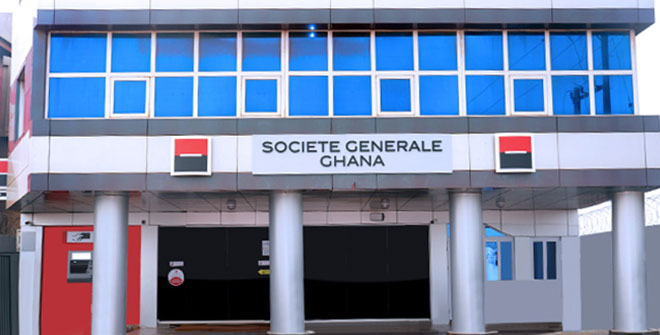

- Société Générale Ghana Profit Falls 56% As Interest Income and Trading Revenue Weaken
Société Générale Ghana recorded a steep decline in profitability, as weaker interest earnings, lower trading revenue and renewed impairment charges outweighed growth in fees, deposits and customer lending.
The bank reported profit after tax of GH¢150 million, down 56.4 per cent from GH¢344.30 million in the comparable 2025 period. Profit before tax fell by a similar margin, dropping 56.2 per cent to GH¢232.14 million from GH¢529.98 million.
Earnings per share declined to GH¢0.28 from GH¢0.65, a reduction of almost 57 per cent. The deterioration indicates that the bank’s larger balance sheet and expanding deposit franchise did not translate into stronger shareholder returns.
The pressure came from interest income, which fell 31.3 per cent to GH¢750.42 million from GH¢1.09 billion. Interest expense also declined, dropping 24.9 per cent to GH¢126.43 million, but the reduction was insufficient to offset weaker asset yields.
Net interest income contracted by 32.4 per cent to GH¢623.99 million from GH¢923.35 million. For a commercial bank, this is a consequential decline because net interest income remains the core margin earned from loans, securities and other interest-bearing assets after funding costs.
This interpretation is reinforced by a major balance-sheet shift. Debt instruments measured at amortised cost fell 44.5 per cent to GH¢1.31 billion from GH¢2.35 billion, while cash and cash equivalents increased 52.7 per cent to GH¢3.96 billion. Holding more liquidity improves resilience, but cash generally earns less than loans or longer-dated securities.
The bank achieved stronger performance in fee-based business. Net fees and commission income rose 31 per cent to GH¢84.35 million, supported by an 8 per cent increase in gross fee income and a 16.4 per cent decline in commission expenses.
Other operating income also improved to GH¢88.75 million from GH¢48.05 million. The change was supported by GH¢14.76 million in other operating income, reversing a GH¢60.96 million expense recorded in 2025. Income from other financial instruments carried at fair value increased 11.5 per cent to GH¢14.30 million.
Those gains were partly offset by weaker trading performance. Net trading revenue declined 37.9 per cent to GH¢59.70 million from GH¢96.18 million. Overall operating income therefore fell 23 per cent to GH¢797.10 million from GH¢1.04 billion.
Credit costs added another layer of pressure. Société Générale Ghana recorded a net impairment loss of GH¢27.17 million, compared with an impairment gain of GH¢32.97 million a year earlier. That represents an adverse year-on-year movement of approximately GH¢60.13 million before considering the wider decline in revenue.
Total operating expenses were virtually unchanged at GH¢537.80 million, compared with GH¢538.78 million. Stability in the aggregate, however, concealed important shifts. Personnel expenses increased 18.3 per cent to GH¢238.26 million, while depreciation and amortisation rose 17.8 per cent to GH¢109.21 million.
Other operating expenses declined 22.2 per cent to GH¢190.32 million, absorbing most of those increases. Nevertheless, because revenue fell while total costs remained broadly flat, the bank’s cost-to-income ratio deteriorated to approximately 67.5 per cent from 52 per cent. This means a considerably larger share of operating income was consumed by expenses.
The balance sheet remained expansive. Total assets grew 7.1 per cent to GH¢11.08 billion from GH¢10.35 billion. Loans and advances to customers increased 8.2 per cent to GH¢4.67 billion, showing that the bank continued extending credit despite weaker profitability and a more cautious asset mix.
Customer deposits rose faster, climbing 14.4 per cent to GH¢7.16 billion from GH¢6.25 billion. The loan-to-deposit ratio consequently eased to about 65.3 per cent from 69.1 per cent, suggesting a larger portion of deposits was held in liquid assets rather than converted into customer loans.
That conservatism is visible in the liquidity indicators. The reported liquidity ratio remained exceptionally high at 100.43 per cent, although it declined from 109.68 per cent. The bank recorded no statutory-liquidity defaults or related sanctions in either period.
Capital measures also improved. The capital adequacy ratio rose to 18.52 per cent from 17.90 per cent, while the leverage ratio strengthened to 12.91 per cent from 12.53 per cent. Shareholders’ funds edged up 1.1 per cent to GH¢2.58 billion.
Asset quality, however, moved in the wrong direction. The non-performing loan ratio increased to 13.98 per cent from 13.51 per cent, a deterioration of 47 basis points. Although the movement was limited, it deserves attention because it coincided with the return of net impairment losses and continued loan growth.
Cash generation offered a positive counterweight. Net cash from operating activities reached GH¢1.13 billion, reversing an outflow of GH¢448.14 million in the comparable period. Customer-deposit growth was an important contributor, while cash and cash equivalents reported in the cash-flow statement closed at GH¢2.60 billion.
The bank paid dividends of GH¢173.67 million, down from GH¢241.11 million in 2025. Total shareholders’ funds nevertheless fell from GH¢2.60 billion at the beginning of 2026 to GH¢2.58 billion at September, as dividend payments exceeded profit generated during the period.
Future performance will depend on whether the bank can rebuild interest margins, contain credit deterioration and translate its growing deposit base into productive assets without compromising liquidity. Fee-income growth provides diversification, but it remains too small to replace the GH¢299.36 million decline in net interest income.
The results present a bank that is safer in some respects but less profitable. For shareholders, the decisive question is whether 2026 represents a temporary repricing cycle or a deeper earnings reset requiring sharper cost, credit and asset-allocation decisions

