
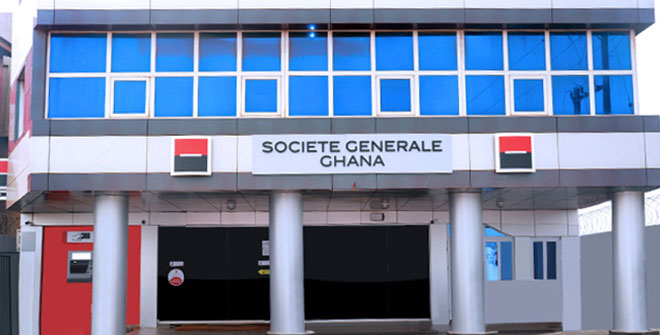

- Societe Generale Ghana’s profit slumps to GH¢52m in Q1 as margins tighten and impairments bite
Societe Generale Ghana recorded a sharp drop in first-quarter profit as lower net interest income and a reversal in credit impairment dynamics weighed on earnings, even as the lender strengthened capital and liquidity buffers and continued to grow customer deposits.
In its unaudited financial statements for the quarter ended 31 March 2026, the bank reported a profit after tax of GH¢51.7m, down from GH¢136.6m in the same period last year. Profit before tax fell to GH¢78.3m from GH¢212.6m, reflecting a weaker revenue base and higher impairment charges.
The core squeeze came through interest margins. Net interest income declined to GH¢224.8m from GH¢305.0m, as interest income fell to GH¢278.8m from GH¢365.2m, while interest expense eased only modestly to GH¢54.0m from GH¢60.2m. Net fees and commission income was largely stable, edging up to GH¢24.8m from GH¢23.4m, while net trading revenue rose to GH¢22.1m from GH¢15.9m.
Overall, operating income fell to GH¢275.5m from GH¢347.5m, weakening the earnings cushion available to absorb credit costs and operating expenses.
Credit quality dynamics also turned less supportive. The bank posted a net impairment loss on financial assets of GH¢21.2m, compared with a net impairment gain of GH¢28.9m a year earlier, a swing of about GH¢50m that materially reduced profit. After impairments, operating income fell to GH¢254.3m from GH¢376.4m before operating expenses of GH¢176.0m were deducted.
Costs rose moderately, with personnel expenses increasing to GH¢76.5m from GH¢72.5m and depreciation and amortisation climbing to GH¢38.5m from GH¢28.8m, while other operating expenses were broadly stable at GH¢61.1m. Basic and diluted earnings per share fell to GH¢0.29 from GH¢0.77.
Despite the earnings decline, the bank’s balance sheet showed improving buffers and continued funding growth. Total assets were broadly flat at GH¢10.62bn, up from GH¢10.57bn, while customer deposits rose to GH¢6.67bn from GH¢6.44bn, indicating steady deposit mobilisation.
The bank’s loan book contracted, with loans and advances to customers falling to GH¢4.18bn from GH¢4.82bn, a shift that could reflect cautious credit posture, repayments, or weaker demand in parts of the real economy. In contrast, debt instruments at amortised cost increased to GH¢2.62bn from GH¢1.40bn, suggesting a greater allocation into securities.
On prudential indicators, Societe Generale Ghana reported a stronger capital adequacy ratio of 22.36% (up from 20.43%) and an improved liquidity ratio of 117.27% (from 98.71%). The bank’s non-performing loan ratio also improved to 13.87% from 17.49%, pointing to progress on asset quality even as impairment charges rose in the quarter. The bank recorded no statutory liquidity defaults and no sanctions during the period.
The quarter’s message is therefore mixed. Profitability has softened sharply, squeezed by weaker net interest income and an unfavourable impairment swing. But the bank has strengthened capital and liquidity cushions and expanded deposits the kinds of balance-sheet markers that matter in a market still rebuilding confidence in the post-crisis cycle.

