

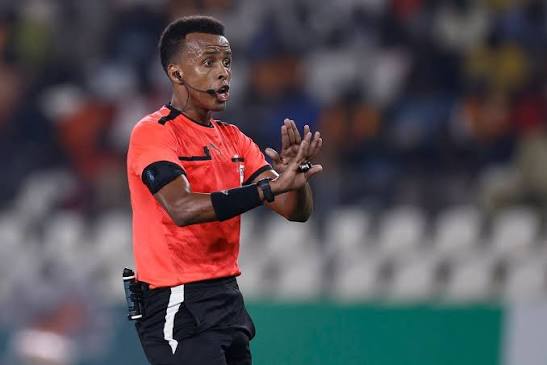

- Somali Official Omar Artan to Referee PSG-Aston Villa UEFA Super Cup Clash
Somali referee Omar Artan has urged African officials to continue pursuing the highest levels of international football after being selected to take charge of the 2026 UEFA Super Cup, completing a remarkable turnaround following a difficult World Cup experience.
Artan will referee Wednesday’s Super Cup between UEFA Champions League winners Paris Saint-Germain and Europa League winners Aston Villa at the Red Bull Arena in Salzburg, Austria. The appointment places him at the centre of one of European football’s major one-off fixtures and provides another significant marker in the rise of African referees on the international stage.
His selection carries additional significance because of the personal difficulties he faced during the 2026 FIFA World Cup. Citi Sports reported that Artan became a major talking point after being denied entry to the United States over reported links to terrorist groups, although he remained one of Africa’s highly rated officials at the tournament.
Artan described the episode as one of the most difficult periods of his career, particularly after years of preparation for opportunities at the highest level. “It was a very tough period,” he said, explaining that being unable to participate as expected after working towards the opportunity for years had been deeply challenging.
Yet rather than allowing that setback to define his career, Artan has used the experience as a message to other African officials trying to break into elite international football. “I believe that if I can succeed, anyone can. Don’t ever stop dreaming,” he said, according to Reuters as cited by Citi Sports.
The UEFA Super Cup appointment therefore represents more than another assignment. For Artan, it is a significant professional endorsement at a time when referees from outside Europe are increasingly being exposed to competitions, tournaments and development programmes beyond their traditional confederations.
His career has already included major FIFA appointments. Citi Sports noted that he officiated at the 2025 FIFA U-20 World Cup in Chile, where he handled matches including the third-place contest between Colombia and France.
Those performances helped strengthen his international reputation and appear to have contributed to the confidence placed in him ahead of the Super Cup. Refereeing at this level requires more than knowledge of the laws of the game, with officials expected to demonstrate consistency, positioning, communication, emotional control and the ability to make high-pressure decisions under intense scrutiny.
The symbolism is also important for African refereeing. Officials from the continent have historically had fewer opportunities than their European and South American counterparts to take charge of the most commercially visible fixtures in world football, making appointments such as Artan’s potentially influential for the next generation.
For young referees in Somalia and elsewhere in Africa, his trajectory offers a practical example of how international pathways can develop through FIFA competitions and strong performances over time. It also reinforces the importance of resilience in a profession where appointments, tournament selection and individual decisions can quickly define public perceptions.
The Super Cup itself will provide another demanding test. Paris Saint-Germain and Aston Villa arrive as the winners of UEFA’s two principal club competitions, meaning Artan will be managing players accustomed to the highest levels of European football and a match likely to attract significant international attention.
The pressure surrounding such fixtures is considerable because refereeing decisions can become part of the broader story almost immediately. Modern officials must also operate within an environment shaped by video technology, detailed performance evaluation and intense post-match scrutiny from supporters, television analysts and clubs.
For Artan, however, the opportunity appears to have a broader meaning than personal recognition. His comments suggest he views the appointment as proof that African referees can reach prestigious stages despite setbacks that might otherwise derail careers.
That message is particularly powerful because it comes after a period he openly described as difficult. The contrast between uncertainty around his World Cup participation and selection for a major European final provides a reminder of how quickly circumstances can change in elite sport.
His appointment also adds to a wider conversation about the globalisation of officiating. Football has become increasingly international not only through players and coaches but also through referees, with FIFA and continental governing bodies seeking to expose officials to different competitive environments and styles of play.
African referees stand to benefit if those pathways continue to expand. More opportunities in high-profile competitions can strengthen experience, visibility and confidence while potentially improving standards across domestic and continental football.
For Somalia specifically, Artan’s rise carries particular symbolic weight. International sporting success can provide visibility for countries whose global narratives are frequently dominated by conflict, political instability or security concerns.
Artan’s story presents a different image: one of professional development, persistence and achievement at the highest level of global football.
There will still be one overriding measure of success on Wednesday — whether he manages the match effectively enough for the football, rather than the refereeing, to dominate discussion afterwards.
That is often the paradox of elite officiating. A referee receives significant attention before a major appointment, but the best performance frequently comes when supporters barely notice the official once the game begins.
For Artan, reaching Salzburg is already a significant milestone. But his message extends beyond one fixture.
“If I can succeed, anyone can” captures the meaning he attaches to the journey: setbacks can interrupt a career without necessarily ending its trajectory.
For African referees looking towards FIFA tournaments, continental competitions and eventually the biggest stages of world football, Artan’s UEFA Super Cup appointment provides perhaps the strongest version of that message opportunity can still arrive after disappointment, provided performance and persistence continue.

