


- SSATP Urges African Ports to Turn Maritime Digitalisation Promises into Delivery
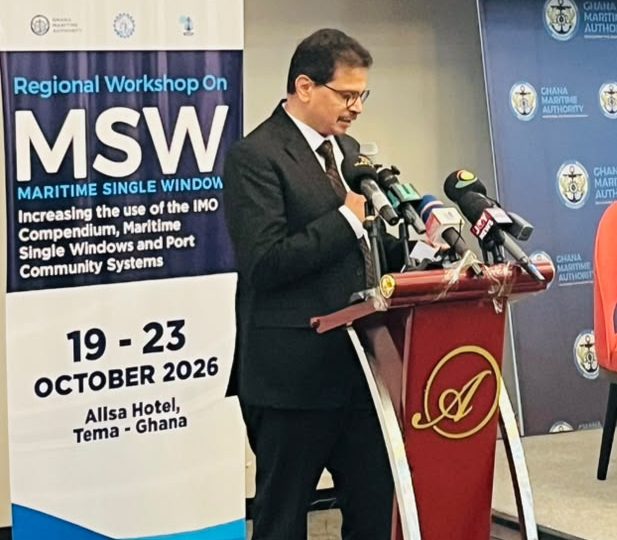
African countries must move their maritime digitalisation programmes beyond workshops, guidelines and policy declarations towards functioning systems that shorten vessel clearance, reduce paperwork and lower trading costs, the Africa Transport Policy Program has said.
Olivier Hartmann, representing SSATP, said implementation of Maritime Single Window systems remained slow across the continent, despite widespread recognition that integrated digital platforms could improve port efficiency, regulatory coordination and trade facilitation.
His remarks at a five-day regional workshop in Tema point to a persistent weakness in Africa’s modernisation agenda: governments frequently agree on the destination but struggle to reorganise institutions, technology and legal frameworks sufficiently to reach it.
These mechanisms are intended to replace repetitive, agency-by-agency submission of maritime information with coordinated electronic processes. A shipping operator should be able to provide required information through one platform, with authorised institutions accessing the data necessary to perform their respective functions.
That proposition appears straightforward technologically. The harder problem is institutional. Ports are occupied by agencies with different legal mandates, reporting structures, revenue interests and operational priorities.
When those institutions operate as isolated administrative territories, digitalisation can reproduce fragmentation rather than remove it. Businesses may submit information electronically but still confront duplicated forms, repeated inspections, incompatible databases and approvals that move sequentially between agencies.
Hartmann said SSATP, working with the IMO and regional port associations, began examining these barriers about two years ago after concerns emerged that Maritime Single Window implementation was progressing slowly in Africa.
The discussions examined institutional constraints, implementation challenges and opportunities for stronger cooperation, culminating in a practical guide published in March 2025.
But Hartmann stressed that technical guidance was only a starting point. The next phase must involve direct engagement with individual countries, practical implementation and the development of complementary tools for port authorities.
The question is whether governments can decide who owns the platform, which agency sets the data standards, how responsibilities are shared and how disputes are resolved.
Without answers, even well-financed technology can become another layer within an already complex port environment. A successful system requires institutions to surrender duplicated procedures, accept information collected by other agencies and recognise electronic records as legally valid.
The Single Window provides one channel for regulatory submissions, while a Port Community System supports wider information exchange among the public and private participants involved in port logistics.
Together, they can give shipping lines, terminal operators, freight forwarders, customs, regulators and other actors access to reliable information without repeatedly reconstructing the same transaction. This can reduce administrative delay, improve transparency and make cargo movement more predictable.
Traders can plan around known charges and processing times; they struggle when cargo is delayed by unclear requirements, manual interventions or conflicting instructions from different institutions.
Delayed inputs disrupt factories, increase storage expenses and weaken the reliability of businesses supplying regional markets.
The reforms therefore have direct relevance to the African Continental Free Trade Area. AfCFTA seeks to create larger markets and deepen regional value chains, but tariff reductions alone cannot deliver integration if goods remain trapped by expensive and unpredictable border and port procedures.
A digital system designed only around the internal procedures of one port may provide local efficiencies without supporting the interoperability required for regional commerce.
That makes common standards essential. Countries need agreement on data formats, messaging protocols, cybersecurity safeguards and the conditions under which electronically submitted information is recognised by law.
Cybersecurity cannot be treated as an addition after platforms are launched. Concentrating maritime information in connected systems can improve efficiency, but it also creates infrastructure whose disruption could affect cargo flows, revenue collection and national supply chains.
Financing presents another constraint. Governments must fund maintenance, software upgrades, user support, cybersecurity, staff training and integration with systems operated by other institutions.
Short-term donor financing can initiate reforms, but it cannot substitute indefinitely for domestic ownership. Systems that depend entirely on external consultants or temporary project funding risk deteriorating once the implementation programme closes.
Hartmann highlighted partnerships involving the IMO, SSATP and the World Bank Korea Partnership Facility in supporting regional workshops and implementation discussions. SSATP is hosted by the World Bank and supported by development partners including the African Development Bank, African Union and Swiss development cooperation.
Some countries and port authorities have already approached the IMO and SSATP after earlier workshops to seek further assistance for their digitalisation programmes. Hartmann expressed hope that the Tema meeting would generate similar interest and lead to sustained country-level interventions.
“I am very hopeful that this workshop is not the last round of the seminar we are going to run, but will be the first step to do something that is going beyond that,” he said.
The emphasis on what happens after the workshop is critical. African transport reform has no shortage of strategies, diagnostic studies and pilot programmes. Its credibility depends on whether these interventions alter the daily experience of vessels, cargo owners and logistics companies.
Governments should therefore define measurable outcomes: fewer duplicate submissions, shorter vessel-clearance times, reduced cargo-processing periods, lower compliance costs and higher use of electronic transactions. Publishing those results would allow businesses and citizens to judge whether digitalisation is producing value.
Development partners, meanwhile, must design support around institutional capacity and long-term sustainability rather than technology procurement alone. Equipment and software cannot resolve disputes over mandates or persuade agencies to share information.
Country case studies presented in Tema can help identify workable models, but no system can simply be copied without considering domestic law, institutional structures and the maturity of existing infrastructure.
The workshop’s success will consequently be determined outside the conference room. If participants return home with timelines, assigned responsibilities and implementation support, Tema could mark movement from technical consensus to delivery. If not, Maritime Single Windows will remain another widely endorsed reform whose potential is repeatedly discussed but incompletely realised.
Africa’s ports do not merely need more digital tools. They need governments capable of coordinating institutions around a single trade process. Technology can connect systems; only policy leadership can persuade the organisations behind them to operate as one port community.

