


- Standard Chartered Targets Sustainable Growth After Profit Rises 10%
Standard Chartered Bank Ghana is positioning disciplined capital allocation, international connectivity and wealth management as the foundations of its next growth phase after reporting stronger profitability and shareholder returns.
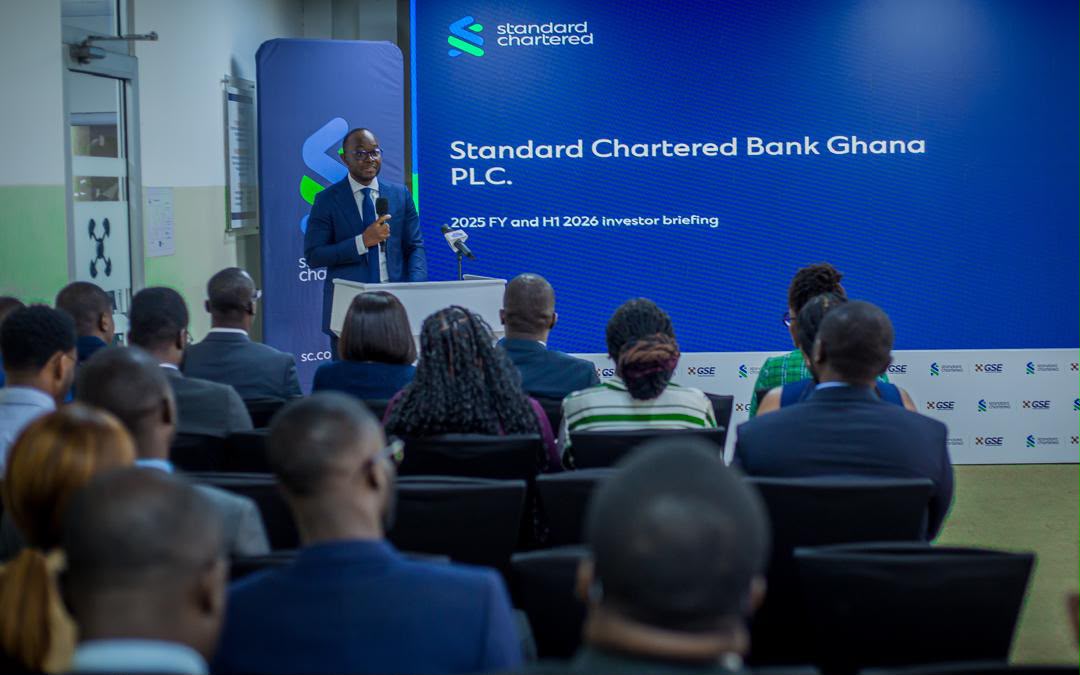
At its 2026 Facts Behind the Figures session at the Ghana Stock Exchange, the bank told investors that sustainable shareholder value remained central to its strategy.
The lender recorded a return on equity of 28 per cent in 2025, while earnings per share increased to GH¢5.97 from GH¢5.31 in 2024. The improvement supported a dividend payout of GH¢673.48 million declared at its 2025 annual general meeting.
Its balance sheet expanded by 15 per cent while remaining within regulatory and capital requirements, reflecting the bank’s emphasis on resilience as it seeks growth in a recovering Ghanaian economy.
Performance remained during the first half of 2026. Total revenue reached GH¢798 million, while profit after tax increased by 10 per cent to GH¢320 million.
The figures suggest that Standard Chartered is seeking to balance income expansion with disciplined risk management rather than pursue growth at any cost. For shareholders, the question is whether the bank can sustain earnings momentum while converting its capital strength into selected business opportunities.
Chief Executive Xorse Godzi said the bank would build on the advantages provided by its international network and cross-border capabilities.
“We will continue to maximise our strongest competitive advantages while harnessing market opportunities to accelerate growth,” he said. “As a super-connector bank, we will leverage our international network and cross-border capabilities to connect corporates, financial institutions and individuals to some of the world’s most dynamic and rapidly growing markets.”
The strategy places trade, investment flows and wealth management at the centre of Standard Chartered’s proposition. Its international footprint could prove valuable to Ghanaian companies seeking foreign capital, export markets and support navigating cross-border transactions.
Chief Financial Officer Albert Larweh Asante attributed the performance to balance-sheet strength and disciplined decision-making.
“Our resilient performance reflects the strength of our balance sheet and our disciplined approach to risk management and capital allocation,” he said. “We remain focused on driving sustainable income growth, maintaining operational efficiency and delivering long-term value for our shareholders.”
The bank also linked its commercial strategy to sustainability and social impact. It invested GH¢4.6 million in youth empowerment programmes through the Standard Chartered Foundation during 2025, targeting disadvantaged young people, particularly women and persons with disabilities, through entrepreneurship and employability support.
Standard Chartered additionally mobilised $30.5 million in climate finance for Ghana through a $200 million World Bank Clean Cooking Outcome Bond. The initiative is expected to benefit 1.3 million people and reduce emissions by more than 1.8 million tonnes of carbon dioxide equivalent.
The transaction illustrates how international banks can use global networks to channel specialised financing into local development priorities. It also gives practical meaning to Standard Chartered’s “super-connector” ambition by linking Ghanaian needs to international capital.
The bank is marking 130 years of uninterrupted operations in Ghana and has been listed on the Ghana Stock Exchange since 1991. That longevity strengthens its institutional standing, but raises expectations that the lender will continue supporting productive investment, infrastructure and trade.
Standard Chartered’s results present a favourable picture of profitability, capital strength and shareholder distributions. Its next test will be execution: turning international reach and disciplined capital allocation into income growth without weakening asset quality or operational efficiency.
For investors, the combination of a 28 per cent return on equity, higher earnings per share and a substantial dividend provides evidence of value creation. Sustaining that record will require the bank to capture Ghana’s opportunities while preserving the measured risk culture that underpinned its recent performance.

