


- Targeted Support, Not Subsidies, Can Best Protect People When Inflation Surges
The cost of everyday essentials, from groceries and electricity to fuel, has risen sharply over the past five years. That’s largely because of disruptions to global commodity markets from the start of Russia’s invasion of Ukraine in 2022 through to this year’s conflict in the Middle East.
During these cost-of-living crises, the prices of necessities such as food and energy surge, outpacing other prices and wage growth. Because it is hard for people to cut back on the basics, or replace them altogether, even temporary spikes in their prices can impose significant hardship.
The consequences extend far beyond a few months of higher inflation.
These crises can threaten macroeconomic stability, as we show in an analytical chapter of the latest World Economic Outlook. We find that the prices of necessities relative to other goods continue rising for more than a year after the start of a typical episode, and remain persistently elevated. As a result, people face not only a temporary spike in food and energy costs, but a lasting deterioration in the affordability of essentials relative to other items.
In addition, inflation remains elevated long after the initial surge in food and energy prices. Inflation expectations also rise and stay above pre-crisis levels for years, suggesting that these episodes may complicate efforts by central banks to control inflation. At the same time, purchasing power erodes as real wages fall and remain below prior levels for an extended period.
These burdens also fall disproportionately on poorer families. Because food and energy account for a larger share of spending by lower-income families, they endure significantly higher inflation than wealthier households during cost-of-living crises.
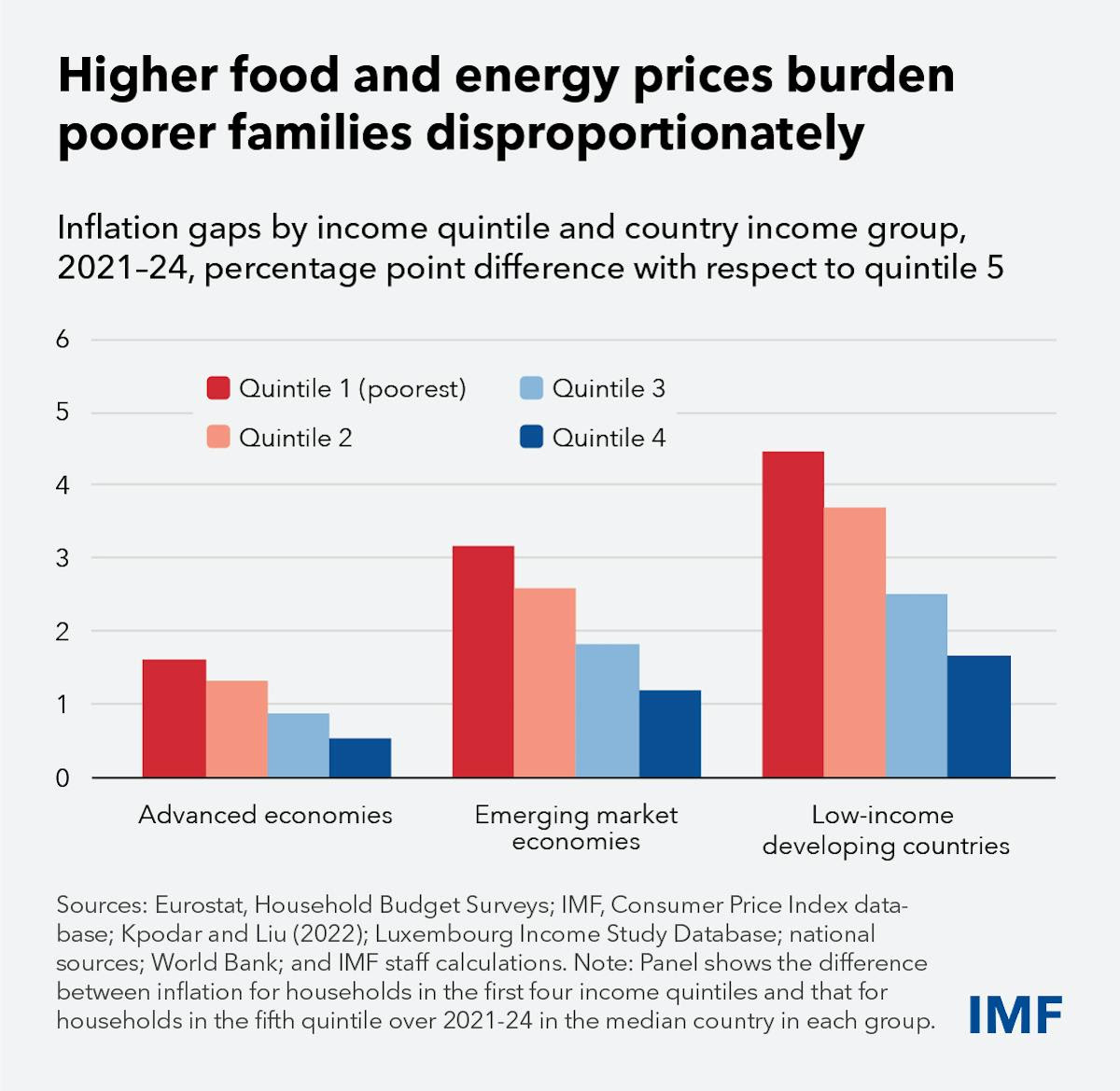
A chart showing higher food and energy prices burdening poorer families disproportionately
The effects on inequality and poverty are substantial, particularly in lower-income countries, where basics account for an even larger share of spending by poor households.
This underscores why cost-of-living crises are economic shocks that can simultaneously undermine price stability, reduce living standards, and widen inequality.
How governments intervene
Facing demands for immediate government action, governments have relied heavily on broad-based interventions to suppress price gains during past episodes, according to new data from 76 countries over the past three decades. This is particularly true in emerging market economies and low-income countries.
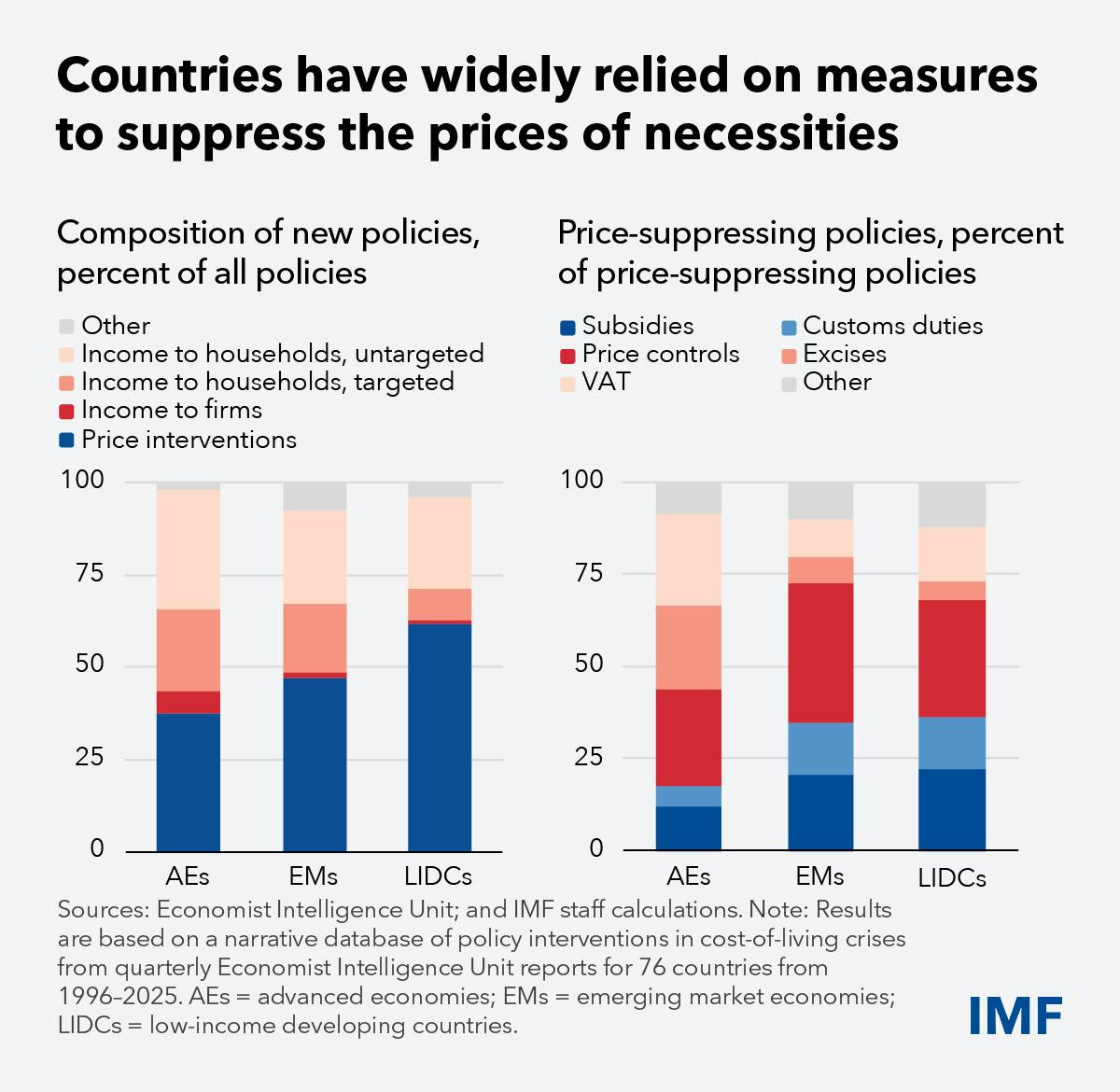
Chart showing countries have widely relied on measures to suppress the prices of necessities
In advanced economies, such price-suppressing interventions mostly took the form of reductions in value-added or excise taxes on food and energy products, which limit price increases for final consumers. By contrast, emerging markets and low-income countries have relied more heavily on policies that address cost pressures upstream in the supply chains, such as producer subsidies, reductions in customs duties, or outright price controls, likely reflecting the greater prevalence of informal retail markets.
Governments have also provided direct income support. While advanced economies have relied somewhat on targeted transfers, poorer countries have more frequently introduced broad-based increases in wages and pensions.
While these interventions may provide immediate relief, they vary widely in how effectively they protect vulnerable households and the burden they place on public finances.
Subsidies are costly
Targeted and temporary transfers are the most effective and cost-efficient way to protect poorer households when prices for basics spike. This approach directly supports those who need it most, preserves scarce fiscal space, and allows high market prices to continue signaling scarcity, encouraging consumers to reduce consumption if they can.
Price-suppressing measures are far less efficient. They can ease monetary policy trade-offs in the short term by containing inflation and preventing inflation expectations from becoming unmoored. But they also come at significantly higher fiscal costs. Delivering the same protection to lower-income familiesthrough consumer subsidies can require three to six times more fiscal resources than targeted transfers. Subsidizing producers can cost 14 to 22 times more than targeted income support, according to evidence from a novel model framework.
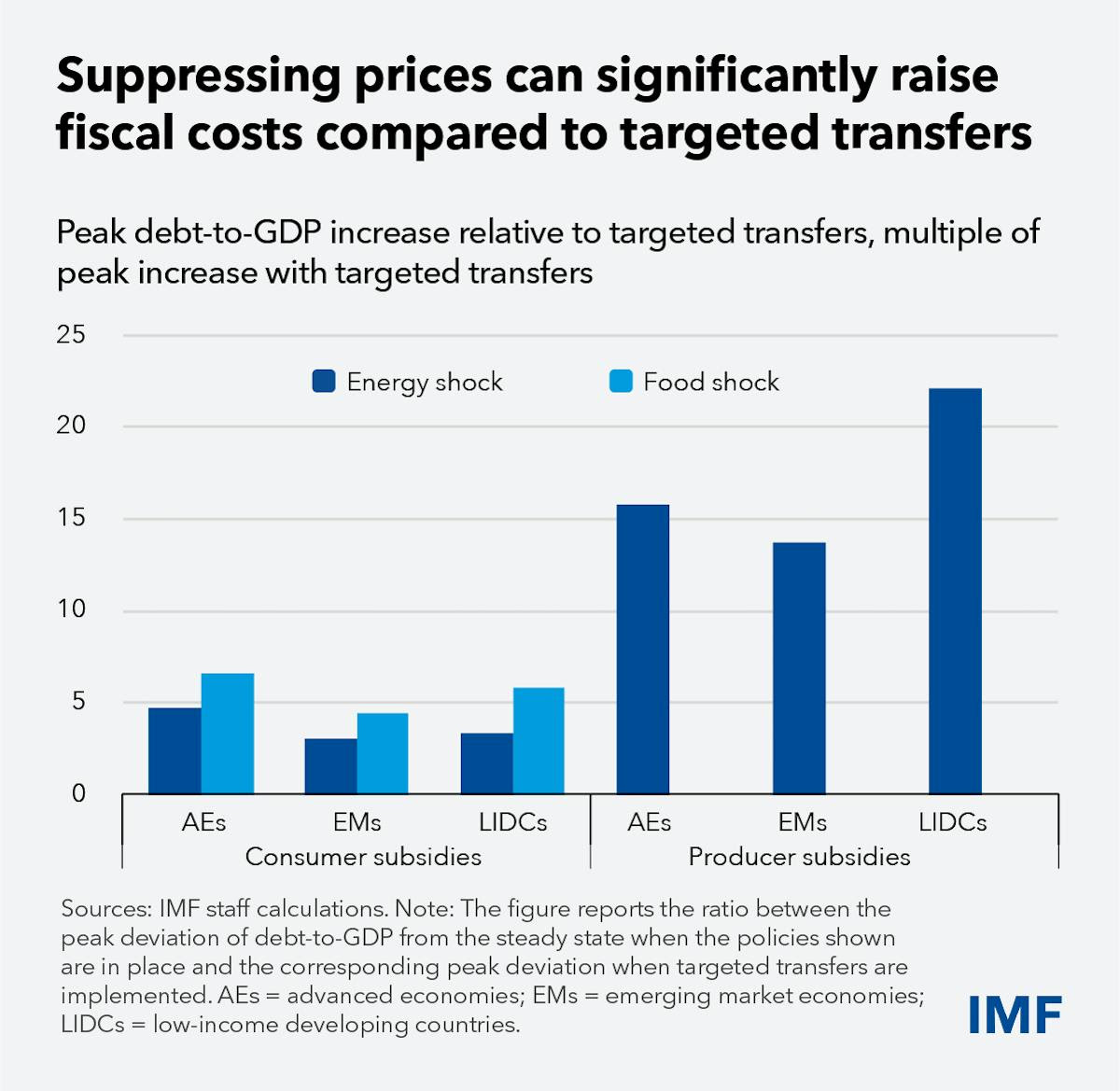
Chart showing suppressing prices can significantly raise fiscal costs compared to targeted transfers
This occurs because much of the support fails to reach those that need it most, as Europe’s 2022-23 energy crisis illustrates. For every euro spent suppressing electricity, natural gas, and gasoline prices, less than 20 cents reached the poorest fifth of households.
These policies also generate broader inefficiencies. By keeping prices artificially low, they weaken incentives to conserve scarce resources. This can further drive up global prices when many countries implement them simultaneously, in turn worsening policy trade-offs for lower-income countries.
Producer subsidies are even less efficient. Because they lower production costs rather than directly supporting households, foreign consumers benefit through lower export prices of downstream products. As a result, taxpayers pay more to benefit people and businesses in other countries rather than vulnerable families at home.
Policy design and sequencing
Cost-of-living crises impose substantial economic and social costs, with particularly large welfare losses for lower-income families. Assistance, when warranted, should be temporary and delivered through targeted income-support measures, ideally using existing social protection systems that can be scaled up quickly.
In exceptional circumstances, such as acute food-security concerns, heightened risks of social unrest, or severe implementation constraints, support may need to extend beyond the poorest households and rely on broader tools, where fiscal space permits.
Even then, support should be calibrated to the temporary component of a particular price increase, with clear sunset clauses, rather than to permanently higher prices. Moreover, when expanding the pool of beneficiaries, the generosity of assistance should remain anchored to the average impact of the shock on lower-income households. When price measures are unavoidable, they should be narrowly focused on the goods and services consumed disproportionately by vulnerable households, preferably in downstream sectors, and designed to preserve as much of the underlying price signals as possible.
In a more shock-prone world, strengthening social protection before crises occur can improve the effectiveness of future policy responses and help preserve the fiscal space needed to address future shocks.
This blog is based on Chapter 2 of the October 2026 World Economic Outlook, “Navigating a Shock-Prone World: Lessons from Cost-of-Living Crises.” Chapter authors are Marijn A. Bolhuis, Braulio Britos, Bertrand Gruss (co-lead), Chiara Maggi (co-lead), Galip Kemal Ozhan and Sihwan Yang, with support from Maryam Abdou, Owen Russell Desberg, Riya Varghese and Yarou Xu. Adeleke Hakeem Adeyemi provided technical and computational assistance.

