

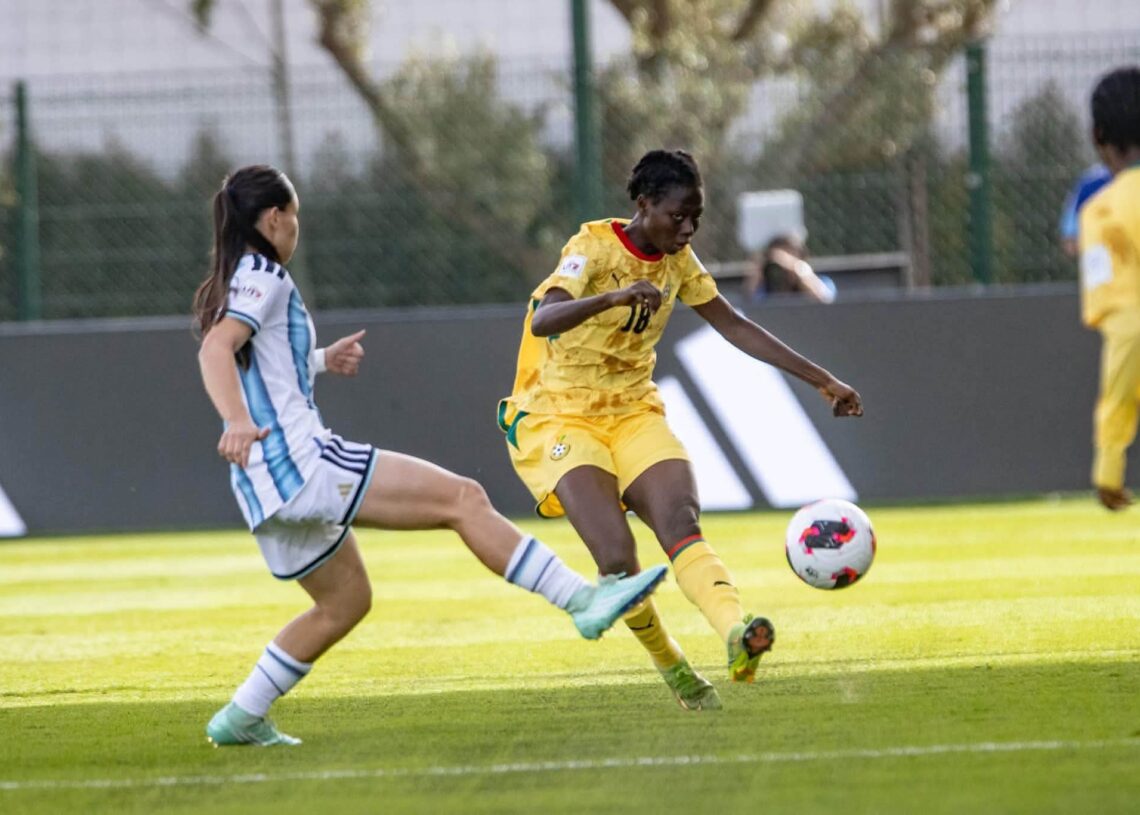

- Ten-Woman Ghana Survive Argentina Scare to Advance at U-17 World Cup
Ghana’s Black Maidens have secured a place in the quarter-finals of the 2026 FIFA U-17 Women’s World Cup after defeating Argentina 5-4 on penalties in a dramatic Round of 16 encounter in Morocco.
The knockout match at the Mohammed VI Football Complex ended 1-1 in regulation time, forcing the two teams into a penalty shootout in which Ghana’s young players demonstrated remarkable composure.
Jessica Appiah Asamoah opened the scoring for Ghana in the 16th minute, giving the Black Maidens an early advantage and placing Argentina under pressure.
Ghana protected the lead for much of the game through defensive discipline and tactical organisation. Argentina pushed forward in search of an equaliser, but the Black Maidens repeatedly resisted their attempts to break through.
The complexion of the contest changed in the 77th minute when Ghana’s Hajara Adam received a second yellow card, reducing the Black Maidens to 10 players.
The numerical disadvantage forced Ghana to retreat and defend more deeply during the closing stages. Argentina increased its attacking pressure, stretching Ghana’s defensive structure and committing additional players forward.
That pressure eventually produced a breakthrough in the 86th minute when Mercedes Diz equalised for Argentina, cancelling out Ghana’s early lead and sending the contest towards a shootout.
Despite the disappointment of conceding so late, the Black Maidens recovered emotionally and remained composed during the decisive penalties.
Ghana converted its kicks to win the shootout 5-4 after Argentina’s Oriana Gomez failed to score from her attempt. The result sparked emotional celebrations among the Ghanaian players and technical team as they confirmed their place among the final eight teams at the tournament.
Black Maidens head coach Joe Nana Adarkwa praised his players for following tactical instructions, particularly after the team was reduced to 10 players.
Ghana had to reorganise its shape following Adam’s dismissal, placing greater responsibility on the remaining players to close spaces and limit Argentina’s opportunities.
“I’m delighted, as usual. You can see in the celebrations I lost my voice, but I’m OK,” Adarkwa said after the match.
“We’re a technical team, but our players did well because if you are not tactical when it’s 10 against 11, you lose the game. But thank God the players played according to our instructions and we drew, so we could go through from that.”
The coach’s comments highlight the maturity Ghana displayed under severe pressure. Playing the closing stages of a World Cup knockout match with 10 players required more than physical effort. It demanded communication, concentration and the ability to respond collectively to Argentina’s numerical advantage.
Although Argentina eventually found an equaliser, the Black Maidens prevented the South Americans from completing the comeback before the final whistle.
Penalty shootouts often expose the psychological pressure faced by young players on the international stage. For the Black Maidens, the disappointment of losing their lead shortly before full-time made the challenge even greater.
However, Ghana’s penalty takers showed confidence and precision when the contest reached its decisive stage.
The victory represented a collective achievement built on Asamoah’s early goal, the defence’s resistance, the tactical adjustments following the red card and the composure displayed during the shootout.
Ghana must nevertheless address the disciplinary problems that nearly changed the outcome. In the quarter-finals, playing for an extended period with 10 players could carry more damaging consequences.
The technical team will also need to manage the physical demands placed on the players. Defending with a numerical disadvantage requires considerable energy, and recovery will be important before the next knockout match.
The Black Maidens will face the winner of the Round of 16 match between Japan and Kenya in the quarter-finals.
Either opponent will present a different challenge. Japan’s youth teams are traditionally recognised for their technical ability, quick movement and possession-based football. Kenya would offer Ghana a continental contest involving two teams familiar with the athletic and competitive qualities of African football.
Whatever the opposition, Ghana will enter the quarter-final with growing confidence. Surviving a late equaliser, a red card and the pressure of penalties should strengthen the players’ belief that they can respond to difficult situations.
Coach Adarkwa’s immediate task will be to restore the team physically while correcting the weaknesses exposed against Argentina.
Ghana will need to retain its defensive organisation but also improve its control of matches when leading. Creating and converting a second goal could reduce the risk of allowing opponents to remain within reach during the closing stages.
The Black Maidens have now moved one victory away from the semi-finals. Their performance against Argentina was not flawless, but it demonstrated resilience, tactical awareness and courage qualities that become increasingly important as a World Cup approaches its decisive stages.

