

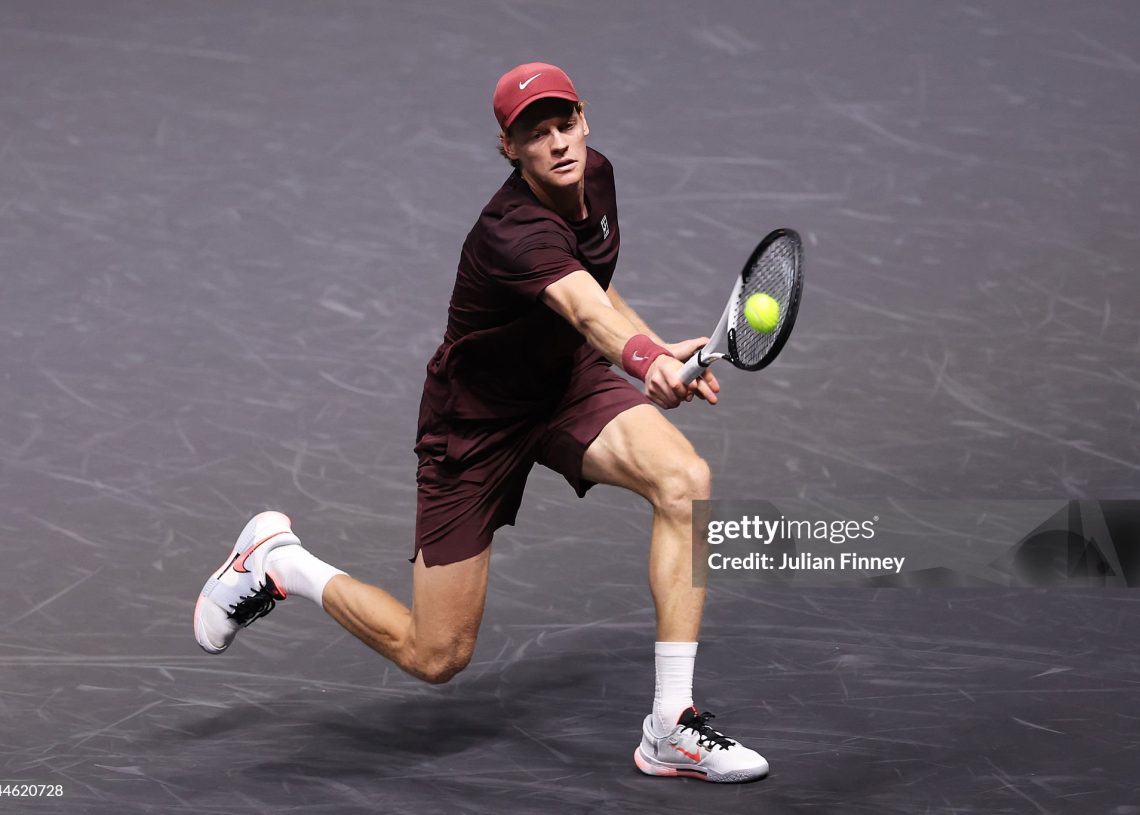

- Two-Time Champion Sinner to Miss Australian Open, Extending Long Injury Lay-Off
Jannik Sinner will miss the 2027 Australian Open after surgery on his right knee, ending hopes of a January return and extending an absence that has kept the Italian off court since July.
The tournament’s organisers confirmed his withdrawal on Thursday, November 26, after Sinner underwent a minor operation earlier in the week.
The two-time Melbourne champion had been working towards a comeback at the season’s first Grand Slam, but his knee did not respond as hoped to non-surgical treatment.
Sinner said the procedure was intended to improve the condition of his iliotibial band, the tissue running along the outside of the thigh and knee.
“Over the past few months, together with my team, we’ve tried everything to treat my injury without surgery,” he said in a statement.
The operation followed what he described as encouraging progress that had not lasted.
The news is a significant blow for a tournament where Sinner has become one of the defining figures of the men’s game.
He won the Australian Open in 2024 and 2025, establishing himself as a leading force on Melbourne’s hard courts.
He was beaten by Novak Djokovic in the 2026 semi-finals, so he will now miss the chance to pursue a third title in four years.
It is also a reminder of how abruptly an exceptional season can be interrupted. Sinner had won Wimbledon in July, his fifth Grand Slam title, before the knee problem forced him out of competition.
He ended his 2026 campaign early and had not played since. His absence from Melbourne now extends that lay-off into the new season, although no confirmed return date has been announced.
Australian Open organisers said they had been in regular contact with Sinner’s team and confirmed he would not join the field in January. The tournament also said he was looking towards a return for the 2028 edition.
That offers a longer-term horizon, but it does not settle when he may be ready to compete again. Reports in Italy have suggested a recovery period of several months; Sinner’s own public statement has not set out a timetable.
For Sinner, the decision appears to place recovery ahead of the pressure to return for a major tournament. The Australian Open had been an obvious target: he has won there twice, and he had previously spoken about aiming to be back in Australia.
But surgery after months of treatment suggests that the original plan could no longer be treated as a reliable deadline. The priority now will be whether the knee responds to rehabilitation, rather than whether he can make a particular date.
That calculation matters beyond one tournament. A player returning too soon from a persistent injury risks turning a short-term absence into a longer disruption.
Sinner’s choice to undergo surgery carries its own uncertainties, but it removes the immediate expectation that he should be match-ready in January.
The absence will cost him the chance to compete for a Grand Slam title; a rushed comeback could put more of his season at risk.
His withdrawal will also alter the competitive picture in Melbourne. Sinner is among the players who have shaped the recent men’s game, and his absence removes a proven champion from the draw.
It creates an opening for rivals, but it also leaves fans without a potential rematch of the tournament’s defining contests.
The field remains strong, yet the loss of a two-time champion changes the stakes for the early rounds and the title race.
The injury comes after a season that had already shown how vulnerable even the sport’s most successful players can be to the physical demands of the tour.
Sinner’s 2026 campaign included a Wimbledon triumph and an early end because of the knee problem.
He had been expected to return in time for Melbourne, but the operation has now made clear that expectation was premature.
His absence will also be watched through the lens of the rankings. Sinner was ranked world No. 2 when organisers confirmed the news, having lost the top position to Alexander Zverev during his time away from competition.
The ranking implications will depend on the points he is unable to defend and on how his rivals perform, but the immediate challenge is simpler: return only when the knee can withstand the demands of elite tennis.
The Australian Open’s announcement closes the question of whether Sinner will play in January.
It leaves the more consequential one open: how long will it take for the Italian to return, and what level will he be able to reach when he does?
For a player whose recent success has been built on consistency and intensity, the answer cannot be assumed from his past results.
Sinner’s Melbourne absence is therefore more than a tournament withdrawal. It is a test of how carefully one of tennis’s leading players can manage the transition from surgery to competition.
His two Australian Open titles will remain part of his record. The next milestone is less glamorous but more important: getting back on court without asking an injured knee to meet a deadline.

