


- Tokenised Treasuries Move from Experiment to Wall Street’s Financing Machinery
Tokenisation is beginning to move beyond financial experimentation and into the machinery of institutional markets, as banks test whether digital securities can reduce settlement delays, release trapped capital and transform the management of collateral.
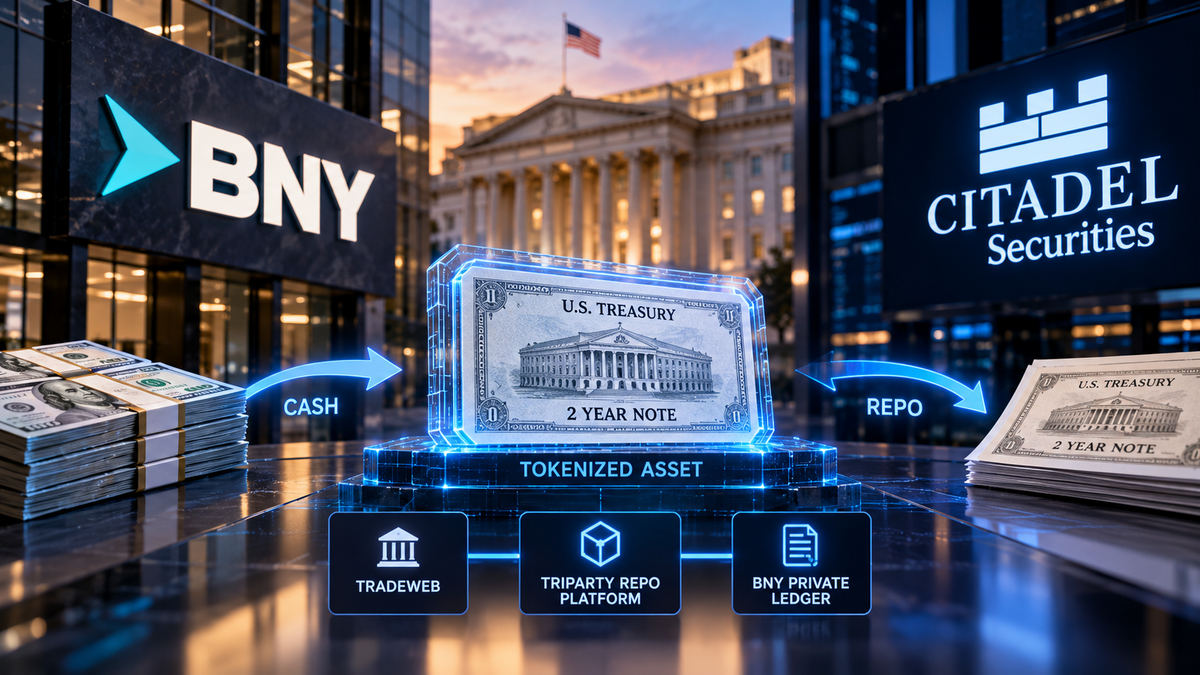
A landmark transaction between BNY and Citadel Securities has provided one of the clearest demonstrations yet. The institutions completed a triparty repurchase transaction using a tokenised two-year US Treasury, marking the first use of a tokenised asset on a major triparty repo platform.
The Treasury was recorded on BNY’s private digital ledger and settled within minutes rather than following the conventional T+1 cycle. Citadel Securities then used it as collateral to obtain overnight financing.
For Edwin Mata, chief executive and co-founder of tokenisation platform Brickken, that transition shows how digital securities may improve the use of collateral and institutional liquidity.
“A Treasury that can settle within minutes and become available for financing sooner could give institutions greater flexibility in managing collateral and accessing liquidity,” he said.
Modern financial institutions hold enormous portfolios of securities, but the value of those assets is not always immediately available. Settlement periods, reconciliation requirements and operating hours can delay their movement between trading, custody and financing systems.
Tokenisation promises to compress that sequence. If ownership can be verified and transferred quickly, the same security may move from trade settlement to collateralisation without remaining idle for a full business day.
The economic prize is improved capital efficiency. Institutions may need smaller liquidity buffers, gain faster access to secured funding and reduce operational exposure during settlement. Markets could also operate for longer hours because blockchain-based ledgers are not inherently limited by conventional processing windows.
Yet faster movement does not automatically eliminate risk. It may instead accelerate the transmission of mistakes, cyber incidents or liquidity stress. A flawed transaction processed in seconds may be harder to halt than one passing through slower manual checks.
The BNY transaction also exposes tokenisation’s next obstacle: interoperability. A token that moves efficiently within one bank’s private ledger may provide limited value if it cannot cross into another custodian, trading venue or financing platform.
Mr Mata expects institutions to explore similar arrangements for government bonds and other liquid securities. But he argues that the next step is enabling assets to work across different custodians and platforms rather than remaining confined within individual systems.
Deutsche Bank’s plans illustrate how banks are broadening their ambitions. The German lender is preparing to launch digital-asset custody services, beginning with Bitcoin and Ether before expanding into stablecoin transactions, tokenised deposits and blockchain-based securities issuance.
The progression from custody towards payments and issuance is commercially important. Custody brings digital assets inside regulated banking relationships. Tokenised deposits may provide the money leg for transactions, while securities issuance supplies the asset leg. Combining the two could allow institutions to issue, hold, settle and finance assets through connected services.
JPMorgan’s deposit-token initiative offers an early example. JPM Coin, made available to institutional clients on the Base blockchain network in November 2025, demonstrates how bank-issued digital money may support faster institutional payments.
Banks are therefore not merely entering the cryptocurrency business. They are exploring whether tokenised money and securities can modernise functions they already perform: safekeeping assets, processing payments, issuing instruments and extending secured finance.
That distinction is crucial for institutional adoption. Financial groups are more likely to embrace systems that improve familiar activities within recognised legal and regulatory frameworks than products built primarily around speculative crypto demand.
The strongest commercial case may consequently come from removing friction rather than inventing exotic assets. Government bonds, deposits, money-market instruments and private-market securities are natural candidates because settlement inefficiencies, limited trading windows and fragmented ownership records impose identifiable costs.
But the controversy surrounding tokenised equities shows that technological access cannot be separated from ownership rights.
Nine US-listed companies, including Broadcom, Verizon and CoreWeave, have objected to tokenised versions of their shares being traded on the proposed OKXICE platform. Their concerns include pricing, liquidity and shareholder rights.
A token referencing a share is not necessarily equivalent to direct ownership of that share. Investors must understand whether they possess the underlying security, a beneficial interest held through an intermediary, or merely contractual exposure to its price.
That distinction determines voting rights, dividends, participation in corporate actions and protection if the platform fails. It also raises questions about who maintains the authoritative ownership register and how token holders are identified to the issuer.
Price formation presents another difficulty. If conventional shares trade during exchange hours while tokenised versions trade around the clock across several platforms, temporary price differences may emerge. Arbitrage could align markets, but fragmented liquidity or restrictions on converting tokens into underlying shares might allow distortions to persist.
Issuers will therefore demand a greater role in authorisation, disclosure and corporate-action management. As Mr Mata observed, making companies comfortable with tokenised structures may become as important as obtaining regulatory approval.
The next phase of tokenisation will be defined by trust rather than novelty. Institutions need confidence that digital securities are legally enforceable, technologically resilient and transferable across credible networks. Issuers need assurance that their shares will not be represented in ways that confuse investors or weaken shareholder protections.
Regulators, meanwhile, must avoid treating every token alike. A tokenised Treasury, bank deposit, company share and speculative cryptoasset present different economic functions and risks. Regulation should follow the substance of the instrument and the rights it conveys.
BNY and Citadel Securities have demonstrated that tokenised securities can enter mainstream financing. Deutsche Bank’s plans suggest banks want to provide an integrated set of digital services. Corporate objections show that adoption will not proceed without negotiation.
The technology has passed an important threshold, but its institutional future will depend on whether markets can combine speed with legal certainty, liquidity with investor protection and innovation with interoperability.
Tokenisation will not transform finance merely because assets appear on a blockchain. It will matter when those assets can move safely across institutions, serve multiple financial purposes and preserve the rights that make a security valuable in the first place.

