


- Tomatoes Surge 158.30% As Ghana’s 5.0% Inflation Masks Sharp Household Price Divides
Ghana’s inflation story is becoming increasingly complicated. Headline inflation remains dramatically below the levels recorded a year ago, but the latest Consumer Price Index data from the Ghana Statistical Service show that the improvement is being experienced very differently across products, regions and household budgets.
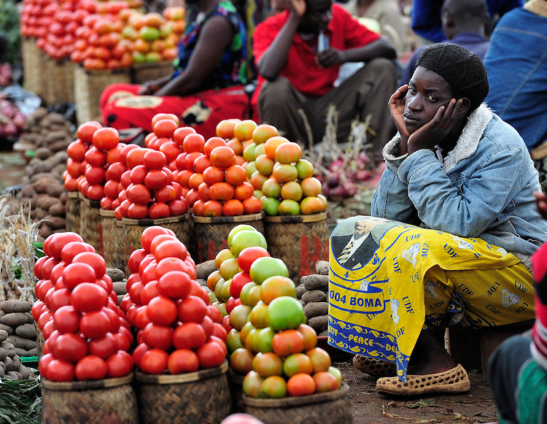
Nowhere is that divergence more striking than in fresh tomatoes, whose prices increased 158.30% year on year in August 2026. The surge made tomatoes the largest individual price mover among the commodities highlighted by the GSS, even as overall food inflation eased marginally to 3.00% from 3.10% in July.
The contrast illustrates an important limitation of headline inflation as a measure of the household experience. A national average can show substantial macroeconomic improvement while consumers heavily dependent on particular goods continue to face dramatic increases at shops and market stalls.
Government Statistician Dr Alhassan Iddrisu highlighted precisely that distinction, noting that fresh tomatoes had more than doubled in price while lime declined sharply. The wider message is that Ghana’s 5.00% headline inflation rate conceals considerably different experiences across the consumption basket.
Headline inflation rose to 5.00% in August from 4.60% in July, but remained substantially below the 11.50% recorded in August 2025. That represents significant progress in slowing the overall pace at which consumer prices are increasing, even if the latest month suggests that further disinflation may become more difficult.
Inflation, however, is an average constructed from a weighted basket of goods and services. It does not mean that every item is increasing by 5.00%, nor does a decline in inflation mean prices have returned to the levels households paid before Ghana’s recent inflationary episode.
The tomato market demonstrates that distinction unusually clearly. Tomatoes are a staple ingredient in Ghanaian cooking, meaning an increase of more than 158.00% can have a disproportionate effect on households that purchase them frequently even if the statistical weight of tomatoes within the entire CPI basket is relatively small.
The increase also points towards vulnerabilities in Ghana’s agricultural supply chain. Fresh-produce prices can respond sharply to seasonality, weather, irrigation conditions, transport costs, post-harvest losses and weaknesses in storage and distribution, making agricultural infrastructure as relevant to food-price stability as monetary policy.
Tomatoes are particularly vulnerable because they are highly perishable. When supply is plentiful, inadequate storage and processing capacity can result in substantial losses; when supply subsequently tightens, those earlier losses can contribute to sharp retail-price increases.
The wider commodity data show just how fragmented Ghana’s food-price environment has become. Ginger increased 128.30%, shrimps 67.10%, mangoes 57.70%, fresh coconut 38.00% and green pepper 30.50%, producing severe increases for consumers exposed to those products.
Yet significant declines occurred elsewhere. Lime prices fell 33.70%, maize declined 31.30%, while cocoyam leaves, sweet apples, fried fish and pawpaw also recorded substantial year-on-year reductions.
Food prices as a whole declined 2.50% month on month in August, providing an important counterpoint to the dramatic annual movements in particular products. It reinforces the need to distinguish between isolated commodity shocks, annual comparisons and the direction of the broader food basket in the latest month.
That distinction also explains why Ghana can simultaneously report improving food inflation and households can still complain that food remains expensive. As the GSS has emphasised, inflation measures the speed at which prices are changing rather than the absolute level at which those prices now stand.
The broader cost-of-living challenge is increasingly shifting beyond food. Non-food inflation stood at 6.80%, more than twice the 3.00% food rate, and accounted for 70.90% of total inflation, compared with 29.10% for food.
Services inflation was even higher at 8.60%, compared with 3.80% for goods. That matters because household expenditure extends well beyond groceries to rent, transport, education, utilities, healthcare and other services where consumers often have less flexibility to reduce spending.
A family can substitute one vegetable for another or temporarily reduce consumption of a particularly expensive fruit. It is much harder to substitute away from rent, school fees, commuting expenses or electricity, making persistent services inflation especially important for real living standards.
The August data also suggest that Ghana’s remaining inflation pressure is increasingly domestic. Locally produced goods and services accounted for 86.20% of overall inflation, while inflation on imported items stood at only 2.20%.
That represents a significant change from periods when cedi depreciation and imported inflation were major drivers of consumer-price increases. Greater exchange-rate stability appears to have reduced the transmission of external price pressures, but that success exposes the next problem: domestic cost structures.
If the remaining inflation is increasingly generated locally, interest-rate policy and currency stability alone cannot eliminate it. Monetary policy can restrain demand and anchor expectations, but it cannot directly increase tomato yields, construct cold-storage facilities, improve feeder roads or reduce post-harvest losses.
The tomato shock therefore deserves to be treated partly as an agricultural productivity and logistics problem. Improving irrigation, protected cultivation, storage, processing, transport and market information could help smooth seasonal supply and reduce the extreme volatility that periodically affects fresh produce.
Processing capacity could be particularly important. Surplus tomatoes during periods of high production could be converted into paste and other products rather than lost, creating additional demand for farmers while providing an alternative source of supply when fresh-market conditions tighten.
Better market information could also reduce inefficiencies between production centres and urban markets. Farmers need clearer demand signals, while traders and consumers benefit when supply conditions and prices are more transparent across regions.
None of these interventions guarantees permanently low tomato prices. Agricultural markets are inherently exposed to weather and seasonal factors, but better infrastructure can reduce the amplitude of those price swings and limit the economic losses associated with gluts followed by shortages.
For policymakers, August consequently offers both encouragement and warning. Ghana has achieved a substantial reduction in annual inflation from 11.50% to 5.00% within a year, but the composition of current price pressure shows that macroeconomic stabilisation does not automatically produce affordability across every component of the household basket.
This is particularly important for lower-income households, which tend to have less financial capacity to absorb sudden increases in frequently consumed staples. A dramatic rise in one commonly purchased food can therefore impose considerable hardship even when the national inflation rate appears moderate.
The next phase of Ghana’s disinflation programme must consequently become broader than simply reducing the headline CPI. Sustainable price stability will increasingly depend on stronger domestic production, efficient markets, infrastructure, agricultural logistics and lower structural business costs.
The tomato market provides an unusually vivid illustration of that challenge. Ghana can simultaneously have 5.00% headline inflation, 3.00% food inflation and tomatoes that cost 158.30% more than a year earlier without any of those statistics contradicting the others.
They simply measure different parts of the same economy. For households, however, the number that matters most is often not the headline CPI but the price attached to the products they buy repeatedly. That is why Ghana’s inflation recovery, while real, cannot yet be equated with a uniformly cheaper cost of living.
The country has made substantial progress in slowing inflation. The harder task now is ensuring that the improvement becomes broad enough for consumers to feel it not only in the official statistics, but at the market stall, in the transport fare and in the household bills that ultimately determine living standards.

