


- UAE Extends US$1 Million Flood Relief to Ghana as Climate Shocks Expose Resilience Financing Gap
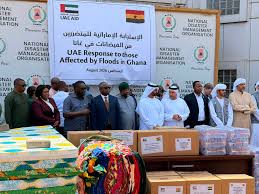
The United Arab Emirates has donated relief items valued at US$1 million to Ghana to support communities affected by recent floods, providing immediate humanitarian assistance while drawing renewed attention to the rising economic cost of climate-related disasters and the country’s ability to finance resilience.
The assistance was received on behalf of the Government of Ghana by Seidu Issifu, Minister of State for Climate Change and Sustainability, as authorities intensify efforts to support households and communities affected by flooding.
“The Government of Ghana is grateful to the Government and people of the United Arab Emirates for this timely support,” Mr Issifu said.
The donation represents another element of Ghana’s expanding relationship with the UAE, but its economic significance extends beyond the value of the relief items. Flooding increasingly affects public infrastructure, household assets, businesses and agricultural production, turning what may initially appear to be a humanitarian emergency into a wider fiscal and economic shock.
For government, the costs can arrive through several channels. Roads, bridges, schools and health facilities damaged by floods require reconstruction, while emergency shelter, food and other support for displaced households can create expenditure that was not anticipated in the national budget.
The pressure is particularly important for Ghana because fiscal space remains constrained following the country’s recent debt crisis and restructuring. Unexpected disaster expenditure can therefore force government to reallocate resources from planned programmes, postpone investments or seek additional financing.
In that context, foreign humanitarian support does more than supply emergency relief. It temporarily shifts part of the immediate cost of responding to disaster away from the public balance sheet.
But external assistance cannot provide a permanent solution to a structural vulnerability.
The larger policy challenge is whether Ghana can mobilise enough investment in drainage, flood-resistant infrastructure, early-warning systems, urban planning and disaster preparedness to reduce the economic losses before extreme weather occurs.
The economics increasingly favour prevention over repeated reconstruction. Climate-resilient infrastructure can require greater upfront capital, but the alternative is to repeatedly repair roads, restore damaged public facilities and compensate communities after disasters have already destroyed economic value.
Ghana’s rapid urbanisation makes the issue more pressing. Settlement expansion, pressure on drainage systems, construction around waterways and weak enforcement of spatial-planning rules can increase exposure to heavy rainfall and turn otherwise manageable weather events into costly urban emergencies.
The consequences are particularly severe for small businesses. Traders can lose inventory, commercial areas can become inaccessible and transportation disruptions can prevent workers and customers from reaching businesses.
Agriculture faces a different set of vulnerabilities. Floods can destroy crops, damage farm infrastructure and disrupt the movement of produce from rural communities to markets, potentially affecting both farmer incomes and food supply.
That creates a link between climate shocks and inflation. If severe weather reduces food availability or increases transportation costs, the consequences can eventually appear in consumer prices.
Climate resilience should therefore increasingly be treated as an economic policy issue rather than a stand-alone environmental concern. Investment decisions about roads, drainage, housing, agriculture and public infrastructure all carry climate implications that can ultimately affect growth and government finances.
The UAE intervention also opens a broader question about whether Ghana can deepen the bilateral relationship from emergency assistance into longer-term climate investment.
The Gulf state has become an increasingly important source of investment capital across Africa, creating potential opportunities for Ghana to seek financing in areas such as renewable energy, climate-smart agriculture, coastal protection, resilient infrastructure and disaster-monitoring technology.
A shift in that direction could have economic benefits beyond flood management. Better drainage in commercial centres could reduce business interruptions, while improved weather and early-warning systems could help communities prepare for extreme conditions before they become catastrophic.
For farmers, improved meteorological information and climate-smart infrastructure could support planting decisions and reduce exposure to increasingly unpredictable weather patterns.
Such investment would also complement Ghana’s efforts to draw more private and development capital into infrastructure as government borrowing remains constrained. The challenge would be structuring projects that deliver measurable resilience benefits while remaining financially sustainable.
The larger fiscal lesson is that climate vulnerability creates liabilities even when those costs do not initially appear as conventional public debt.
Every road reconstructed after a flood represents money that cannot be invested elsewhere. Every emergency allocation for affected households increases expenditure, while every business forced to suspend operations represents lost production, employment and potentially tax revenue.
Those costs are dispersed across government, businesses and households, but they eventually accumulate into a meaningful economic burden.
The US$1 million UAE contribution therefore provides an important immediate response, but it also illustrates the limitations of relying on disaster relief after losses have already occurred.
For Ghana, the more difficult transition is from emergency response to resilience financing.
That means making flood prevention, stronger planning, early-warning systems and climate-resilient infrastructure part of mainstream fiscal and development strategy rather than treating them primarily as interventions activated after extreme weather strikes.
The long-term objective should be to ensure that international partnerships increasingly help Ghana prevent disasters from producing severe economic losses, rather than simply helping the country recover after those losses have already been incurred.

