



Upstream: Entry of Major Oil Firms to Reverse Ghana’s Continuous Production Decline
A strong case has been made for the deliberate attraction of well-capitalised and experienced international oil companies into Ghana’s upstream petroleum sector as part of efforts to reverse the country’s sustained decline in crude oil production.
The proposal, which featured prominently during a media engagement on the 2025 annual report by the Public Interest and Accountability Committee (PIAC), centres on leveraging the technical and financial capacity of major oil firms to develop dormant oil blocks, particularly within the Tano Cape Three Points (Western Basin), as well as the largely unexplored Saltpond/Central Basin and Accra-Keta/Eastern Basin.
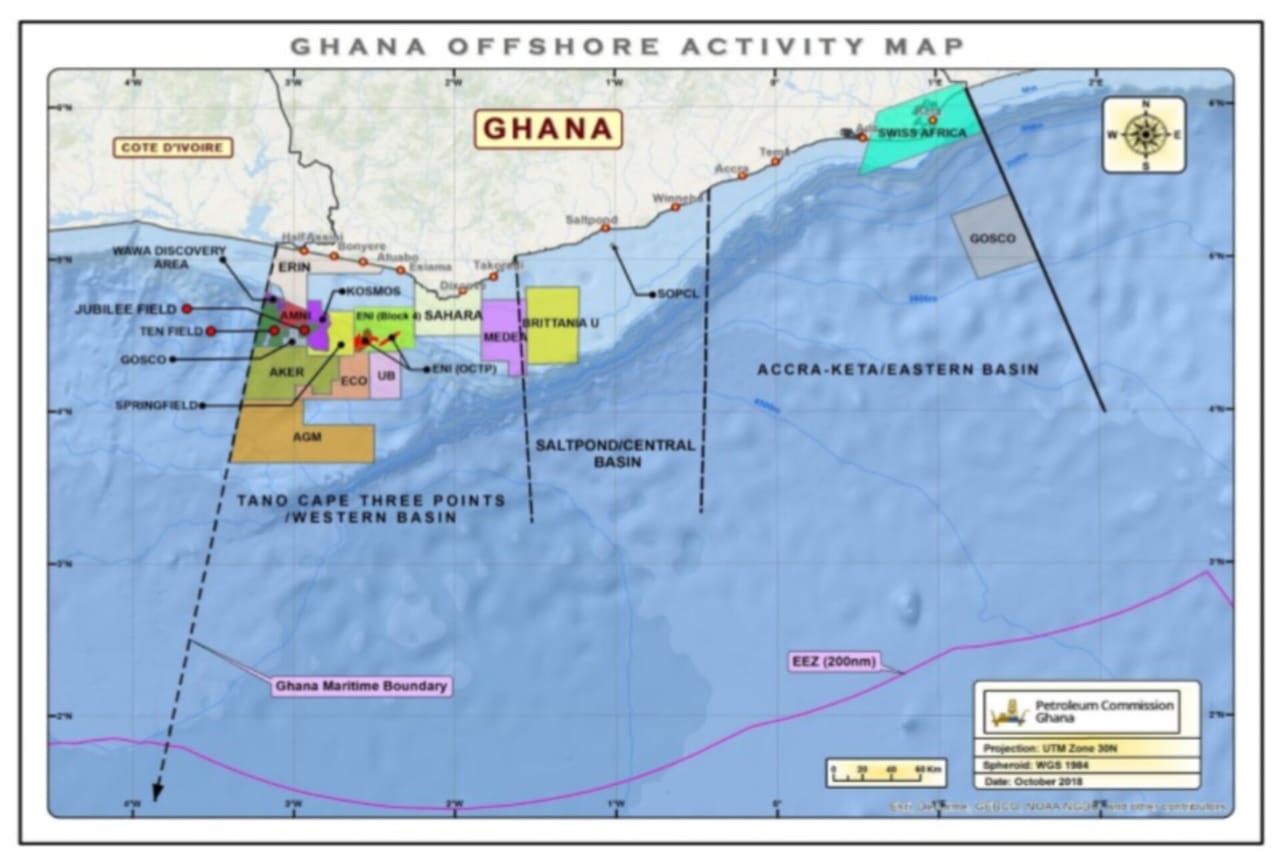
Stakeholders at the engagement argued that beyond the producing Jubilee, TEN and SGN fields, several oil blocks remain undeveloped due to capacity constraints among smaller operators. The entry of globally recognised oil firms, they noted, could catalyse investment inflows, boost confidence in Ghana’s petroleum governance framework, and ultimately increase production levels.
Data from the PIAC report indicates that total crude oil production for 2025 declined to 37.3 million barrels, representing a significant drop from the peak of 71.4 million barrels recorded in 2019. Production from the Jubilee, TEN and SGN fields fell by 30.3 per cent, 14 per cent and 3.6 per cent respectively in 2025.
Petroleum receipts also weakened, with total inflows dropping to $770.27 million in 2025, down by 43.27 per cent from $1.36 billion recorded in 2024, underscoring the fiscal implications of the production downturn.
The push for attracting major oil companies is anchored on the view that existing smaller operators often lack the requisite capital and technical expertise to undertake high-risk exploration and production activities, particularly in frontier basins where geological data remains limited.
As part of the strategy to de-risk investments, stakeholders proposed a differentiated fiscal regime for the Central and Eastern Basins relative to the Western Basin. The move is intended to reflect the higher exploration risks and data uncertainty associated with these areas, while making them more commercially attractive to prospective investors.
Discussions also highlighted the need for policy consistency and regulatory clarity, particularly in the wake of Ghana’s recent arbitration proceedings involving Eni, which participants noted has weighed heavily on investor sentiments with regard to investing in Ghana’s upstream sector.
Beyond attracting new entrants, other recommendations outlined at the engagement included addressing technical production challenges, especially within the TEN field, diversifying the economy to reduce reliance on oil revenues, and strengthening the management of petroleum proceeds.
There was broad consensus among PIAC members, civil society organisations and media participants that urgent investment is required to revitalise Ghana’s upstream sector. Failure to reverse the declining production trend, stakeholders cautioned, could see the country’s oil industry face significant contraction over the next decade.

