

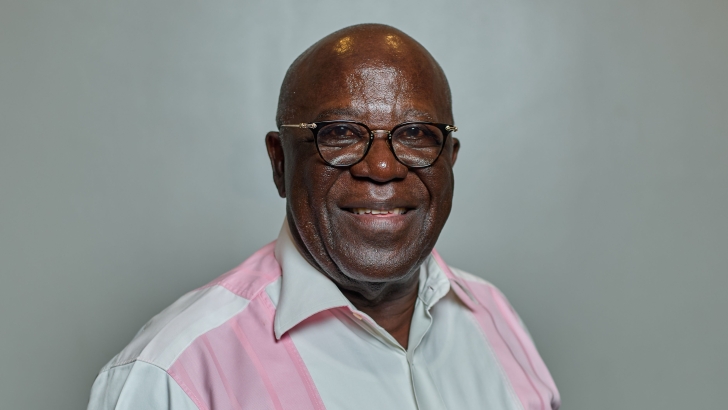

- ‘What Hope Has the Young Entrepreneur?’ — Sir Sam Jonah Recounts Investment Troubles in Nigeria
Ghanaian business leader Sir Sam Jonah has raised concerns over the treatment of African investors operating across the continent after disclosing that a significant real estate investment he made in Nigeria has been subjected to what he described as “sustained harassment” by state agencies.
The veteran mining executive said Ghanaian workers involved in the Nigerian project had also faced troubling treatment, using his experience to question whether African governments are creating the conditions required for businesses from the continent to invest and operate freely across national borders.
“I have made a significant investment in a real estate development in Nigeria, a country I hold in high regard and in whose promise I have long believed. That investment has been subjected to sustained harassment by state agencies,” Sir Sam said.
He made the disclosure while delivering the keynote address at the Global Business Forum – Ghana Edition on Friday, August 28, 2026.
Sir Sam also said Ghanaian workers at the project had experienced treatment that he compared with scenes of hostility towards foreign African nationals elsewhere on the continent.
“Ghanaian workers on the site have endured treatment not dissimilar to the scenes we deplore in South Africa,” he said.
The claims represent Sir Sam’s account of his experience and raise a wider question about whether the institutional environment within African economies is keeping pace with political ambitions for deeper continental trade and investment integration.
The significance of the intervention extends beyond an individual investment dispute.
Sir Sam is one of Africa’s most prominent business figures, having risen from working underground at Obuasi to leading Ashanti Goldfields as it developed into an internationally recognised mining company and became the first operating African company to list on the New York Stock Exchange.
He argued that if an investor with his resources, experience and networks could face substantial difficulties in another African jurisdiction, younger and less established entrepreneurs seeking to expand across borders were likely to encounter even greater obstacles.
“If this is the experience of an investor with my resources, my networks and my grey hairs, what hope has the young entrepreneur with none of these?” he asked.
That question goes directly to one of the underlying assumptions behind the African Continental Free Trade Area.
AfCFTA seeks to create a more integrated continental market by reducing barriers to trade and expanding opportunities for businesses to operate across national borders. But lower tariffs alone will not produce meaningful integration if companies encounter administrative obstruction, discriminatory treatment, unpredictable regulation or inadequate protection when they invest outside their home countries.
Sir Sam warned that such conditions could ultimately drive African capital away from the continent.
“When African capital is harassed in Africa, we should not wonder why it flees to London and Dubai,” he said.
The argument highlights a longstanding contradiction in Africa’s investment model.
Governments across the continent routinely compete for foreign direct investment, offering multinational companies tax concessions, investment guarantees, access to government officials and other forms of facilitation.
Yet African businesses seeking to expand into neighbouring markets can encounter regulatory uncertainty, bureaucracy and other barriers that make cross-border expansion difficult.
Sir Sam wants that distinction addressed.
“Protect the African investor and the African worker in your jurisdiction as zealously as you court the foreign one for no treaty can accomplish what hospitality refuses,” he said.
A continental free-trade agreement can reduce tariffs and harmonise elements of regulation, but businesses ultimately operate within national legal and administrative systems.
Their willingness to invest will depend on whether contracts are respected, property rights are protected, regulations are predictable and government agencies apply rules consistently.
One of the longer-term ambitions of African economic integration is the development of regional value chains in which capital, skills, intermediate goods and services can move more efficiently across borders.
Hostility towards workers from other African countries can undermine that process even where formal trade agreements encourage greater commercial integration.
Sir Sam’s disclosure is therefore likely to reinforce debate over whether African governments should establish stronger mechanisms for protecting intra-African investors.
Such arrangements could include clearer investment protections, faster dispute-resolution systems, transparent administrative procedures and stronger safeguards against discriminatory regulatory treatment.
The issue is increasingly important because Africa’s development strategy requires significantly higher levels of private investment.
Infrastructure, manufacturing, energy, technology, agribusiness and services all require capital on a scale that governments cannot provide alone.
While foreign investment will remain important, African capital itself represents a potentially significant source of financing.
But investors will naturally direct money towards jurisdictions where they believe assets, contracts and employees will be protected.
That makes institutional credibility an economic issue rather than merely a governance concern.
If African entrepreneurs perceive investing in London, Dubai or other international financial centres as safer than expanding into neighbouring African markets, the continent risks losing not only capital but also management expertise, employment, tax revenues and opportunities to create multinational African businesses.
Large businesses can employ legal advisers, establish government-relations teams and absorb the costs associated with lengthy regulatory disputes.
Young entrepreneurs and small and medium-sized enterprises generally cannot.
For them, unpredictable administrative treatment can be enough to make cross-border expansion commercially impossible.
Sir Sam’s experience therefore raises a more fundamental question about Africa’s integration project: whether governments are prepared to treat businesses from other African countries with the same urgency and protection they frequently extend to investors arriving from outside the continent.
AfCFTA has created the framework for a market connecting economies across Africa, but achieving its promise will require more than removing customs duties.
It will require trust between businesses and institutions.
Africa cannot repeatedly call on its entrepreneurs to build continental companies while allowing them to encounter barriers when they cross African borders.
And if African governments want African capital to remain and circulate within the continent, they will have to demonstrate that investing across Africa is not only economically attractive, but institutionally secure.

