


- What Is Needed for Tokenization to Deliver
The promise of tokenization is enticing: faster transactions, lower costs, broader access, and seamlessly operating markets. The reality, at least for now, is more complicated. Although growing rapidly, tokenized markets remain very small and fragmented. Yet investors are already showing interest in some of their key features, such as round-the-clock trading and fractional ownership of equities, as we show in an analytical chapter of the latest Global Financial Stability Report.
What sets tokenization apart from previous financial innovations is its potential to reorganize markets. By representing assets directly on distributed programmable ledgers, tokenization can bring together functions that are traditionally performed by separate institutions and infrastructures, from issuance and trading to settlement and servicing. It can also compress processes that now happen in sequence. If widely adopted, it could reshape how financial markets operate. But much of this potential remains unrealized.
Fast growth from a small base
The bulk of tokenized activity takes place in the market for so-called repurchase agreements (or “repos,” short-term loans backed by government bonds, in which the parties agree to reverse the transaction at a later date). These average around $300 billion to $350 billion in daily transaction volume, reflecting tokenization’s appeal for collateral management.
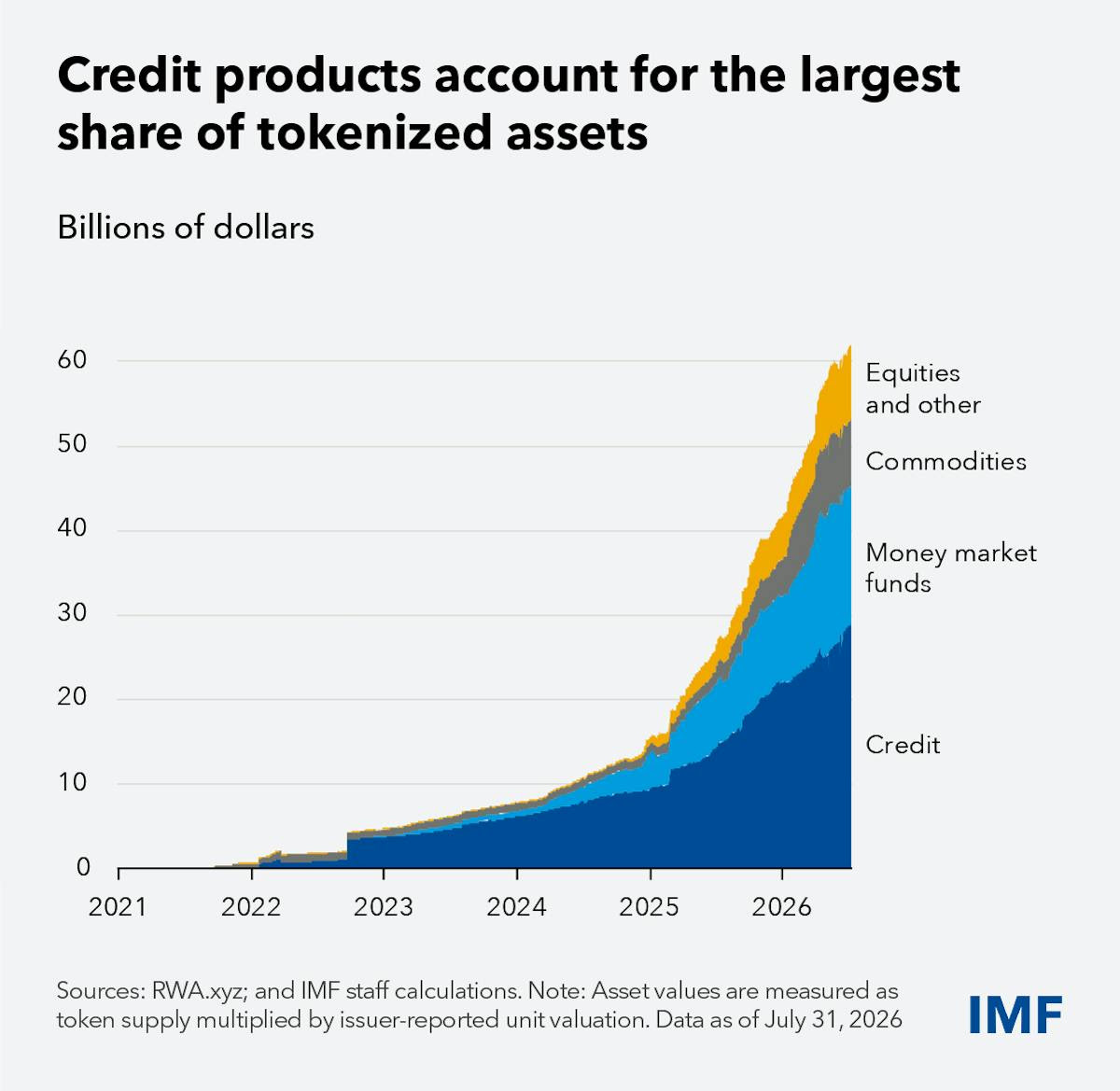
Chart showing credit products account for the largest share of tokenized assets
Trade in tokenized assets (credit, money market funds, and equities, among others) adds another $65 billion. While these volumes have been growing rapidly, they are still tiny compared with their “traditional” versions—the volume of the US repo market is about $13 trillion daily, while global capital markets represent $300 trillion in assets.
Issuance of tokenized assets is concentrated in a few markets, such as the US and a few major offshore jurisdictions, while trading is highly fragmented across platforms, networks, and settlement arrangements.
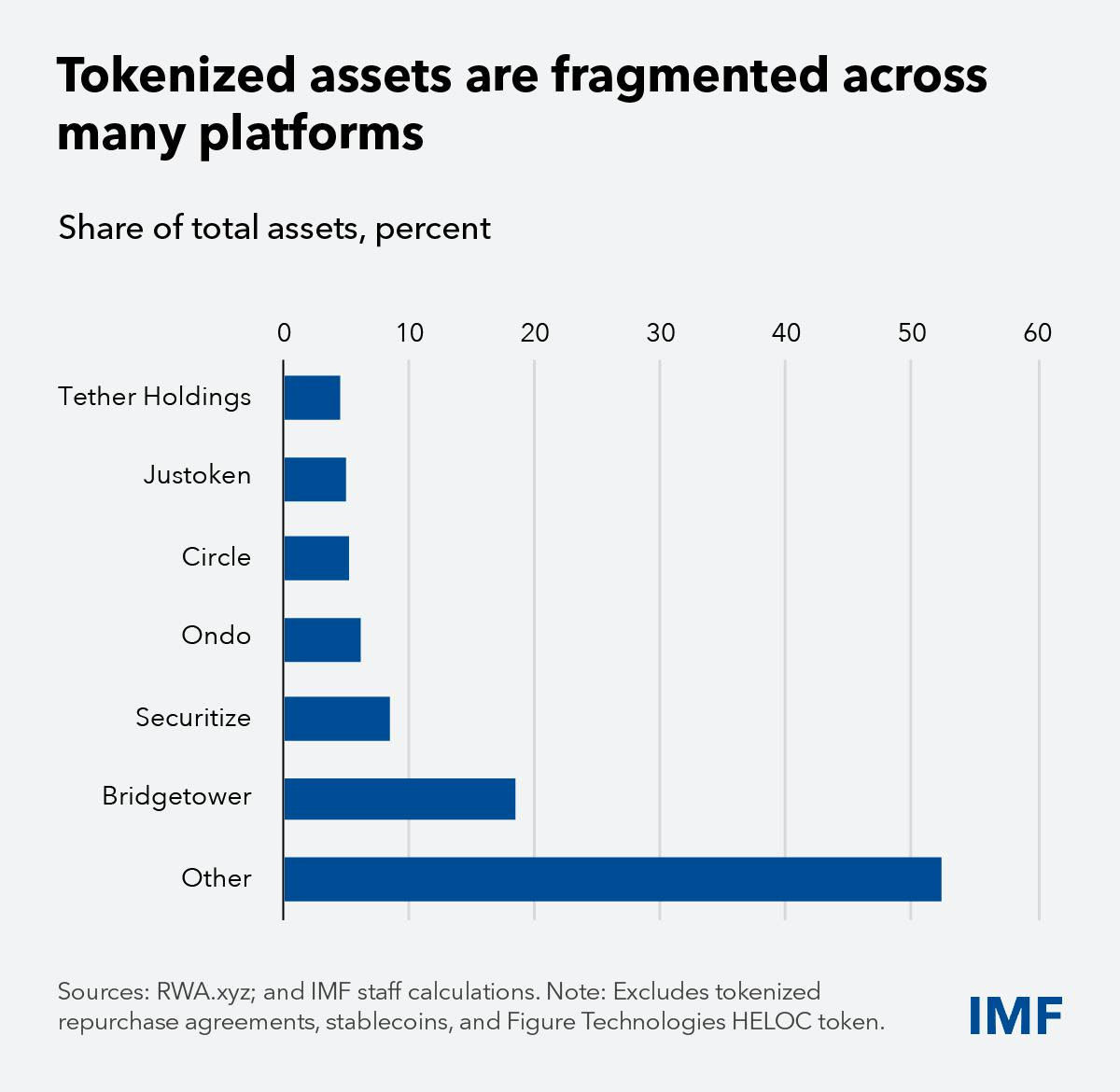
Chart showing tokenized assets are being fragmented across many platforms
What prevents tokenization from growing faster? Our work points to four mutually reinforcing constraints: legal certainty, regulatory clarity, interoperability, and the availability of settlement assets.
Investors require legal certainty that tokenized assets represent enforceable rights.
Regulators ought to clarify how existing rules apply to new ledgers and market functions.
Platforms will have to become interoperable rather than isolated liquidity pools.
Settlement needs to rely on safe, widely accepted forms of money.
Useful features, thin liquidity
Early evidence suggests that investors value some of the features that tokenization enables. More than half of trading occurs outside traditional market hours, indicating demand for continuous around-the-clock access. Fractional ownership is widely used, allowing retail investors to, for example, buy less than one share of a company and participate with lower entry costs. In fact, around 80 percent of the tokenized equity trades we analyzed were executed in sizes smaller than one share.
Additionally, overnight tokenized-equity returns are reflected in traditional equity prices shortly after the market opens, suggesting that tokenized and traditional markets respond to similar information and that overnight signals from tokenized markets are relevant in “traditional” trading.
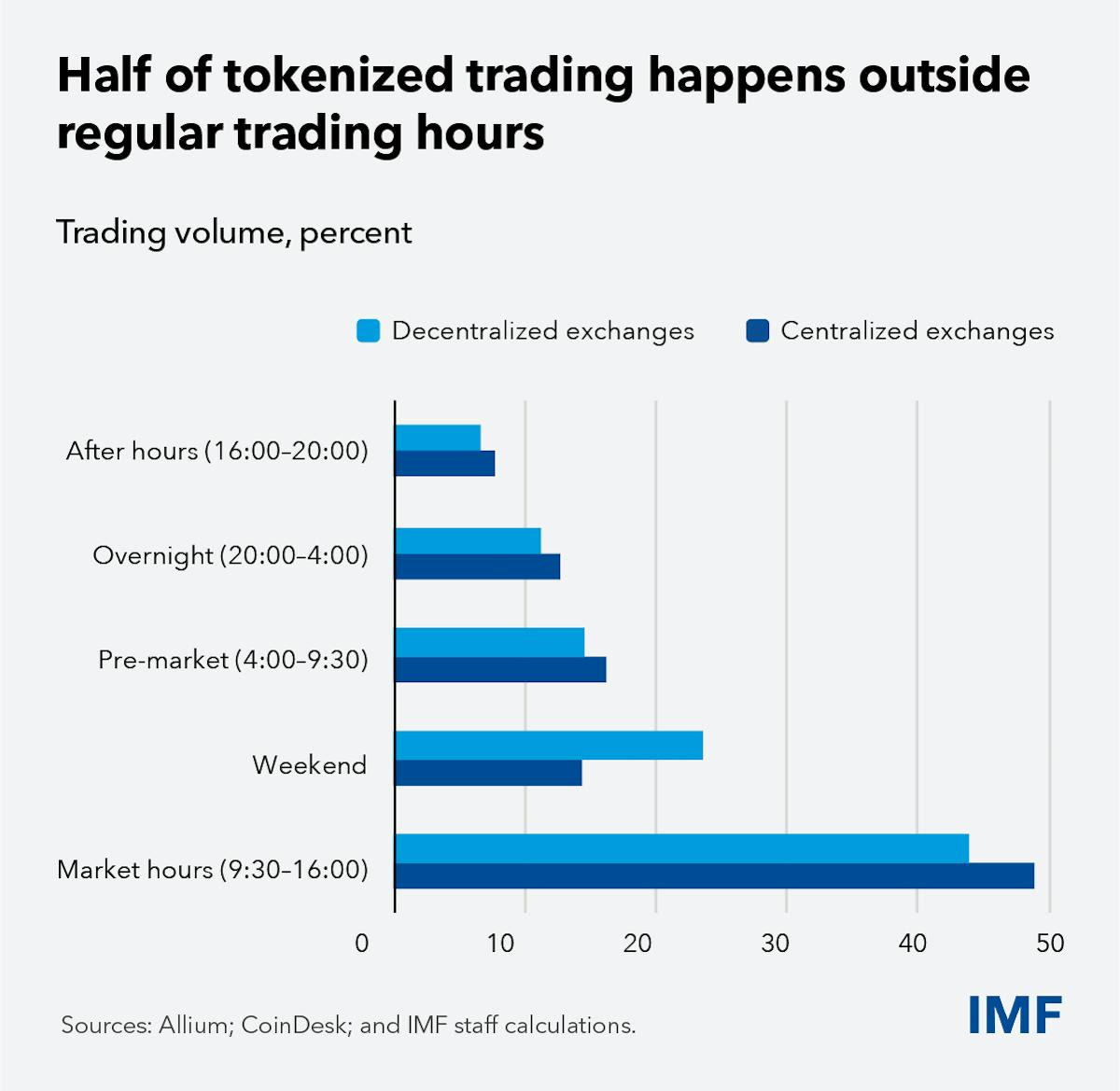
Chart showing half of tokenized trading happens outside regular trading hours
However, while tokenization offers the prospect of more efficient financial markets over time, tokenized markets today remain relatively illiquid and exhibit higher volatility than their traditional counterparts. Liquidity is further weakened by fragmentation across multiple networks and venues, preventing efficient price formation and contributing to price deviations.
Fragmentation across various platforms, and the lack of both interoperability and common settlement assets, undermine the network effect that could help tokenized markets grow faster. The value of a tokenized ecosystem depends on how many assets, investors, and settlement instruments are connected to it. As these networks grow and consolidate, benefits such as liquidity, efficiency, and composability (the ability of smart contracts to interact and combine with each other) can increase substantially.
How to grow safely
Greater scale, however, could also amplify risks. While technological and infrastructure risks may dominate in the early stages of market development, some tokenization features can create new channels for transmitting and amplifying traditional financial risks, such as fire sales, liquidity runs, and contagion through greater interconnectedness and leverage. Today’s sequential processes of messaging, trading, delayed settlement and reconciliation add frictions and costs, but also provide buffers, safety and liquidity management that would mostly disappear in a hypothetical fully tokenized environment.
As greater scale in tokenized markets can increase both benefits and risks, the challenge for policymakers is to create the conditions for safe and efficient development of tokenization.
A technology-neutral approach is essential. Countries should clarify the legal rights linked to tokenized assets, ensure that similar activities are regulated consistently regardless of technology, and support interoperability between tokenized platforms and traditional financial systems. They also need to continue monitoring emerging vulnerabilities, including those arising from growing interconnectedness, leverage, and liquidity risks, and ensure that safeguards keep pace as markets scale.
Tokenization may yet transform finance, but its future will be determined less by technological possibilities than by policies that ensure market depth, trust, and sound safeguards.
This blog is based on Chapter 3 of the October 2026 Global Financial Stability Report: “Scaling Tokenization: New Efficiencies, New Vulnerabilities.”

