



- Why Ghana’s PPI Is Back at 4.00% and What It Means for Factories, Businesses and Household Bills
Ghana’s producer inflation increased to 4% in July 2026, but the headline figure conceals a more complicated shift underneath: price pressures are not accelerating uniformly across the economy, with mining, electricity and selected manufacturing industries driving much of the renewed increase while services and construction remain comparatively subdued.
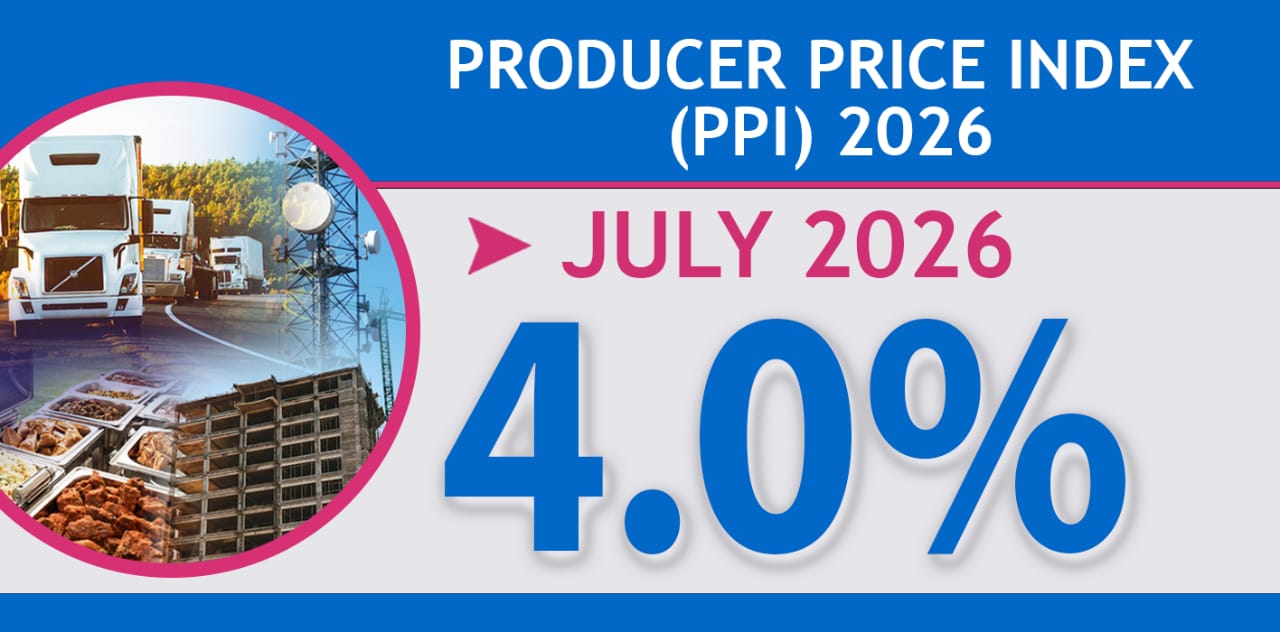
Data from the Ghana Statistical Service show that the Producer Price Index rose to 272.6 in July, from 267.4 in June and 262.2 a year earlier. This translated into year-on-year producer inflation of 4.00%, up from 3.50% in June, while prices increased 2% in July alone, reversing a sharp 3.70% month-on-month decline recorded in June.
That monthly reversal is arguably more important than the modest 0.50 percentage-point increase in the annual rate. It suggests that after producers experienced significant price relief in June, part of that decline was reversed in July, raising the question of whether Ghana is witnessing a temporary adjustment in volatile commodity-related prices or the beginning of a broader rebuilding of production costs.
The answer, based on the detailed GSS numbers, lies primarily in mining and quarrying.
Mining carries a 43.70% weight in the producer price basket, making it by far the single most influential sub-sector in the national PPI.
Its year-on-year inflation accelerated from 2.60% in June to 3.50% in July, increasing its contribution to headline inflation from 1.1 percentage points to 1.5 percentage points. Manufacturing, with a 35.00% weight, recorded inflation of 3.70%, while electricity and gas rose substantially faster at 13.30%.
The weighting matters enormously. A large change in an economically small category may barely move national producer inflation, while a relatively modest movement in mining can materially alter the headline rate because almost GH¢44 of every GH¢100 represented by the PPI weighting comes from that part of the economy.
That helps explain why national PPI moved higher even though inflation actually eased in several other areas.
The GSS explicitly identifies mining and quarrying as the principal driver of the July increase, with its presentation linking the sharp month-on-month movement to higher gold prices. Mining prices swung from a 9.40% monthly decline in June to a 3.00% increase in July, a reversal of 12.40 percentage points.
This is the first important distinction for households: Ghana’s 4% PPI does not mean that the cost of everything produced in Ghana suddenly increased by 4% in July, nor does it mean household prices will automatically rise by 4%.
The PPI measures the average change in prices received by domestic producers for goods and services. It is therefore an upstream measure what is happening at the factory gate, mine, utility, construction site or service provider before some retail margins, distribution costs and other elements eventually determine what consumers pay.
GSS describes producer prices as an economic “early-warning system” because pressures can emerge there before reaching shops and households.
The July numbers consequently carry both reassurance and warning. On one hand, 4% producer inflation remains moderate. On the other, prices increased 2.00% in a single month after declining 3.70% the month before, and some economically important categories are recording inflation far above the national average. GSS itself describes the July outcome as a “moderate strengthening” of producer price pressures.
The clearest area of concern is energy.
Electricity and gas producer inflation increased from 12.50% in June to 13.30% in July, making it the fastest-rising major sub-sector measured in the national release. Electricity and gas prices also increased 2.90% between June and July alone.
Electricity has an unusually powerful transmission mechanism through an economy because it is simultaneously a final household expense and an input into virtually every productive activity. A manufacturer needs electricity to operate machinery; a supermarket needs it for refrigeration; restaurants use it in food preparation and storage; offices need it for operations; and many businesses incur additional energy costs through backup systems when grid reliability is inadequate.
This means sustained producer inflation in electricity can eventually appear elsewhere, not necessarily because electricity alone becomes more expensive to households, but because businesses attempt to recover higher operating expenses through the prices of their own products.
The implications for industry are therefore more significant than the 4.00% headline initially suggests. Industrial producer inflation excluding construction reached 5.60%, up sharply from 3.30% in June. More strikingly, industrial prices increased 4% in July alone, compared with relatively little movement in construction and services.
Manufacturing inflation itself remained relatively contained at 3.70%, but the average hides exceptionally large differences between industries.
Of the 23 manufacturing groups measured by GSS, 15 recorded inflation above the 3.70% manufacturing average. Fabricated metal products excluding machinery and equipment recorded producer inflation of 25.90%, leather and related products 17.40%, wood products 11.60%, furniture 9.30% and food manufacturing 8.80%.
Machinery and equipment recorded inflation of 8.50%, other transport equipment 7.00%, printing 5.80%, rubber and plastics 5.80%, pharmaceuticals 5.70% and chemicals 4.90%. By contrast, basic metals recorded deflation of 0.20%, while other non-metallic mineral products declined 2.30%.
A business operating in fabricated metals is experiencing a dramatically different cost and pricing environment from a company producing non-metallic mineral products. The national 4.00% rate therefore cannot sensibly be treated as the inflation experience of every Ghanaian producer.
Food manufacturing deserves particular attention because its 8.80% producer inflation has a more direct potential route into household budgets. If processors are receiving substantially higher prices for manufactured food products, retailers and distributors may eventually pass some of those increases to consumers, depending on competition, inventories, exchange-rate movements and the ability of businesses to absorb costs through their margins.
Companies may choose to protect market share by accepting lower profit margins rather than immediately raising consumer prices. Others may improve productivity, renegotiate supply contracts or draw down inventories purchased at lower prices. But if higher production costs persist for several months, the probability of eventual price transmission increases.
That is why the July PPI deserves attention even though it remains relatively low. The pressure is also visible in parts of the services economy most directly encountered by households.
Overall services producer inflation was only 2.50%, with prices rising just 0.20% between June and July. But transportation and storage recorded 10.10% year-on-year inflation, while accommodation and food services stood at 9.90%. Information and communication, in contrast, recorded only 0.70%.
For households, transportation is especially important because its influence extends far beyond the fare paid for a journey. Transport is embedded in the cost of getting food from farms to markets, moving imported inputs from ports to factories, distributing manufactured products and moving workers to places of employment.
Persistent transport cost pressures can consequently spread through supply chains even when headline producer inflation remains moderate.
Accommodation and food services tell a similar story. At 9.90%, businesses within that category are experiencing much stronger annual price growth than the national average, although inflation eased from 10.90% in June. The decline is encouraging, but the level remains elevated.
Construction provides a somewhat more reassuring picture. Overall construction producer inflation eased marginally to 4.80% from 4.90% in June, while prices increased only 0.20% during July. But building construction remained substantially more expensive than the sector average, recording year-on-year inflation of 7.90%, against 3.50% for civil engineering and 4.30% for specialised construction activities.
The implications extend to housing, government infrastructure and private investment. Sustained increases in building costs can raise the capital required for property development and eventually affect the prices or rents needed to make projects commercially viable.
Yet the most important economic message from July is the unusual combination of moderate headline inflation and concentrated pockets of much higher cost pressure.
National PPI is being held down by relatively benign price developments in some sectors even as electricity, transport, food manufacturing, crude oil-related activity and selected industrial products register much stronger increases.
Inside mining itself, the picture is similarly divided. Extraction of crude oil and natural gas recorded inflation of 12.20%, while mining support services stood at 5.90%. Yet mining of metal ores recorded 2.30% deflation, demonstrating again why the movement in the aggregate index should not be interpreted as a uniform increase across every activity.
For policymakers, this creates a delicate problem. Reacting aggressively to a 4% headline rate could be unnecessary if July largely represents the unwinding of volatile mining-price declines recorded in June. Ignoring it entirely would also be risky because the monthly numbers show clear increases in industrial and energy-related prices that could become more persistent.
The Bank of Ghana and government therefore have to distinguish between first-round price movements and broader inflation transmission.
If higher gold or extractive-sector prices remain largely contained within mining, their effect on household inflation may be limited. If electricity, transport, manufactured food and other production costs continue rising together, however, businesses may increasingly pass those costs through to consumers.
That is precisely why PPI matters for monetary and fiscal policy. GSS notes that producer-price data help government and the central bank assess emerging inflationary pressures when making decisions on interest rates, budgets and wider economic policy.
For industry, the immediate challenge is margin management. A manufacturer facing higher electricity, transport, metal, chemical or food-input costs has essentially four options: increase selling prices, accept lower margins, improve efficiency or change its input and supply arrangements. In practice, businesses frequently use a combination of all four.
GSS therefore advises businesses to improve efficiency, manage pricing carefully, maintain adequate inventories of critical inputs, secure reliable suppliers and consider longer-term contracts as a buffer against price increases.
The household effect is more indirect but potentially more consequential. Families do not pay the PPI. They pay retail prices. Yet the goods and services they eventually purchase originate somewhere in the productive system measured by the index.
If factories face persistent cost increases, supermarkets may eventually receive goods at higher wholesale prices. If transport and electricity remain expensive, retailers themselves face additional distribution and operating costs. The eventual consumer price becomes the cumulative result of those pressures, productivity gains, taxes, margins and competition throughout the supply chain.
This is why GSS cautions that higher producer prices may translate into higher retail prices in coming months, while specifically drawing attention to electricity, water and transport as areas where consumers should monitor costs carefully.
But there is an equally important reason not to overstate the danger. Services inflation eased from 2.60% to 2.50%, construction slowed from 4.90% to 4.80%, transportation declined from 10.30% to 10.10%, accommodation and food services dropped from 10.90% to 9.90%, and water supply, sewerage and waste management eased from 10.30% to 10.10%.
In other words, July was not a broad economy-wide inflation breakout. It was principally an industrial and mining-driven acceleration, powerful enough to lift the national number because of the large weights those activities carry.
Indeed, mining and quarrying alone accounts for 43.70% of the PPI basket, while manufacturing contributes another 35.00%. Together they make up 78.70% of the weighting, meaning movements in those two areas will naturally dominate the national producer inflation story.
The sharp monthly turnaround also requires perspective. June recorded a 3.70% decline in overall producer prices, driven heavily by a 9.40% fall in mining and quarrying. July’s 3.00% mining increase therefore partly represents a reversal from an unusually weak preceding month rather than evidence on its own of runaway inflation.
That makes August and subsequent releases particularly important. If monthly PPI returns towards stability while annual inflation remains around current levels, July could eventually look like a normalisation following June’s unusually large decline. If industrial prices continue rising by several percentage points monthly, however, the interpretation changes considerably.
GSS’s own conclusion is balanced: producer inflation remains “moderate but persistent,” driven by mining and quarrying, while manufacturing contributed marginally to the increase. The Service also warns that consumer price pressures could rise if higher factory-gate prices are eventually passed on.
Government therefore faces a different challenge from the high-inflation environment Ghana experienced previously. The task is no longer simply crushing broad price escalation; it is preventing concentrated cost pressures in strategic sectors from spreading across the wider economy.
GSS recommends prudent policy to contain costs, targeted attention to sectors facing persistent pressures particularly transport, utilities and food services and measures that lower production costs and strengthen competitiveness.
For households, the 4.00% figure should therefore be read neither as cause for panic nor as irrelevant statistical noise.
It is an early warning that the rapid decline in upstream price pressure has encountered resistance. Electricity remains expensive, transportation and food-service producer inflation remain close to double digits, and industrial prices turned sharply higher in July.
For businesses, those signals determine margins, investment and pricing decisions. For households, they matter because today’s factory-gate pressures can become tomorrow’s retail prices if firms can no longer absorb them.
And for policymakers, the July data present the essential inflation dilemma: the headline number remains low, but the direction has changed.
Ghana’s PPI rose only 0.50 percentage points to 4% year-on-year, yet producer prices jumped 2% in a single month after falling 3.70% in June. That is why the next few readings will matter more than the headline alone.
The most favourable outcome would be for July’s mining-led rebound to fade while electricity, transport and manufacturing pressures moderate. The greater risk is that those increases become persistent and begin reinforcing one another across production chains.
At 4%, Ghana does not yet have a producer-price problem of the scale suggested by the inflation crises of the recent past. But the July numbers are a reminder that low inflation is not merely about reaching a favourable number once.
It is about keeping the forces underneath that number under control.

