


- World Bank Review Puts Focus on Utility Finances, Reliability and Resilience in Ghana’s Energy Sector
Ghana’s energy-sector reform programme has entered a fresh implementation review with the World Bank, as government seeks to determine whether measures introduced under the Ghana Energy Sector Recovery Program for Results are producing tangible improvements in reliability, financial sustainability and operational resilience.
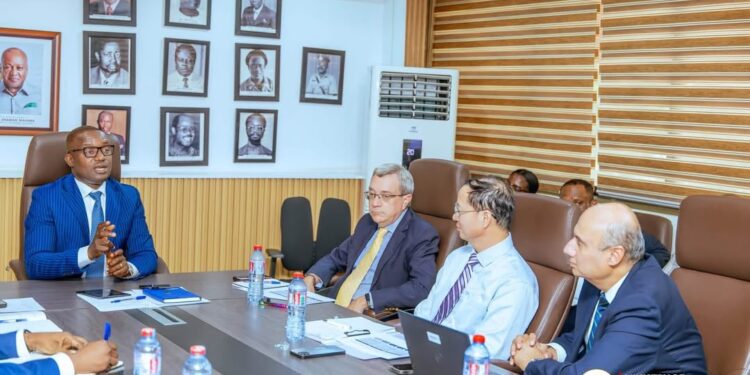
Energy and Green Transition Minister John Abdulai Jinapor said the review brings together key stakeholders to assess progress, identify implementation bottlenecks and agree on priorities for the next phase of the reform programme.
“The mission provides an opportunity to assess progress, review implementation priorities, address emerging challenges, and strengthen collaboration among stakeholders,” Mr Jinapor said.
The significance of the exercise lies in the fact that Ghana’s energy challenge is no longer principally about adding generation capacity. The more difficult problem is ensuring that electricity generated can be transmitted, distributed, billed and paid for efficiently enough to sustain the entire power value chain.
A sector can have adequate generation capacity and still remain financially unstable if utilities are unable to recover the cost of supplying power, distribution losses remain high or revenues collected from consumers are insufficient to meet contractual obligations.
That makes the World Bank-supported Programme-for-Results framework particularly important.
Unlike reform programmes that focus largely on policy commitments or the completion of individual projects, a results-based approach places greater weight on whether interventions actually improve measurable sector outcomes.
For Ghana, the central question is therefore whether reform is changing the economics of the electricity system rather than simply changing the language of policy.
The power sector has historically operated under considerable financial pressure. Weaknesses at one stage of the value chain can quickly migrate elsewhere: insufficient revenue collection at distribution level can affect payments to generators, which in turn can affect fuel suppliers and eventually create contingent liabilities for government.
The consequence is that what begins as an operational problem can become a fiscal problem.
This is why financial recovery remains central to the current review.
Improving the sector’s finances requires more than increasing tariffs. Utilities must also reduce technical and commercial losses, improve billing accuracy, strengthen revenue collection and ensure that money collected flows efficiently through the value chain.
If these reforms fail, higher electricity revenues can still be absorbed by inefficiencies rather than producing stronger balance sheets or better service.
That relationship between finance and reliability is critical.
A utility without adequate cash flow may struggle to maintain substations, replace ageing equipment, invest in distribution infrastructure or undertake preventive maintenance. Over time, financial weakness can therefore translate directly into poorer service quality.
Conversely, better reliability can strengthen financial performance. Businesses and households are more willing and able to pay consistently when electricity supply is dependable, while fewer technical failures can reduce losses and emergency expenditure.
Mr Jinapor’s emphasis on building a “more reliable” sector therefore goes beyond keeping the lights on.
It reflects a broader systems challenge involving generation, transmission, distribution, fuel security, maintenance and revenue management.
Ghana has invested substantially in generation over the years, but generation alone cannot guarantee reliable electricity supply. New capacity must be supported by adequate transmission infrastructure and distribution networks capable of moving power efficiently to consumers.
If transmission bottlenecks persist or distribution infrastructure remains weak, additional generation may have only a limited effect on final service delivery.
The same logic applies to short-term emergency interventions.
Temporary measures can help stabilise supply during acute shortages, but they do not substitute for long-term investment in infrastructure, institutional capacity and maintenance.
The World Bank review therefore represents an opportunity to assess whether Ghana is moving away from repeated crisis-response measures towards a more preventative model of energy-sector management.
Resilience is another important part of that equation.
The power system is exposed to multiple risks, including fuel-price volatility, exchange-rate movements, generation outages, transmission failures and changes in electricity demand.
Many of these risks are interconnected.
A depreciation of the cedi, for example, can raise the local-currency cost of dollar-denominated fuel and power-purchase obligations. Higher costs can weaken utility finances, which can then constrain investment and maintenance, potentially increasing the risk of service disruptions.
A resilient energy system must therefore be capable of absorbing shocks without allowing them to spread throughout the entire sector.
That requires diversification, stronger infrastructure and better financial management, but also institutions capable of identifying risks early enough to act before they develop into larger crises.
The World Bank mission consequently offers a broader test than whether specific milestones have been completed.
It provides an opportunity to examine whether Ghana’s reforms are strengthening the system as a whole.
Mr Jinapor said government and its partners share a common objective.
“Our shared objective is to advance reforms that will contribute to a more reliable, financially sustainable, and resilient energy sector for Ghana,” he said.
Achieving that objective will require discipline across the entire electricity value chain.
Generation companies need predictable payment. Transmission infrastructure requires sustained investment. Distribution utilities must improve operational efficiency and revenue collection. Consumers require reliable service at tariffs that are both economically sustainable and socially manageable.
Government, meanwhile, must limit the extent to which unresolved sector liabilities migrate onto the public balance sheet.
This is where the reform programme has broader implications for the economy. Electricity is a basic input into virtually every productive activity. Manufacturers depend on it to run machinery, service businesses require it for daily operations, mines and industrial facilities rely on secure power, while retailers and households face direct costs when supply is unreliable.
Businesses may respond to unreliable supply by investing in generators, fuel storage and backup systems. Those additional costs are eventually reflected in margins, prices and investment decisions.
A more financially stable and reliable power sector can therefore support competitiveness beyond the energy industry itself.
If power-sector liabilities continue to accumulate, government may ultimately have to absorb part of the burden, creating pressure on public finances that could otherwise be directed towards infrastructure, education, healthcare or debt reduction.
That makes the World Bank review an important fiscal exercise as much as an energy-sector one.
The Programme-for-Results model also raises the standard against which reform should be judged.
Policy announcements are relatively easy to make. The more difficult questions are whether losses have fallen, whether collection rates have improved, whether utilities are meeting obligations, whether infrastructure is becoming more reliable and whether the government’s fiscal exposure to the sector is declining.
Those are the outcomes that will ultimately determine whether the recovery programme is working.
The review is therefore timely because Ghana has undertaken multiple energy-sector reform initiatives over the years, often with the objective of restoring financial sustainability and improving operational efficiency.
The enduring problem has been implementation. Reforms can produce temporary improvements, but without institutional discipline they can lose momentum as political, financial and operational pressures re-emerge.
That is why the current mission should be viewed as more than a routine progress assessment.
It is a test of whether reforms are becoming embedded deeply enough to survive beyond individual interventions or administrations.
For investors, a credible energy-sector recovery would improve confidence in one of the economy’s most important pieces of infrastructure.
For businesses, it would reduce uncertainty around power supply and operating costs.
For households, the eventual benefit should be more reliable electricity and a system less prone to periodic crises that often translate into emergency measures and higher costs.
And for government, success would mean reducing one of the most persistent sources of fiscal and contingent liability risk.
The real measure of the programme will therefore not be the number of meetings held or reform plans adopted.
It will be whether electricity becomes more reliable, utilities become more financially viable and the sector becomes better able to withstand shocks without repeatedly requiring extraordinary government intervention.
For Ghana, that is the standard against which the World Bank review will ultimately matter.

