

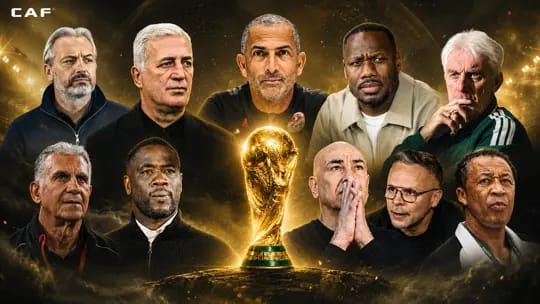

- 2026 FIFA World Cup: The Coaches Driving Africa’s World Cup Dream
Africa’s strongest-ever presence at the FIFA World Cup is not only a celebration of elite talent on the pitch but also a reflection of the tactical brilliance developing on the continent’s sidelines. Ten nations will proudly represent Africa at the global showpiece, each guided by a coach carrying unique ambitions, philosophies and stories.
From seasoned international tacticians to homegrown heroes rewriting football history, these coaches have become central figures in Africa’s rise on the world stage. Several have already lifted continental silverware, while others have rebuilt struggling teams into fearless competitors capable of challenging football’s traditional powers.
A significant feature of this new era is the growing confidence in African coaching expertise, with more than half of the continent’s World Cup representatives led by African-born managers a powerful sign of progress within the game.
Vladimir Petković – Reawakening Algeria’s Fighting Spirit
When Vladimir Petković stepped into the Algeria job, the Desert Foxes were searching for direction after disappointing performances in recent tournaments. The experienced coach immediately focused on restoring order, defensive solidity and confidence within the squad.
Under his leadership, Algeria rediscovered the consistency that once made them one of Africa’s most feared teams. Qualification for the World Cup marked an important turning point, with Petković rebuilding belief around a talented but previously underperforming group.
Now, the Algerians face one of the toughest assignments of the tournament in Group J alongside Argentina, Austria and Jordan. Petković will be expected to produce the discipline and resilience that have become trademarks of his side.
Mohamed Ouahbi – Protecting Morocco’s Golden Generation
Replacing a successful era is rarely easy, yet Mohamed Ouahbi has handled the pressure with composure since taking charge of Morocco.
The Atlas Lions have maintained the fearless mentality and tactical organisation that made them global sensations during their historic 2022 World Cup campaign. Ouahbi has also successfully introduced younger players while preserving the identity that turned Morocco into Africa’s benchmark side.
His reign began impressively with a hard-fought draw against Brazil, proving Morocco remain capable of competing with the world’s elite. With Scotland and Haiti still to come in Group C, expectations remain high for another memorable run.
Emerse Faé – The Hero Who Inspired a Miracle
Few stories in African football can rival the rise of Emerse Faé. Thrown into the spotlight during a turbulent AFCON campaign on home soil, Faé masterminded a stunning turnaround that carried Côte d’Ivoire from near elimination to continental champions. That remarkable achievement transformed him into a national icon.
He later guided the Elephants back to the World Cup, becoming the first local coach from Côte d’Ivoire to achieve the feat. His calm leadership and motivational skills have reignited belief throughout the nation.
The Ivorians now prepare for demanding clashes against Germany, Curacao and Ecuador in Group E.
Hossam Hassan – Reviving Egypt’s Winning Mentality
A legendary figure in Egyptian football, Hossam Hassan has brought fresh energy to the Pharaohs.
Egypt’s rich football history has not always translated into success on the world stage, but Hassan is determined to change that narrative. Since taking charge, he has rebuilt the team’s aggressive edge while blending experienced stars with promising young talent.
His approach has restored confidence and competitiveness within the squad as Egypt aim to make a deeper impact internationally. Group G presents another stern examination with Belgium, Iran and New Zealand standing in their path.
Sabri Lamouchi – Bringing Balance Back to Tunisia
Sabri Lamouchi returned to African football with valuable experience already gained from previous World Cup involvement.
The Tunisian side under his guidance has become organised, disciplined and difficult to break down. Lamouchi’s tactical structure has restored stability while helping the Carthage Eagles regain their competitive identity.
Tunisia’s challenge, however, remains enormous. Drawn against the Netherlands, Sweden and Japan in Group F, Lamouchi will need all his experience to guide his side beyond the opening stage.
Hugo Broos – The Architect of South Africa’s Revival
Hugo Broos has once again demonstrated why he remains one of the most respected coaching figures in African football.
After famously guiding Cameroon to AFCON glory in 2017, the Belgian tactician took on the task of rebuilding South Africa. He successfully restored belief in domestic talent and ended Bafana Bafana’s long absence from the World Cup.
Although South Africa opened their campaign with defeat to Mexico, Broos is trusted to inspire a response as his team prepares for crucial matches against South Korea and Czechia. His influence has already transformed the national side into a far more competitive force.
Bubista – Leading Cape Verde’s Remarkable Rise
Bubista has overseen one of the continent’s most inspiring football success stories.
Cape Verde were once viewed as outsiders, but under his leadership the Blue Sharks have evolved into a disciplined and tactically mature team capable of troubling stronger opponents. Guiding the island nation to its first-ever World Cup qualification stands as one of Africa’s greatest recent football achievements.
His impressive work during AFCON 2023, where Cape Verde reached the quarter-finals, further strengthened his reputation. The challenge now becomes navigating a difficult Group H featuring Spain, Uruguay and Saudi Arabia.
Pape Thiaw – Preserving Senegal’s Elite Standards
Replacing a successful coach is never simple, yet Pape Thiaw has ensured Senegal’s progress has not slowed.
The Lions of Teranga remain one of Africa’s strongest and most balanced teams, with Thiaw continuing the winning culture established over recent years. His steady leadership has kept Senegal tactically sharp and highly competitive against top opposition.
Senegal enter the tournament carrying the hopes of many African supporters, though a demanding Group I featuring France, Iraq and Norway will provide an immediate challenge.
Carlos Queiroz – Experience Guiding Ghana’s Ambitions
Few coaches at the World Cup possess the international experience of Carlos Queiroz.
The veteran tactician has managed at multiple World Cups and worked with some of football’s biggest nations and clubs, including Real Madrid, Portugal, Iran and Colombia. His understanding of tournament football is expected to play a key role for Ghana.
Queiroz is also familiar with African football, having previously coached South Africa and later led Egypt to the AFCON 2021 final. Now, he faces another major challenge as he attempts to steer the Black Stars through a difficult group containing England, Croatia and Panama.
Sébastien Desabre – Restoring Hope in DR Congo
Sébastien Desabre has transformed DR Congo into one of Africa’s most exciting football projects.
His greatest achievement came in ending the Leopards’ 52-year absence from the World Cup, a milestone that reignited national pride and excitement. Desabre’s side has become known for adventurous attacking football combined with renewed confidence and energy.
As DR Congo prepare to face Portugal, Uzbekistan and Colombia in Group K, hopes are growing that the Leopards can continue their impressive resurgence on football’s biggest stage.

