
- Bank of Ghana Withdraws GH¢28.24bn From Market Through 14-Day Bills
The Bank of Ghana sold GH¢28.24 billion through its latest 14-day bill auction, as short-term liquidity management operations continued to absorb funds from the banking system.
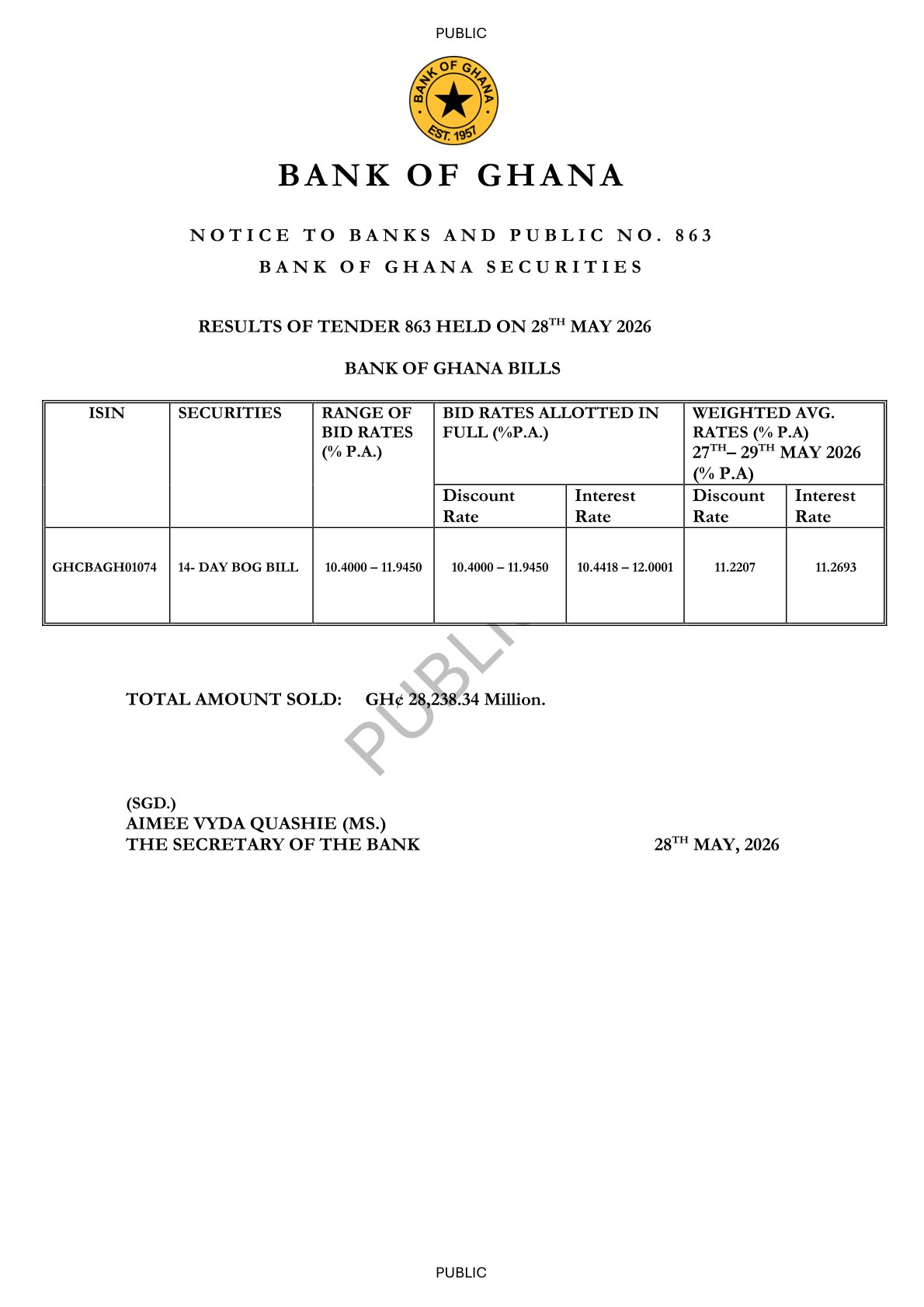
According to the results of Tender 863, held on May 28, 2026, the central bank issued 14-day Bank of Ghana bills under ISIN GHCBAGH01074, with total amount sold reaching GH¢28,238.34 million.
The auction recorded bid rates ranging from 10.4000 per cent to 11.9450 per cent, with all allotted bid rates falling within the same range.
The weighted average discount rate for the period May 27 to May 29, 2026 stood at 11.2207 per cent, while the weighted average interest rate was 11.2693 per cent.
The latest outcome points to continued active use of Bank of Ghana bills as a liquidity management instrument, particularly at a time when the central bank is seeking to preserve disinflation gains and maintain stability in short-term money market conditions.
The 14-day bill remains a key open market operation tool used by the central bank to manage excess liquidity and influence short-term interest rate dynamics within the banking sector.
The GH¢28.24 billion sale also reflects the scale of liquidity being sterilised through short-dated central bank securities, even as broader market rates have eased sharply from levels seen during Ghana’s debt and inflation crisis.
For banks and institutional investors, the instrument provides a short-term placement option with relatively low duration risk, while for the central bank, it supports monetary policy transmission and helps manage liquidity pressures that could otherwise affect inflation and exchange rate expectations.
The auction result also suggests that market appetite for short-dated Bank of Ghana securities remains strong, supported by improved confidence in the macroeconomic environment and continued demand for low-risk liquidity management instruments.
However, the size of the sale will keep attention on the cost of sterilisation and the broader implications for central bank profitability, especially after recent debates over the Bank of Ghana’s financial statements and the fiscal cost of liquidity absorption.
For policymakers, the challenge remains balancing price stability with the cost of mopping up liquidity.
The latest auction shows that the central bank is still relying heavily on short-term instruments to manage banking system liquidity — a strategy that supports macroeconomic stability, but one that must be carefully managed to avoid creating excessive quasi-fiscal costs.
Overall, Tender 863 confirms that the Bank of Ghana remains active in the short-term money market, with the latest GH¢28.24 billion operation underscoring the continuing importance of liquidity sterilisation in Ghana’s post-stabilisation monetary policy environment.