


- TCDA Signs MoU With Russia’s Golden Forest in $5.5bn Value Capture to Deepen Ghana’s Shea Processing
Ghana is moving to capture a larger share of the global shea market after the Tree Crops Development Authority signed a Memorandum of Understanding with Golden Forest Limited, a subsidiary of Russia’s EFKO Group of Companies, to strengthen local processing, research, reforestation and women-led production systems.
The agreement, signed in Accra, is aimed at restructuring Ghana’s downstream shea industry by injecting capital, refining technology and ecological support into a sector long constrained by raw commodity exports and limited domestic value addition.
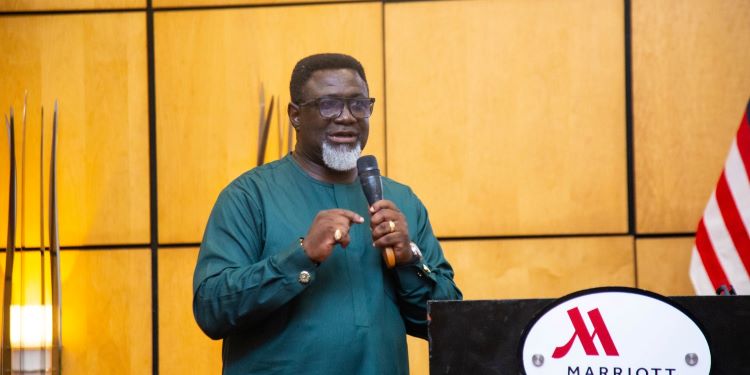
The MoU was signed by the Chief Executive Officer of the Tree Crops Development Authority, Dr Andy Osei Okrah, and the Chief Executive Officer of Golden Forest Limited, Timur Bakusev. The signing was witnessed by Dr Natalia Muzhennikova, Counsellor at the Embassy of the Russian Federation in Ghana.
“The partnership represents a significant step toward our collective efforts to transform the shea value chain that delivers greater value to all actors, especially the rural women who form the backbone of the industry,” Dr Okrah said.
According to the TCDA, the partnership will focus on four critical areas: large-scale investment in processing infrastructure, local scientific research, shea parkland reforestation and the formal organisation of rural women’s production cooperatives.
The deal comes as the global market for shea and its derivatives continues to expand, driven largely by demand from cosmetics, confectionery and pharmaceutical industries. The market is currently valued at about $2.75 billion, with projections suggesting it could exceed $5.5 billion in the coming years.
Despite West Africa producing the overwhelming majority of raw shea nuts, the most profitable stages of the value chain including refining, fractionation and final product manufacturing have historically been concentrated in Europe and Asia.
That structure has left producer economies exposed to raw commodity price swings while limiting foreign exchange earnings, tax revenues, industrial jobs and value retention.
Dr Okrah said the arrangement presents an opportunity for Ghana to reposition itself “not just as a supplier of raw materials but as a competitive player in value addition and industrial processing.”
Under the agreement, Golden Forest and TCDA will jointly support targeted parkland rehabilitation to address the degradation of indigenous shea parklands across northern Ghana’s savanna ecosystem.
The initiative will also support research into tree breeding, seedling cultivation and disease-resistance models aimed at reducing long gestation periods and improving raw nut yields.
The processing component is expected to support direct capital deployment into infrastructure that allows harvested nuts to be crushed, refined and deodorised within local industrial enclaves, rather than exported largely in raw form.
For rural communities, the social dimension of the agreement may prove just as important as the industrial one.
The TCDA has introduced structural reforms including registration and licensing of value chain actors, export permit controls and standardised quality systems to protect rural women collectors from unfair buying cartels.
The Authority is also relying on a state-enforced minimum pricing formula to ensure international processors buy raw materials at a floor price that covers local production costs and supports fair earnings for women in the upstream sector.
Beyond agriculture and processing, the partnership also carries a human capital component. Golden Forest has committed to funding advanced higher education opportunities for young Ghanaian students in tree crop processing, agricultural engineering and biochemistry at leading Russian agricultural universities.
The Russian delegation reportedly indicated that industrial agriculture, technology sharing and infrastructure investment will feature prominently at the upcoming Third Russia-Africa Summit scheduled for Moscow in October 2026.
For Ghana, the agreement reflects a broader policy ambition: to move beyond raw commodity exports and retain greater value from the country’s natural resource and agricultural base.
The shea sector is particularly strategic because of its strong connection to rural women, northern livelihoods, cosmetics exports and agro-processing potential.
If implemented effectively, the MoU could help Ghana shift from being a supplier of raw shea nuts to a processor of higher-value shea derivatives for global markets.
The country’s history of value-addition ambitions shows that investment announcements alone do not transform commodity sectors. Ghana will need functioning processing plants, predictable supply chains, quality control systems, reliable energy, export market access and transparent community benefit structures.
The Ghana-Russia shea MoU therefore represents an important opening. The harder task will be converting diplomatic and commercial commitments into factories, jobs, higher farmer incomes and a larger share of the $5.5 billion global shea value chain.

