


- Beneficial Ownership Rules Alone Cannot Dismantle Illegal Mining Networks — NRGI
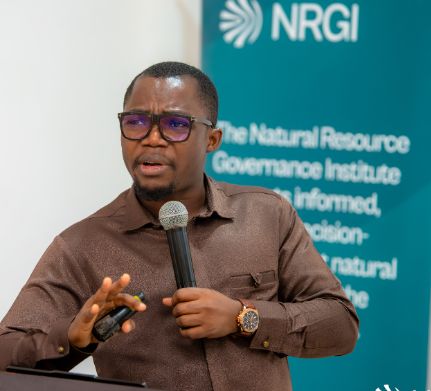
Ghana must move beyond arrests at illegal mining sites and build an integrated system capable of tracing the money, machinery and gold markets that sustain the industry, according to Patrick Stephenson, Ghana’s Country Manager of the Natural Resource Governance Institute.
Mr Stephenson said the country had made progress in establishing a beneficial ownership regime, but warned that corporate records alone would not expose the financiers, equipment owners, traders and politically connected interests that may sit behind illegal and unregulated mining operations.
He argued that the authorities required “complete visibility” across the mining value chain, from the importation and financing of excavators to the purchase, aggregation, processing and export of gold.
Speaking during a NorvanReports discussion on the theme “Beyond Wontumi’s Conviction: Can Ghana Dismantle the Political, Financial and Corporate Networks Behind Illegal Mining?”, Mr Stephenson said Ghana’s legal framework had created an important basis for identifying the real owners and controllers of companies.
The Companies Act, 2019 (Act 992), requires companies to disclose beneficial owners, including individuals who exercise significant ownership, influence or control even where their names do not appear publicly as directors or shareholders.
The framework is particularly relevant to mining, where corporate structures, nominee arrangements and related companies may be used to obscure the individuals who ultimately control concessions, provide financing or benefit from mineral exports.
Mr Stephenson said Ghana’s beneficial ownership disclosure threshold in the extractive sector was about 5.00%, compared with an international benchmark of roughly 25.00% in several jurisdictions. The lower threshold should, in principle, give regulators greater visibility over individuals with meaningful interests in mining companies.
But he cautioned that the information would remain largely administrative unless it was systematically connected to mining licences, customs declarations, tax records, banking transactions and data held by institutions such as the Minerals Commission.
“Beneficial ownership is important, but it has to be triangulated with financing, licensing, equipment ownership and the movement of gold,” he said.
Such integration, he argued, would allow investigators to determine whether individuals financing machinery or purchasing gold were linked to licensed operators, illegal concessions or companies operating outside the conditions of their permits.
It could also expose discrepancies between the declared capacity of a mining company and the volume or type of equipment deployed at its site.
Small-scale mining in Ghana has become increasingly mechanised, relying on excavators, bulldozers, water pumps, trucks and other heavy machinery. The scale and cost of that equipment raise questions about who provides the capital, particularly where machinery worth substantial sums is found at sites operated by workers with limited financial means.
Mr Stephenson said customs and import records should make it possible to identify who imported the equipment, how it was classified, who purchased it and where it was eventually deployed.
The difficulty, he noted, was that machinery brought into Ghana for road construction, quarrying or other legitimate industrial purposes could later be transferred or leased to illegal mining operators.
A single inspection at the port would therefore be insufficient without a system capable of monitoring subsequent ownership, movement and use.
Mr Stephenson also called for greater scrutiny of the downstream gold market, including the networks of buyers, aggregators, exporters and foreign trading partners that receive Ghanaian gold.
He said authorities should be able to trace gold from its point of production through licensed buyers and exporters to its final destination. A credible traceability system would connect the origin of the gold to the producer’s licence, the identity of the buyer, the transaction value and the exporter.
Such a system could help regulators identify gold entering the formal market from illegal sources and determine whether licensed traders were purchasing from unregistered or environmentally destructive operations.
Mr Stephenson acknowledged reforms introduced by the Ghana Gold Board to strengthen oversight of the gold trade, but said recent directives suggested continuing weaknesses in pricing, documentation and the timing of recorded purchases.
Businesses, he warned, often adapt quickly to new regulations where strong financial incentives exist to exploit loopholes.
“A policymaker cannot go to sleep after introducing a new system,” he said, adding that regulations must be continuously monitored and adjusted as market participants change their methods.
He also urged the government to examine whether tax incentives and import exemptions intended to support legitimate industry were inadvertently lowering the operating cost of illegal mining.
Along the Takoradi-Tarkwa corridor, he said, local artisans manufacture, repair and maintain “chamfan” machines commonly used in river-based mining. Although security agencies often seize or destroy the machines, they can be reconstructed within weeks using locally fabricated components and imported spare parts.
Some replacement parts may enter the country under tax exemptions or reduced duties intended for industrial machinery, creating what Mr Stephenson described as a policy contradiction: the state may destroy illegal mining equipment while indirectly subsidising its reconstruction through poorly monitored incentives.
That dynamic, he said, illustrated why enforcement must extend beyond the mine site to the businesses that import equipment, supply parts, provide maintenance, transport machinery and finance operations.
Without that wider view, security interventions may temporarily interrupt illegal mining without dismantling the commercial system that enables operators to return.
Mr Stephenson also warned that Ghana should apply the lessons from failures in gold-sector regulation to emerging minerals such as lithium.
The expansion of lithium and other transition-mineral industries could generate new environmental, licensing and corruption risks if governance systems were not strengthened before production increased.
He pointed to experiences in countries including Zimbabwe, where small-scale lithium mining had raised concerns about smuggling, environmental degradation and politically connected actors.
Ghana should therefore conduct a comprehensive corruption-risk assessment covering concession allocation, beneficial ownership, machinery imports, financing, spare-parts supply, mining operations, gold purchasing, aggregation and exports.
Banks, private lenders and informal financiers should also form part of the scrutiny. Transactions involving heavy machinery, large fuel purchases and significant gold payments could provide useful indicators where activity appeared inconsistent with the declared operations of a company or individual.
Mr Stephenson said the objective should be to create a system in which corporate, customs, financial and regulatory information could be cross-checked rather than held in separate institutional silos.
Where the same individual finances machinery, controls a concession, purchases gold and appears in the ownership structure of a related company, investigators should be able to identify those connections.
Without such integration, beneficial ownership disclosure risks becoming little more than a filing requirement. With it, Ghana could begin targeting not only the workers found at illegal mining sites, but also the investors, equipment owners, traders and corporate actors who profit from the industry.

