


- BRICS Finance Chiefs Push IMF, World Bank Reform as Emerging Economies Demand Greater Voice
BRICS finance ministers and central bank governors have intensified calls for reform of the International Monetary Fund and World Bank, arguing that the growing contribution of emerging and developing economies to global output and economic growth should be matched by greater representation within the institutions that shape the international financial system.
In a joint statement issued ahead of the BRICS Leaders’ Summit in New Delhi, the group said reform of global economic governance remained a longstanding priority and pledged to strengthen coordination among member countries to make international financial institutions more representative, transparent and accountable.
The intervention adds momentum to a long-running debate over whether the governance structures of the Bretton Woods institutions adequately reflect changes in the global economy, where emerging markets have become increasingly important contributors to growth, trade, investment and commodity demand.
“With the growing share of emerging market and developing economies in global output and growth, reform of global economic governance remains a consistent BRICS priority,” the finance chiefs said.
The statement places institutional reform at the centre of a wider BRICS agenda that increasingly combines demands for greater representation in international bodies with efforts to develop alternative channels for trade, payments and financial cooperation among emerging economies.
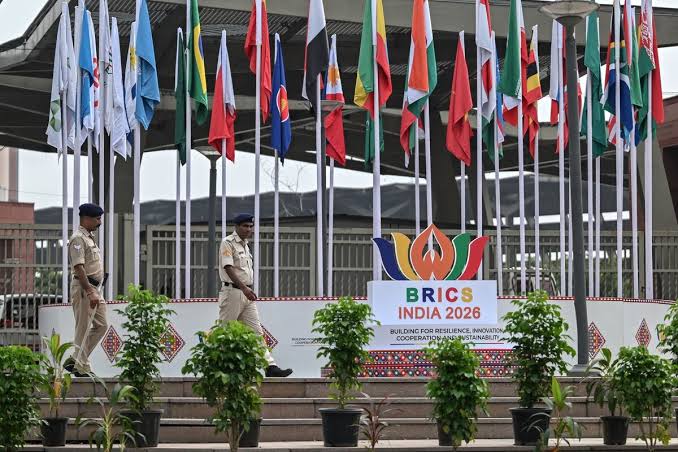
India is hosting the BRICS Leaders’ Summit in New Delhi, with leaders from Russia, China and Iran among those expected to participate. The meeting comes against a strained global economic and geopolitical backdrop, including the conflict involving the United States, Israel and Iran and renewed volatility in international trade.
The resulting rise in oil prices has added pressure on emerging economies already contending with uncertainty created by shifting tariff policies, according to Reuters.
BRICS finance chiefs used their statement to criticise unilateral trade and finance-related measures, including tariffs and non-tariff barriers that they said distort international commerce and run contrary to World Trade Organisation rules.
The criticism points to concerns among emerging economies that rising protectionism could complicate efforts to sustain investment, manage inflation and maintain external stability at a time when geopolitical tensions are already reshaping global supply chains.
For commodity-importing developing countries in particular, higher energy costs can feed directly into inflation, fiscal pressures and foreign-exchange demand. At the same time, abrupt tariff changes can alter export competitiveness and investment decisions, adding another layer of uncertainty for economies already exposed to changes in global financial conditions.
The BRICS position therefore links institutional reform with a broader argument that emerging economies should have greater influence over the rules and institutions governing international finance and trade.
The IMF and World Bank sit at the centre of that architecture. The IMF provides surveillance, balance-of-payments financing and policy support to member countries, while the World Bank Group is one of the largest sources of development finance for emerging and developing economies.
For BRICS, the question is increasingly whether the voting influence, governance arrangements and decision-making structures of those institutions have evolved sufficiently to reflect the rising economic weight of countries outside the traditional advanced-economy centres of power.
The finance chiefs said they would continue coordinating to make international financial institutions “more representative, transparent and accountable”, signalling that the campaign for governance reform is likely to remain a recurring feature of the bloc’s engagement with the existing multilateral system.
Alongside institutional reform, BRICS is also accelerating work on cross-border payment infrastructure.
Finance ministers and central bank governors acknowledged progress made by the BRICS Payment Task Force but called for greater interoperability between the payment systems of member countries.
They encouraged the task force to pursue practical arrangements that would allow cross-border transactions among BRICS economies to become faster, cheaper, more accessible, efficient, transparent and secure.
The issue has grown in importance as governments around the world seek to modernise payment architecture and reduce the cost and complexity of transferring money between jurisdictions.
Improved payment-system interoperability could potentially lower transaction costs for businesses trading across BRICS markets while reducing settlement friction for consumers and financial institutions.
It could also provide member states with greater flexibility in conducting transactions through their own national payment infrastructure rather than depending exclusively on established international systems.
India is separately expected to push for progress on linking digital currencies across BRICS economies, according to two people familiar with the discussions cited by Reuters.
Any move towards greater connectivity between digital currencies would add another dimension to BRICS efforts to strengthen financial links among its members, although Reuters reported no final framework or implementation timetable.
The payments discussion also illustrates how BRICS’ reform agenda increasingly operates on two tracks.
On one side, the bloc is seeking greater influence within existing international institutions such as the IMF and World Bank. On the other, members are developing mechanisms for deeper financial cooperation among themselves, particularly in payments and settlement infrastructure.
That dual approach stops short, on the evidence contained in the joint statement reported by Reuters, of abandoning existing global institutions. Instead, BRICS is pressing for those institutions to become more reflective of the changing distribution of economic power while simultaneously strengthening financial links within the grouping.
The demands come as the expanded BRICS bloc seeks to translate its growing economic and geopolitical weight into greater influence over international economic governance.
Whether that pressure results in significant changes to the IMF, World Bank or broader financial architecture will depend not only on agreement among BRICS members but also on negotiations with the advanced economies that retain substantial influence within existing institutions.
But the direction of the debate is increasingly clear. For BRICS finance chiefs, the growing role of emerging markets in the world economy strengthens the case for a corresponding shift in who has influence over global financial decision-making.
As leaders gather in New Delhi, reform of the IMF and World Bank, resistance to unilateral trade measures and the development of cheaper cross-border payment systems are converging into a wider BRICS argument: that an increasingly multipolar global economy requires institutions and financial infrastructure that distribute influence more broadly than the system that preceded it.

