


- Camelot Ghana Revenue Rises 31.50% To GH¢36.97m As Flexo Business Powers Diversification
Camelot Ghana Plc is accelerating its transition from traditional security printing towards flexographic printing and technology-enabled solutions after revenue increased 31.50% to GH¢36.97 million in 2025, as the Ghana Stock Exchange-listed company seeks new growth engines around a business with more than four decades of operating history.
Revenue rose from GH¢28.11 million in 2024 and has now almost tripled from GH¢13.41 million in 2022. Profit after tax increased 27.00% to GH¢3.26 million from GH¢2.56 million, while total equity strengthened to GH¢6.83 million from GH¢4.03 million.
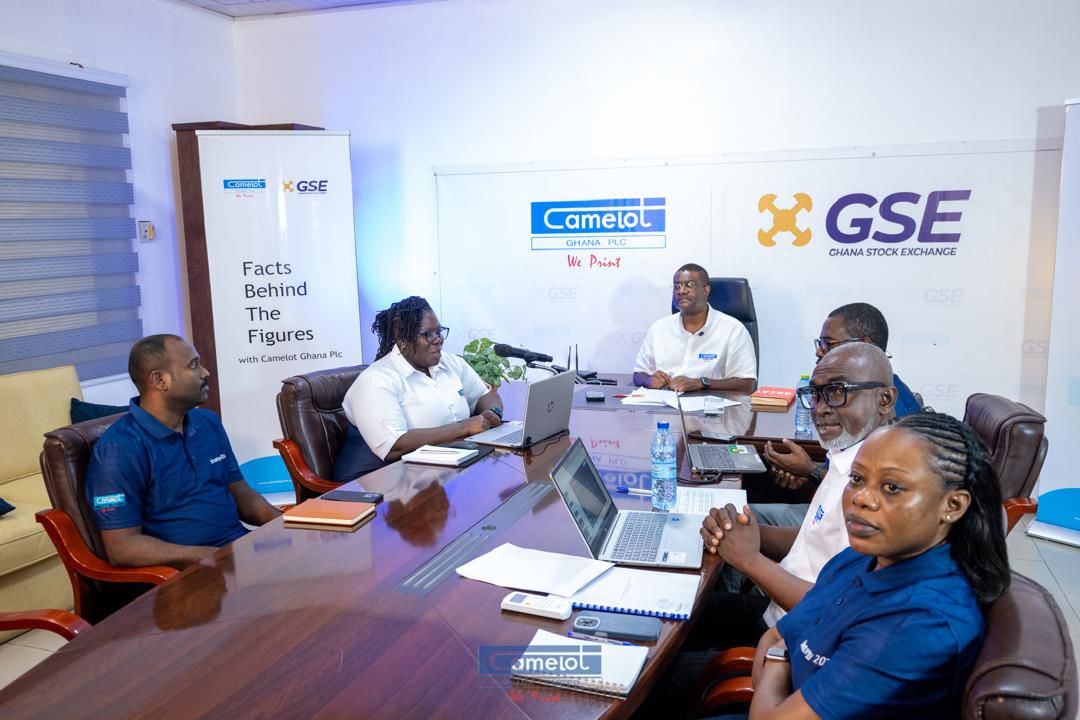
Management used its “Facts Behind the Figures” engagement with the Ghana Stock Exchange on Friday to present the performance as evidence of a wider transformation rather than simply stronger demand for conventional printing products.
“Facts Behind the Figures is about giving the market a transparent, evidence-based view of who we are and where we are going — not just the numbers, but the reasoning behind them,” Managing Director John Villars said.
“Our growth has been broad-based, our people metrics stand up against real industry benchmarks, and we are building sustainability into how we source and produce rather than treating it as an afterthought.”
At the centre of Camelot’s changing business model is flexographic printing, or Flexo, which management said has expanded 321.00% cumulatively since 2022.
The segment now accounts for about 34.00% of revenue, compared with 23.00% four years ago, reducing the company’s historic dependence on cheque books and other security documents while increasing its exposure to labels and packaging-related demand.
That shift is strategically important as digital payments and financial technology continue to alter the economics of traditional paper-based financial instruments.
Camelot’s figures, however, suggest diversification is so far complementing rather than replacing its established businesses.
Cheque-related revenue has increased every year since 2022 and is up 140.00% cumulatively, although its share of total revenue has declined because Flexo has expanded faster. Traditional printing, the smallest of Camelot’s three principal business lines, has also recorded cumulative growth of 102.00% over the period.
Camelot recorded an after-tax loss of GH¢1.38 million in 2022 before returning to profitability with GH¢2.16 million in 2023 and GH¢2.56 million in 2024.
The turnaround has continued into 2026, although revenue growth is moderating as the company expands from a larger base.
Turnover for the first six months of 2026 reached GH¢21.40 million, about 9.00% higher than the GH¢19.57 million recorded in the corresponding period of 2025.
Profit after tax increased 19.00% to GH¢2.61 million, while gross profit rose to GH¢10.40 million from GH¢9.33 million.
Gross margin improved to approximately 48.60% from 47.60%, suggesting that earnings are currently expanding faster than revenue.
For investors, that development may prove more significant than top-line growth alone because it indicates Camelot is extracting more profit from each cedi of sales as its business mix evolves.
The company’s balance sheet has also strengthened, with shareholders’ funds recovering from a negative position in 2022 to GH¢6.83 million by the end of 2025.
That gives management greater financial flexibility as it considers additional investment in production capacity and technology.
Inventories increased to GH¢9.54 million in 2025 from GH¢5.89 million, while trade and other receivables rose to GH¢7.31 million from GH¢6.39 million.
Cash and cash equivalents declined to GH¢963,913 from GH¢1.93 million.
For a manufacturing company exposed to imported inputs and customer payment cycles, converting accounting profits into sustained operating cash will therefore remain important as production expands.
Camelot is also bringing environmental sustainability more directly into its investment agenda. Management said it plans to shift cheque and certificate production towards Forest Stewardship Council-certified and recycled-content paper, increase the use of low-VOC and water-based inks, and monitor energy consumption across Flexo production.
The company is also developing a formal sustainability policy and reporting structure aligned with Ghana Stock Exchange disclosure requirements, while supplier certification mapping and audits of ink use and energy consumption are under way.
Such measures could become increasingly important as banks, multinational companies and other corporate customers embed environmental requirements into procurement decisions.
Human capital is also emerging as part of Camelot’s investor proposition. The company reported an employee retention rate of 99.00%, compared with a manufacturing-sector benchmark of about 72.00%–74.00%, while retention among critical and skilled workers stands at 95.00%.
Camelot said it invests the equivalent of 5.00% of revenue in learning and development, compared with a 2.90% cross-industry reference point.
Women account for 45.00% of its workforce, although female representation at management level stands at 27.27%, below the company’s 30.00% target.
The next phase of Camelot’s strategy will test whether its financial recovery can be converted into durable growth.
Management has identified expansion of Flexo capacity, further diversification into digital printing, the internal deployment of artificial intelligence, development of AI-enabled solutions for the printing industry, pursuit of state-sector contracts, stronger market research and continued staff development as key priorities.
Camelot traces its history to founder Elizabeth Joyce Villars, Ghana’s first qualified female computer programmer, who developed billing and payroll software for major institutions, including the Volta River Authority, before establishing the businesses that eventually became Camelot.
More than four decades later, the company is confronting another technological shift. Its challenge is no longer simply to print more. It is to determine how Flexo, digital production, verification technology, artificial intelligence and sustainability standards can extend the relevance of a traditional security-printing business as payments, packaging and authentication markets evolve.
Whether Camelot can sustain margins, strengthen cash generation and successfully scale its newer business lines will determine whether the recent recovery becomes the foundation for its next phase as a listed Ghanaian manufacturer.

