

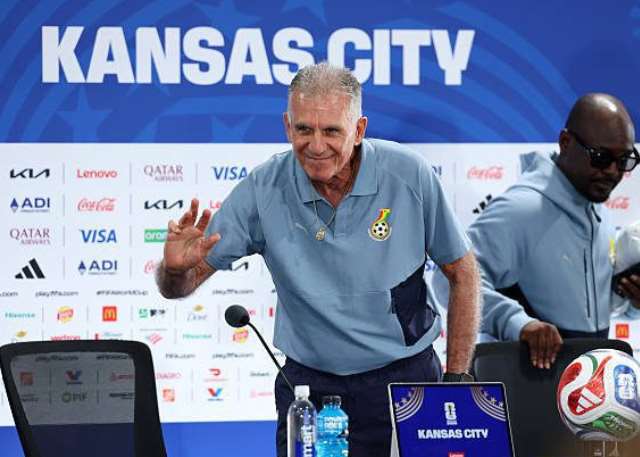

- Carlos Queiroz Leaves Ghana with One Final Warning: Talent Is Not a Football Plan
Carlos Queiroz has left the Black Stars job the same way he entered it: with Ghana football standing at a crossroads, full of promise, heavy with expectation, but still searching for the structures that turn talent into sustained success.
His farewell, delivered after Ghana’s 1-0 defeat to Colombia in the Round of 32 at the 2026 FIFA World Cup, was not merely a resignation note. It was a diagnosis. It was also a warning.
The Portuguese coach, who took charge of Ghana in April 2026 after Otto Addo’s departure, leaves after barely three months in the role. In that short period, he guided the Black Stars through a difficult World Cup campaign, beating Panama, drawing with England, losing to Croatia and then exiting against Colombia in the first knockout round.
On paper, that record will divide opinion. For some, Ghana restored a measure of respect by escaping Group L as one of the best third-placed teams. For others, a Round of 32 exit, especially after a performance against Colombia that produced more frustration than conviction, cannot be dressed up as success.
Queiroz himself seemed to understand both sides of that argument. In his farewell message, he said he was leaving with pride in what had been achieved, but also with what he called the “healthy dissatisfaction” of someone who wanted more. He insisted that reaching a higher level should not be the destination but the beginning of even greater ambition.
That sentence matters because it cuts through one of Ghana football’s most persistent weaknesses: the temptation to confuse moments with systems.
Ghana has never lacked football talent. It has produced technically gifted players, physically imposing competitors, intelligent midfielders, fearless defenders and forwards capable of shining on major stages. From Abedi Pele to Michael Essien, Stephen Appiah, Asamoah Gyan and the newer generation now carrying the shirt, the country has always had individuals capable of giving the Black Stars global relevance.
But modern international football is no longer won by talent alone. It is won by preparation, data, player conditioning, tactical continuity, elite scouting, strong youth development, sports science, psychology, medical planning, logistics and administrative seriousness. It is won by nations that treat football as a system, not a series of emotional rescue missions.
That is the deeper point in Queiroz’s farewell. He said the future of the Black Stars would not be built only on the pitch, but by creating the best possible environment to prepare, protect and develop Ghana’s extraordinary football talent.
It is a polite sentence, but its meaning is hard. Ghana cannot keep expecting players to rescue structural weaknesses with patriotism.
The Colombia defeat exposed that truth painfully. Ghana conceded early after an injury forced a defensive adjustment, and the team never fully imposed itself on the contest. Queiroz is said to have later blamed the elimination partly on a lack of maturity, saying some players were not “cool, calm and collected” when pressure arrived.
That should not be read only as criticism of the players. It should be read as criticism of the environment that shaped them.
Maturity in tournament football is not created in press conferences. It is built through repeated exposure to pressure, coherent tactical education, stable coaching, consistent selection principles and strong leadership structures. Young players do not become tournament-ready simply because they are talented or because the national anthem is playing.
Queiroz’s appointment itself revealed the familiar disorder. He was hired just 72 days before the tournament, replacing Otto Addo at a time when most serious World Cup teams would already have settled their tactical identity, squad hierarchy and tournament plans.
That was always going to be a difficult assignment. Queiroz brought experience, discipline and World Cup knowledge. He had managed at multiple tournaments and understood the language of international football pressure. But no coach, however decorated, can compress years of planning into a few weeks and expect a polished national team to emerge.
This is where Ghana must be honest. The problem is not only who coaches the Black Stars. The problem is the pattern that keeps making the coaching position unstable, reactive and politically charged.
Every tournament disappointment is followed by the same cycle: public anger, technical review, administrative promises, new appointment, short honeymoon, another tournament, another disappointment. The names change. The structure does not.
Queiroz has now become the latest figure to pass through that revolving door.
His exit should therefore not be treated simply as another coaching change. It should be treated as a moment to ask whether Ghana knows what kind of national team it wants to build.
Does Ghana want a pressing team? A transition team? A possession-based team? A physically aggressive tournament team? A side built around diaspora talent? A side anchored in domestic football development? A hybrid model? Where is the documented technical philosophy that runs from under-15 football to the Black Stars? Who owns it? Who protects it when coaches change?
These questions may sound administrative, but they are football questions. Countries that succeed consistently do not rebuild from scratch every two years. They build continuity beneath the surface, so that when one coach leaves, the national project does not collapse with him.
Ghana’s football authorities now have a choice. They can reduce Queiroz’s departure to a personnel matter, thank him for his service and start another search. Or they can listen carefully to the message he left behind.
His words about preparation, protection and development should force a broader conversation about player pathways, technical planning, sports science, analytics, local league competitiveness and national-team logistics.
The Black Stars also need a clearer emotional culture. Ghana teams often play with energy and pride, but tournament football demands more than emotion. It demands controlled aggression, tactical patience and decision-making under stress. Against Colombia, Ghana had effort. What it lacked was authority.
That is where leadership matters. The next phase of the Black Stars project must identify not only talented players, but footballers capable of carrying responsibility. Ghana needs players who can manage difficult phases of games, slow things down when required, lift younger teammates, challenge standards in camp and understand that international football is as much mental as technical.
The next coach must also be appointed with a long-term mandate and a clearly defined structure. Ghana cannot afford another appointment that feels like a last-minute tournament intervention. The new technical team must be given enough time, meaningful friendlies, proper opposition analysis and institutional support to build something durable.
Queiroz’s farewell also contains a challenge to supporters. He thanked Ghanaians and said the team had honoured the colours of Ghana and restored respect and credibility to the Black Stars on football’s greatest stage.
That statement may be debated, but it points to a truth: rebuilding requires patience. Not blind patience, and certainly not patience without accountability. But patience tied to a visible plan.
Ghanaians are right to demand more from the Black Stars. This is a country with football pedigree, continental history and global recognition. But the demand for excellence must be matched by a demand for systems. Anger after elimination is easy. Building a national football architecture is harder.
Queiroz leaves with no trophy, no deep World Cup run and no fairytale ending. But perhaps his most important contribution may be the final message he leaves behind.
Talent is not enough. Passion is not enough. History is not enough. Even a respected foreign coach is not enough.
The Black Stars need a football ecosystem serious enough to match the dreams placed on the team. That means better planning, deeper development, stronger leadership and a national commitment to building beyond tournament emotion.
Carlos Queiroz has gone. The question now is whether Ghana will simply replace him, or finally confront the uncomfortable truth his exit has exposed.
The Black Stars do not only need a new coach. They need a new way of thinking.

