


- Cocoa Pricing Reform: Ghana and Côte d’Ivoire Target Stronger Farmer Incomes and Market Power
Ghana and Côte d’Ivoire have agreed to harmonise their cocoa farm-gate pricing policies in a major step aimed at improving farmer incomes, reducing market distortions and strengthening the bargaining power of the world’s two largest cocoa-producing countries.
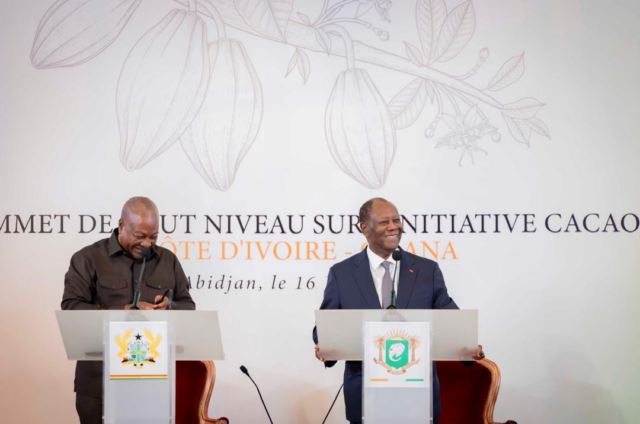
The agreement was announced in a joint declaration issued by President John Dramani Mahama and President Alassane Ouattara after the Côte d’Ivoire-Ghana High-Level Summit on the Future of the Cocoa Economy held in Abidjan.
Together, Ghana and Côte d’Ivoire account for about 60.00% of global cocoa production, making their policy coordination central to the future of the international cocoa market.
The move to align farm-gate prices marks one of the clearest attempts yet by both countries to use their combined production weight to address a long-standing imbalance in the cocoa value chain: farmers grow the crop, but often capture only a small fraction of the final value.
Under the agreement, both countries pledged to coordinate farm-gate pricing policies to enhance producer earnings and reduce distortions created when one country’s producer price differs significantly from the other.
The initiative will also involve closer market coordination, alignment of cocoa premiums and harmonisation of crop-season calendars.
These measures are expected to help curb cross-border smuggling, which often rises when price differences between Ghana and Côte d’Ivoire become wide enough to create arbitrage opportunities.
For years, cocoa smuggling has been a recurring challenge in both countries. When one country offers a higher producer price, beans may be illegally moved across the border, affecting official purchases, export volumes and revenue projections.
By aligning pricing policies more closely, Ghana and Côte d’Ivoire hope to reduce this incentive and bring greater stability to the cocoa trade.
The decision also has wider market implications.
If the two countries can coordinate prices, premiums and crop calendars more effectively, they could strengthen their position in negotiations with international buyers, processors and chocolate manufacturers.
The leaders reaffirmed that fair compensation for cocoa farmers remains central to the long-term sustainability of the sector and essential to promoting economic justice and social stability in cocoa-growing communities.
That message is important because cocoa farmers remain vulnerable despite the commodity’s global importance.
While chocolate and cocoa-based products generate significant value internationally, many farmers continue to face low incomes, rising input costs, ageing farms, climate shocks and limited access to finance.
The price harmonisation push therefore reflects a broader political and economic question: how can Africa’s leading cocoa producers secure a fairer share of the value generated from their own crop?
The joint declaration praised progress made under the Côte d’Ivoire-Ghana Cocoa Initiative, especially the implementation of the Living Income Differential, efforts to coordinate price announcements, and cooperation on cocoa traceability and sustainability standards.
The Living Income Differential was introduced to secure an additional premium for cocoa farmers in Ghana and Côte d’Ivoire. It has been one of the most significant attempts by producing countries to influence pricing in favour of farmers.
However, its implementation has faced challenges, including resistance from some market actors, price volatility and questions over how much of the value actually reaches producers.
The latest agreement suggests both countries want to move beyond symbolic cooperation and deepen practical alignment in areas that directly affect farmer income.
The declaration also acknowledged that the cocoa sector continues to face serious threats.
These include volatile global prices, illegal mining, climate change, the growing use of cocoa substitutes and increasingly strict international sustainability requirements.
In Ghana, illegal mining has become a major threat to cocoa production, with farms and water bodies in some growing areas affected by environmental degradation. The destruction of cocoa farms by mining activities threatens output, farmer livelihoods and the country’s long-term production capacity.
Climate change is another major risk.
Changing rainfall patterns, rising temperatures, disease outbreaks and declining soil fertility are already affecting cocoa yields in parts of West Africa.
If these challenges are not addressed, price reforms alone will not be enough to secure farmer incomes or sustain production.
This is why the agreement also includes scientific cooperation to combat cocoa diseases, particularly the Cocoa Swollen Shoot Virus Disease.
The disease has long been one of the most damaging threats to cocoa farms in Ghana and Côte d’Ivoire, reducing yields and forcing the destruction of infected trees in many areas.
Strengthening joint research, disease surveillance and farm rehabilitation could help protect production and support farmer livelihoods.
Beyond production, both countries also agreed to expand cocoa processing, value addition and local consumption of cocoa products.
This is critical because Ghana and Côte d’Ivoire export large volumes of raw cocoa but capture a smaller share of the downstream value generated from processing, branding and retail chocolate products.
Greater local processing could create jobs, increase export earnings and reduce exposure to raw commodity price volatility.
However, value addition will require investment in processing capacity, affordable energy, logistics, financing, product development and access to international markets.
It will also require policies that encourage local industry without discouraging investment or weakening competitiveness.
The two countries also announced plans to expand the Côte d’Ivoire-Ghana Cocoa Initiative to include other African cocoa-producing nations.
This could mark an important shift in Africa’s approach to global cocoa governance.
If more producing countries align policies, Africa could improve its collective bargaining power and strengthen its voice in setting standards, prices and sustainability rules.
The challenge, however, will be implementation.
Ghana and Côte d’Ivoire have announced several cocoa cooperation initiatives in the past, but the real test has often been whether policy commitments translate into coordinated action.
Aligning farm-gate prices will require technical discipline, fiscal capacity and trust between the two countries.
Both governments must consider exchange rate movements, domestic budget pressures, producer price committees, export contracts and market conditions.
A common direction is possible, but full harmonisation may be difficult if macroeconomic conditions differ significantly.
Still, the political signal is strong.
By committing to price alignment, Ghana and Côte d’Ivoire are telling the global cocoa market that farmer incomes cannot remain a secondary concern.
They are also acknowledging that fragmented national policies weaken their collective influence.
For farmers, the promise is better income and fairer treatment.
For governments, the prize is market stability, reduced smuggling and stronger export value.
For the global cocoa industry, the message is that the two countries that supply most of the world’s cocoa are seeking a stronger voice in how value is shared.
If the agreement is implemented effectively, it could become one of the most important cocoa policy shifts in recent years.
But if it remains only a declaration, farmers may see little change.
The future of the cocoa economy will therefore depend not just on what Ghana and Côte d’Ivoire have agreed in Abidjan, but on whether they can turn coordination into enforceable policy, sustained farmer income gains and a fairer global cocoa trade.

