


- Community Banks to Enter Urban Markets Under New BoG Reform Framework
The Bank of Ghana has announced a major reform of the rural and community banking sector, opening the door for community banks to be established in both rural and urban areas as the country marks 50 years since the creation of its first rural bank.
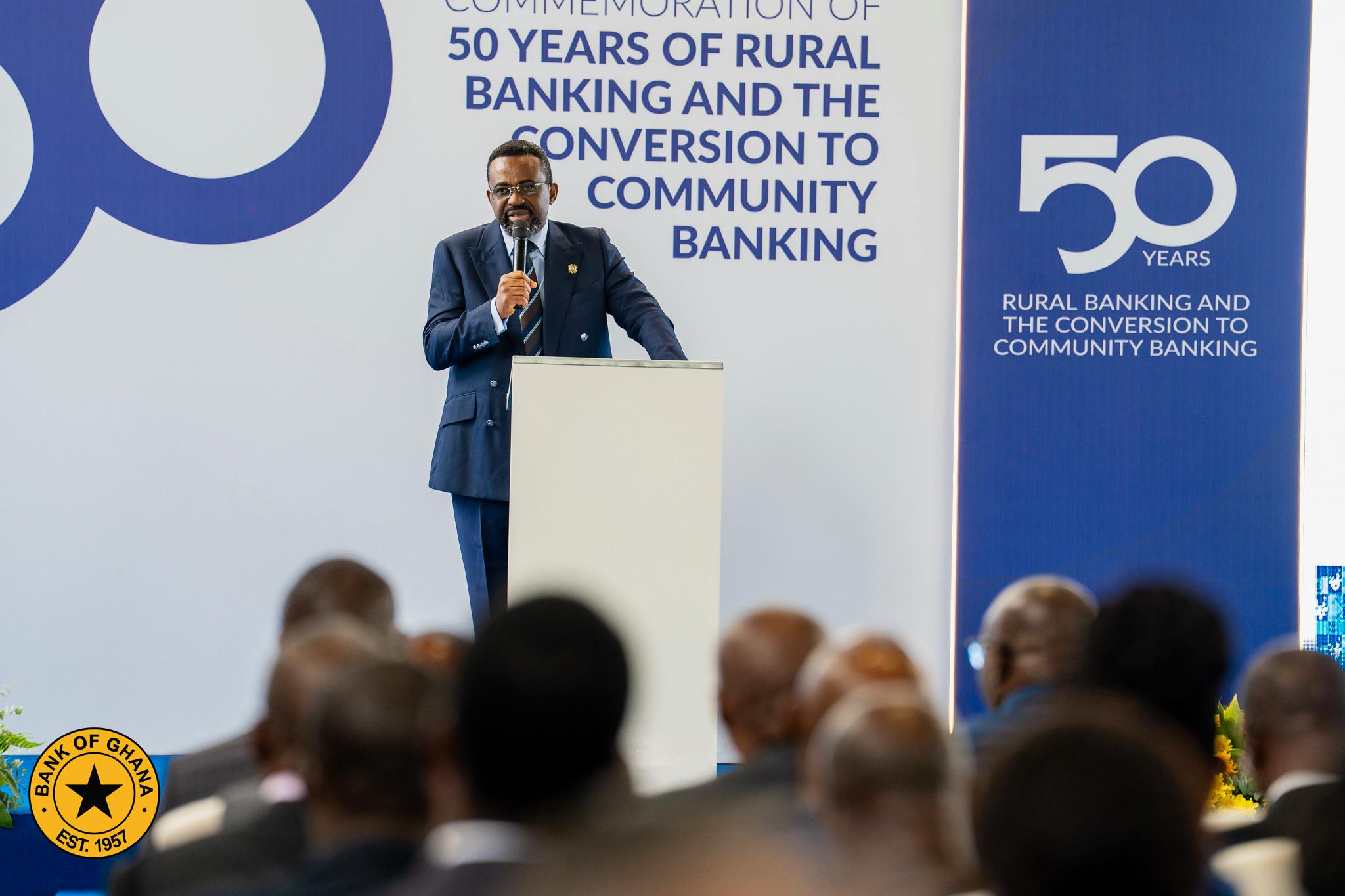
Governor Dr Johnson Pandit Asiama, speaking at the commemoration of 50 years of rural banking and the formal conversion to community banking, said the reform is intended to preserve the original purpose of rural banking while adapting the model to Ghana’s changing economic structure.
The Governor traced the sector’s roots to 1976, when the first rural bank was established at Nyakrom in the Central Region. He said that single community-led decision eventually grew into a network of 147 licensed institutions, about 1,000 branches, more than eight million customers and an asset base of approximately GH¢26.00 billion as at May 2026.
“What began with one bank at Nyakrom is today 147 licensed institutions, about a thousand branches, more than eight million customers, and an asset base of approximately GHS 26 billion as at May 2026,” Dr Asiama said.
He described the original rural banking model as one of Ghana’s most important financial inclusion experiments, created to serve communities that had been excluded from formal banking.
According to him, formal banking in Ghana had historically served colonial administration, merchants, commercial finance and development institutions, but did not adequately reach ordinary villages, farmers, traders and small businesses.
“A farmer could grow the crop that earned this country its foreign exchange and live a day’s journey from the nearest counter. A trader could feed a whole town and be invisible to the financial system,” he said.
Dr Asiama said the Rural Banking Programme, established through a partnership between the Government of Ghana and the Bank of Ghana, did not merely seek to send banks into underserved areas. It sought to ensure that communities owned the banks themselves.
He acknowledged the role of the late Governor Amon Nikoi and other key figures such as Mr Emmanuel Asiedu-Mantey in laying the foundations for community-based banking. Within a year of the Nyakrom Rural Bank launch, three more banks were licensed at Biriwa, Afosu and Asiama.
The Governor said the sector had helped communities to bank, financed farms and small businesses, supported household savings and enabled the Akuafo Cheque Scheme in the 1980s by helping cocoa farmers turn cheques into cash.
But he also cautioned that the anniversary must not romanticise the past. Not every rural bank survived, and not all were well governed.
“When one failed, the loss was not recorded in a supervisory return and forgotten. It was recorded in a community: in its savings, in its confidence, and in the faith it had placed in an institution carrying its own name,” he said.
Dr Asiama said that experience explains the need for reforms. He argued that the idea behind rural banking was right, but the framework around it must now be strong enough to support the next phase of growth.
The first reform is the shift in name from rural banking to community banking. The Governor said Ghana has changed significantly since 1976, with many areas formerly classified as rural now becoming towns, commercial centres and peri-urban economies.
“Community is the truer word, because it describes what these institutions are for rather than where they happen to sit,” he said.
He noted that the Bank of Ghana licensed the first community bank, La Community Bank, in 1987, with 10 more licensed since. He also disclosed that the central bank had begun considering a full sector transition as far back as 1995, although circumstances did not permit it at the time.
The second and more substantive reform is the introduction of urban community banking. Dr Asiama said exclusion has changed in character. In the past, many communities were excluded because they were physically distant from banks. Today, people may live close to bank branches but still lack access to the financial services they need.
“Being near a bank is not the same as being served by one,” he said.
The Governor acknowledged the role of mobile money, fintech and digital services in expanding access, but said access alone does not amount to full financial service.
“Mobile money, fintech and digital services have widened access enormously, and we should say so. But access is not the same as service,” he said.
He added that Ghana should not be surprised to see institutions such as East Legon Community Bank, Cantonments Community Bank or Airport Hills Community Bank emerge under the new framework.
“No, East Legon is not short of bank branches. It is short of banks that will lend to the woman who trades there, the artisan who works there, and the young business that has just opened its doors there,” he said.
The third reform concerns governance and prudential standards. Dr Asiama said community ownership must not become an excuse for weak governance, poor risk management or financial indiscipline.
“Community ownership cannot mean weaker governance. Local knowledge is not a substitute for risk management. And social purpose does not excuse financial indiscipline,” he warned.
He said community banks must be locally rooted but professionally managed, inclusive in purpose but prudent in operation, ambitious in reach but careful with depositors’ money.
The Bank of Ghana has directed existing banks to complete their statutory name changes, corporate rebranding and other regulatory alignments by the end of December 2026. The transition will be supported by prudential regulation and supervision to ensure that institutions live up to the new name.
Dr Asiama said a resilient financial system cannot rest on only a small number of large institutions, adding that depth in the financial sector is not only about size but also about spread.
The reform therefore opens a pathway for community banks to broaden their services, compete more effectively and, for the strongest among them, grow into nationally significant institutions over time.
For the sector, the message is clear. The next 50 years will require stronger governance, better risk controls, technology adoption and deeper service to communities, whether rural or urban.
But Dr Asiama said some values must remain unchanged.
“The values that carried this sector for fifty years trust, participation, accountability and local development are the values that must carry it for the next fifty. Everything else about your institutions is open to change. Those four values are not,” he said.
The conversion to community banking therefore marks more than a rebrand. It is a regulatory attempt to preserve the local ownership model that made rural banking relevant, while giving it a stronger, broader and more modern framework for Ghana’s next phase of financial inclusion.

