

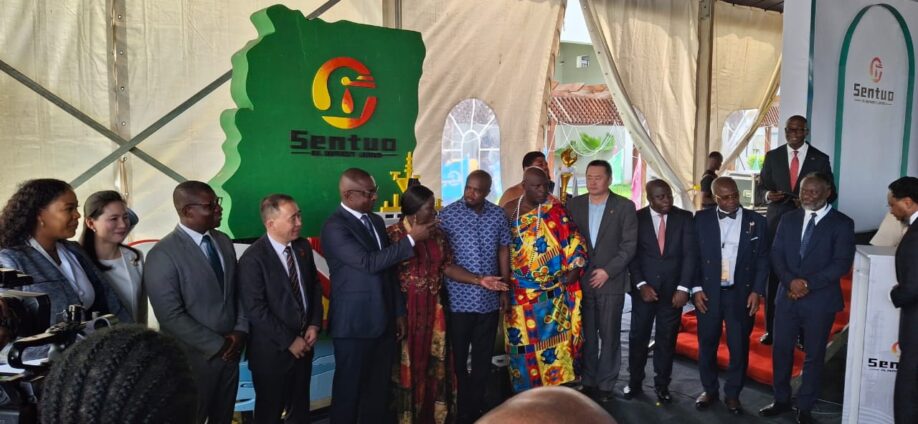

- First Jubilee crude delivery to Sentuo refinery signals Ghana’s push to retain more value
Ghana has taken a significant step towards deepening industrialisation and reducing dependence on imported fuel products after Sentuo Oil Refinery received crude oil from the Jubilee Field for domestic processing for the first time.
The development marks a major shift in Ghana’s petroleum strategy, where crude oil has historically been exported while refined petroleum products are imported back into the country at higher cost.
Speaking at the refinery’s Jubilee Crude Oil Berthing Ceremony in Tema, the Minister for Trade, Agribusiness and Industry, Elizabeth Ofosu-Adjare, described the development as a major milestone in Ghana’s industrial transformation agenda and a key pillar in the government’s broader economic reset strategy.
“For the first time in Ghana’s history, crude oil from the Jubilee Field has arrived at a Ghanaian refinery for processing,” the minister said, describing the moment as a turning point in Ghana’s quest for economic self-sufficiency and value addition.
For decades, Ghana has remained heavily dependent on imported refined petroleum products despite being an oil-producing country.
That model has exposed the economy to volatile global fuel prices, exchange rate pressures and external supply disruptions while limiting the country’s ability to retain value from its natural resources.
Authorities now believe expanding local refining capacity could help Ghana reduce exposure to international supply shocks, retain foreign exchange and stimulate industrial growth.
Mrs Ofosu-Adjare said Sentuo’s operations would create strong linkages across sectors including transport, agriculture, manufacturing and infrastructure development while supporting employment creation and local enterprise growth.
The minister also praised Sentuo Oil Refinery for committing nearly US$2 billion in investment into Ghana at a time when investor appetite for large-scale industrial projects across Africa remains cautious.
According to her, the refinery forms part of a broader ambition to build an integrated industrial ecosystem around petroleum processing, including petrochemicals, fertiliser production and plastics manufacturing.
“Ghana does not only extract resources; Ghana refines, processes and creates value,” she said.
The Minister for Energy and Green Transition, John Abdulai Jinapor, described the delivery as a historic milestone in Ghana’s petroleum industry and a deliberate policy decision to deepen local value addition.
“This achievement goes beyond a commercial transaction,” he said. “It represents a deliberate national policy decision to deepen local value addition, strengthen energy security, promote industrialisation and retain a greater share of the benefit derived from Ghana’s petroleum resources within our economy.”
Mr Jinapor argued that Ghana’s long-standing practice of exporting crude oil while importing refined products was no longer sustainable if the country wanted true economic transformation.
“True economic transformation requires that we process, refine and add value to our resources locally,” he said. “By so doing, we end up creating jobs, building technical capacity, strengthening domestic industries and generating greater economic benefit for our people.”
He noted that the refinery itself demonstrated the employment potential of local refining, adding that many of the jobs currently being created would not exist without such investments.
Mr Jinapor described Sentuo Oil Refinery as one of the most significant private sector investments in Ghana’s downstream petroleum industry.
According to him, the refinery was originally designed as a 100,000 barrels-per-day facility, with the first phase currently processing about 40,000 barrels per day.
Completion of the second phase is expected to increase capacity to 100,000 barrels per day.
The Energy Minister also disclosed that the Tema Oil Refinery had recently taken delivery of one million barrels of crude oil for processing, suggesting that Ghana’s local refining strategy is being pursued across multiple facilities.
“If these refineries are processing at their peak, Ghana would no longer need to import crude oil. We would rather become an exporter when it comes to finished products,” he said.
Mr Jinapor linked the urgency of local refining to recent geopolitical tensions in the Middle East, which he said had exposed the vulnerability of fuel-importing economies to global supply disruptions.
He revealed that government held a special Cabinet meeting to assess the possible impact of the conflict and directed the Ministry of Energy, together with other ministries and stakeholders, to explore the possibility of refining Ghana’s own crude locally instead of exporting it in raw form.
“The Ministry of Energy responded swiftly because we firmly believe that domestic refining is not only an energy security imperative, but also a critical component of our industrial transformation agenda,” he said.
The minister said the Ministry engaged stakeholders including Sentuo, the Jubilee Partners, Sankofa Partners, the National Petroleum Authority, BOST, GNPC, Tullow Ghana, Kosmos Energy, PetroSA and Vitol to develop the commercial and operational arrangements that made the delivery possible.
Beyond the immediate commercial benefits, Mr Jinapor said a stronger domestic refining industry would improve petroleum supply reliability, reduce exposure to international supply shocks, retain foreign exchange, create employment and support ancillary industries across the petroleum value chain.
For Ghana, the Sentuo crude delivery comes as the country intensifies efforts to reposition itself from a commodity-exporting economy into a value-added industrial hub within West Africa.
Mrs Ofosu-Adjare revealed that recent engagements with Chinese investors had also sparked interest in additional industrial projects, signalling renewed international confidence in Ghana’s economic recovery and long-term growth prospects.
She assured investors of government support in facilitating future expansion plans, stressing that the success of projects such as Sentuo would define the next phase of Ghana’s industrial transformation.
The significance of the Jubilee crude delivery extends beyond the refinery itself.
The larger question is whether Ghana can use local refining as a platform for jobs, petrochemicals, fertiliser, manufacturing, plastics, logistics and broader industrial development.
But the real test will be consistency.
A single crude delivery does not by itself transform Ghana’s petroleum economy. The long-term value of the Sentuo milestone will depend on whether local refineries receive regular crude supply, operate efficiently, meet environmental and safety standards, and deliver measurable benefits to consumers, businesses and the wider economy.
Mr Jinapor appeared to recognise that risk, warning that the delivery must not become a ceremonial one-off.
“This should be the beginning,” he said. “Let me appeal to the Jubilee Partners: this is just the first one. We are waiting for round two, round three, round four and all the rounds forever. It shouldn’t be a one-day activity.”
For now, the arrival of Jubilee crude at Sentuo sends a clear message: Ghana wants to move beyond exporting raw petroleum and importing finished products.
The harder task will be turning that ambition into a sustained industrial strategy that keeps more value, more jobs and more economic benefit within the country.

