
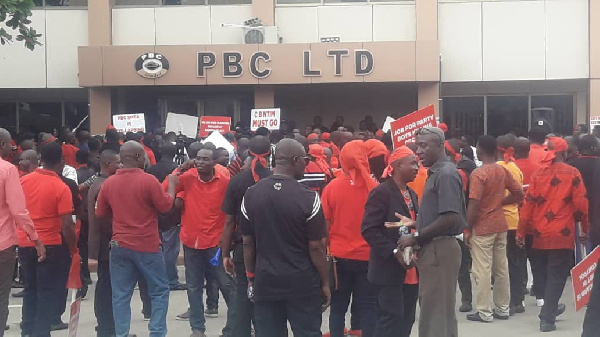

- From Letter of Comfort to Failed Rescue and Asset Seizure: How PBC’s Debt Crisis Unfolded
Assets belonging to PBC Limited, Ghana’s state-linked cocoa buying company, have been seized under a court-backed execution process, marking a dramatic escalation in the financial crisis of an institution once regarded as a central pillar of the country’s cocoa purchasing system.
Documents sighted by NorvanReports show that the seizure is tied to a High Court judgement secured by a consortium of banks against PBC, following years of unresolved repayment obligations under a restructured banking facility that was known to key state institutions, including the Ministry of Finance, the State Interests and Governance Authority, and Ghana Cocoa Board.
The story of PBC’s distress is therefore not merely one of corporate indebtedness. It is a story of state comfort without state guarantee, delayed intervention, creditor impatience, failed rescue efforts, unpaid farmers, and the gradual unravelling of a company that once carried strategic importance in Ghana’s cocoa value chain.
At the centre of the matter is a Letter of Comfort issued by the Ministry of Finance on March 30, 2020, in connection with the restructured banking facilities of Produce Buying Company Limited. The letter, signed by then Finance Minister Ken Ofori-Atta, stated that PBC had agreed to an arrangement with various commercial banks to restructure its debts into what the document described as a “consolidated single facility”, referred to as the “Restructured Facility”.
The Ministry’s letter stated that the amount involved was GH¢495.02 million, described in the document as “Four Hundred and Ninety-Five Million and Twenty-Four Thousand, Three Hundred and Ninety Ghana Cedis.”
The letter also disclosed that the existing lenders required, as part of the security for financial closure of the restructured facility, a letter of comfort from the Ministry of Finance. It further stated that SIGA and COCOBOD had put in place mechanisms, including a Collection Account into which PBC receivables from COCOBOD would be lodged, as well as monitoring measures to ensure appropriate disbursements to repay the facility.
That disclosure is significant. It shows that the PBC restructuring was not a quiet bilateral arrangement between a distressed company and its banks. It was a broader state-sector arrangement involving the Ministry of Finance, SIGA and COCOBOD, with repayment expectations linked to PBC’s cocoa receivables.
Yet the same Ministry letter also drew a firm legal line. It stated that PBC, as a limited liability company registered on the Ghana Stock Exchange, was “solely responsible for its liabilities, including its financial obligations under the Restructured Facility arrangement with the Existing Lenders, on its own balance sheet without recourse at any time to GoG and this Ministry.”
The Ministry further stated that, under Section 67(10) of the Public Financial Management Act, 2016, Act 921, the letter “does not constitute, and shall not be construed at any time and in any manner to constitute a legal undertaking by GoG.”
In simple terms, the government gave comfort, but not a guarantee.
That distinction now sits at the heart of PBC’s crisis. The banks appear to have entered or maintained the restructuring on the back of state comfort, monitoring arrangements and expected receivables. But when repayment failed, the state’s legal exposure was limited, leaving PBC directly exposed to creditor action.
By August 2022, the arrangement had begun to unravel.
A second demand letter dated August 15, 2022, addressed to the Chief Executive Officer of PBC Limited, warned that the lenders considered PBC’s missed repayment obligation an act of default. The letter stated: “For avoidance of doubt, the Lenders want to make it unequivocally clear that we consider the missed loan repayment of GHS 33.0 Million which was due in June 2022 as an act of default.”
The banks warned that they would be “compelled to initiate legal action if settlement is not made within 30 days of receipt of this letter.” They also reminded stakeholders, including the Ministry of Finance, SIGA and COCOBOD, of their obligations under the restructured facility arrangement. The demand letter was copied to the Minister of Finance, the Chief Executive Officer of Ghana Cocoa Board and the Director-General of SIGA. That warning became prophetic.
On October 30, 2023, judgment was entered against PBC Limited at the High Court, Commercial Division, Accra, in Suit No. CM/RPC/0555/2023, involving Agricultural Development Bank, Bank of Africa Ghana Limited, CAL Bank PLC, GCB Bank PLC, Universal Merchant Bank PLC and United Bank for Africa Ghana as plaintiffs. The court document states: “It is adjudged that the Defendant hereby pays each of the Plaintiffs as follows.”
The judgment listed substantial amounts owed to the banks. Agricultural Development Bank was owed GH¢50.56 million, Bank of Africa Ghana GH¢11.50 million, CAL Bank GH¢73.70 million, GCB Bank GH¢111.36 million, and Universal Merchant Bank GH¢43.43 million, inclusive of interest as stated in the judgment. The court also awarded GH¢600,000 in legal costs.
The cumulative exposure in the judgement was about GH¢290.55 million, based on the figures stated in the court document.
NorvanReports further understands that at a later stage, an attempt was made to create a rescue pathway through SSNIT. Individuals familiar with the matter say the government of the day asked SSNIT to settle the obligation on behalf of PBC. SSNIT management, however, is understood to have requested a corresponding transfer of Golden Bean Hotel, which is said to be owned by PBC, before any payment could be made.
According to the same sources, an arrangement was put in place for the shareholders of Golden Bean Hotel, including PBC, the Ministry of Finance and SIC to meet and approve the transfer to SSNIT. But the process reportedly stalled after the Ministry of Finance failed to attend the scheduled shareholder meeting, making it impossible for the transfer to be completed.
If confirmed by further documentary evidence, the SSNIT-Golden Bean episode would suggest that PBC’s crisis was not only about weak liquidity or creditor pressure. It would point to a failed institutional rescue one in which a possible settlement route existed but collapsed because the necessary public-sector coordination did not materialise. That is the deeper governance problem.
PBC appears to have been caught in a grey zone: public enough to attract state comfort, public-sector attention and strategic rhetoric; but corporate enough to carry debt on its own balance sheet without sovereign recourse. When the arrangement worked, that ambiguity may have been convenient. When it failed, creditors, farmers, workers and the cocoa sector were left to absorb the consequences.
The latest documents show that execution has now moved from court judgement to physical attachment of assets.
A handwritten inventory document headed “Writ of F.I. FA. or Distress Warrant” records inventory taken on properties of PBC Limited at Dzorwulu on April 30, 2026. It lists multiple old MAN trucks, DAF trucks, pickups, forklifts, a compressor machine, a vulcanising machine and other machinery.
A second inventory document, also under a writ of fieri facias or distress warrant, lists additional vehicles, including old Toyota Hilux pickups, a Mercedes-Benz car and a Fortuner car, again in the same judgement creditor and judgement debtor matter.
A third inventory further lists additional old MAN trucks, Rhino trucks, box trucks and other vehicles and equipment taken as part of the execution process.
Together, the documents show a disturbing progression: a 2020 restructuring arrangement of nearly GH¢500 million, a 2022 default warning over a missed GH¢33 million repayment, a 2023 High Court judgement of about GH¢290.55 million, an alleged failed rescue arrangement involving SSNIT and Golden Bean Hotel, and a 2026 execution process involving the seizure of operational assets.
For PBC, this is not merely a financial embarrassment. It is an existential crisis.
The company’s historic role in Ghana’s cocoa sector was not peripheral. PBC was once one of the most important licensed buying companies in the country, with a broad national footprint and a public-interest role in cocoa purchasing. Its significance lay not only in the volume of cocoa it bought, but in the confidence it gave farmers that the state had a dependable presence in the purchasing chain.
That confidence is now under severe strain.
A cocoa buyer that cannot promptly pay farmers, cannot meet bank repayment obligations and is losing trucks, pickups and equipment to creditor enforcement faces a fundamental operational problem. Cocoa buying is not only about licence and mandate. It requires liquidity, logistics, trust and speed. If the vehicles and equipment that support field operations are seized, PBC’s ability to function as a credible buyer is further weakened.
The farmer remains the most exposed party in this chain.
Banks can go to court. Government can issue policy statements. Shareholders can debate restructuring. But the farmer who has delivered cocoa and is waiting for payment carries the immediate pain of institutional failure. In cocoa-growing communities, delayed payments can affect school fees, household consumption, farm maintenance and preparation for the next production cycle.
The seizure also raises uncomfortable questions for the state. Why did the monitoring mechanisms referred to in the Ministry of Finance letter fail to prevent default? What happened to the Collection Account into which PBC receivables from COCOBOD were expected to be lodged? Did COCOBOD’s measures to assure lenders that PBC would achieve the required volumes and margins materialise? At what point did SIGA, COCOBOD and the Ministry of Finance conclude that PBC’s repayment capacity had broken down?
The alleged SSNIT-Golden Bean arrangement raises additional questions. Who formally asked SSNIT to pay on behalf of PBC? Was the request backed by Cabinet, the Ministry of Finance, SIGA, COCOBOD or PBC’s board? What valuation was placed on the Golden Bean Hotel? Did all shareholders agree in principle to the transfer? And why did the Ministry of Finance, a key actor in the matter, allegedly fail to attend the meeting required to complete the transaction?
These questions matter because the documents sighted by NorvanReports show that PBC’s debt crisis was foreseeable. The Ministry of Finance knew of the restructuring in 2020. The banks warned of default in 2022. The court entered judgement in 2023. Assets were inventoried in 2026.
This was not a sudden collapse. It was a slow institutional unravelling.
For Ghana’s cocoa sector, the implications are profound. PBC’s distress is not only about one company’s debt. It is about the credibility of state-backed commercial entities, the limits of government comfort, the discipline of public financial management, and the protection of farmers whose livelihoods depend on institutions that are now visibly failing.
If the government believes PBC remains strategically necessary, then the response cannot be cosmetic. It must involve a credible restructuring of debt, governance, operations and capital. It must clarify the roles of COCOBOD, SIGA, shareholders, creditor banks and any statutory institution asked to participate in a rescue. It must also protect farmers from becoming collateral damage in a dispute among public-interest institutions.
If, however, the government believes PBC is no longer commercially viable, then it must say so and manage an orderly transition that protects farmers, workers and cocoa supply chain stability.
What cannot continue is the fiction of a state cocoa buyer with no liquidity, weakened logistics, unpaid obligations and shrinking credibility.
The seizure of PBC’s assets should therefore be treated as more than a creditor recovery exercise. It is a warning that when public-interest institutions deteriorate without decisive reform, they do not end as a policy memo. It arrives with a court order, a sheriff, and an inventory of trucks, pickups, and equipment that the sheriff takes away.
PBC was not merely abandoned by the market. It appears to have been stranded inside the state’s own machinery too strategic to ignore, but apparently not coordinated enough to save.

