

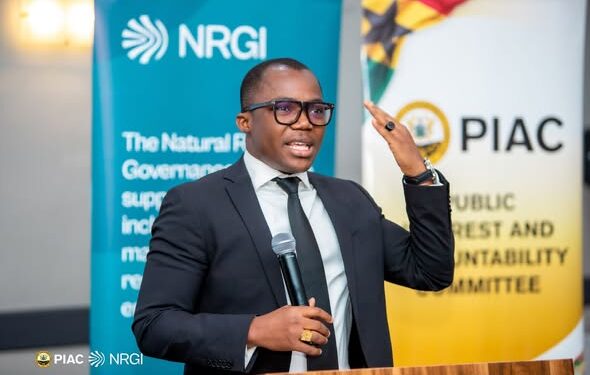

- Ghana Risks Losing Transition Minerals Value Without Stronger Governance – NRGI
The Natural Resource Governance Institute has warned that Ghana’s ambition to become a competitive player in the global transition minerals economy will depend less on the excitement around lithium and other critical minerals, and more on whether the country can build robust governance systems to manage the sector.
According to the Institute, Ghana’s transition minerals strategy must be anchored in transparency, regulatory clarity, institutional discipline and long-term national interest if the country is to capture meaningful value from rising global demand for minerals used in clean energy technologies.
The warning comes as Ghana seeks to position itself within the battery minerals value chain at a time when lithium, bauxite, manganese and other minerals are increasingly shaping global industrial policy.
NRGI argues that attracting investment is important, but investment alone will not guarantee development benefits.
“The success of Ghana’s transition minerals strategy will depend not only on attracting investment, but on building robust governance systems that ensure transparency, accountability, and equitable benefit sharing,” the Institute said.
That message is particularly important as Ghana continues to debate the future of the Ewoyaa lithium project and the broader framework for transition mineral development.
The global race for critical minerals has intensified as countries move to secure inputs for electric vehicles, battery storage, renewable energy infrastructure and wider green industrialisation. For mineral-rich developing countries, the opportunity is significant.
Without strong governance, countries can export raw minerals while capturing only a small share of the value created further down the supply chain. They can also lose revenue through weak fiscal terms, transfer pricing, opaque contracts, tax incentives, poor monitoring and limited local participation.
NRGI’s central concern is that Ghana must avoid repeating old mistakes from the gold, bauxite and broader extractive sectors.
The country has decades of mining experience, but public debate continues over whether mineral extraction has delivered enough domestic value, industrial linkages, local jobs, community development and public revenue.
Transition minerals therefore present both a new opportunity and an old warning.
If Ghana treats lithium and other critical minerals merely as another export commodity, the country may miss the industrial and fiscal benefits that the global energy transition could offer.
But if it builds the right governance architecture, Ghana could use transition minerals to support industrialisation, local processing, skills development and stronger public finances.
NRGI has urged Ghana to ground its strategy in national interest rather than imitation. In earlier policy analysis, the Institute cautioned that Ghana should learn from countries such as Indonesia, but should not blindly copy policies such as raw mineral export bans without considering its own reserve base, technical capacity and market realities.
Indonesia’s success in nickel processing is often cited by African policymakers seeking to move beyond raw exports. But Ghana’s lithium sector is at a much earlier stage, and reserve potential, processing economics, infrastructure and investor appetite differ significantly.
A poorly designed value-addition policy could discourage investment without creating a viable domestic processing industry.
NRGI has therefore advocated a more realistic and evidence-led approach: know the reserves, assess what processing is commercially viable, strengthen fiscal terms, build technical capacity and negotiate partnerships from a position of clarity.
The Institute has also warned that 2026 is a pivotal year for Ghana’s lithium governance as the country prepares to revisit the Ewoyaa lithium mining agreement. Previous reporting by NorvanReports noted that NRGI sees the period ahead as a narrow but important window for Ghana to strengthen its fiscal and regulatory approach before any renegotiated deal returns to Parliament.
At the heart of the debate is how Ghana should balance investor returns with national benefits.
Lithium prices have been volatile, and mining companies have pushed for terms that reflect weaker market conditions. But civil society groups and policy analysts have warned against permanent fiscal concessions that could reduce Ghana’s gains if prices recover.
NRGI has supported flexible fiscal tools, including sliding-scale royalties, that allow the state to capture more revenue when prices rise while protecting project viability when prices fall.
Such mechanisms are increasingly important in transition minerals because price cycles can be severe.
A fixed fiscal regime may either overburden investors during downturns or leave the state underpaid during price booms. A flexible regime can help balance risk more intelligently.
NRGI has also stressed the need for contract transparency, beneficial ownership disclosure, strict monitoring of downstream processing commitments and safeguards against profit shifting.
These issues matter because the real value in battery minerals is often captured outside the mine gate in processing, refining, component manufacturing and technology supply chains.
If Ghana signs agreements that promise local processing but fails to enforce them, companies may still export raw or semi-processed ore while the country remains outside the most valuable segments of the battery value chain.
The NRGI’s concern is that without transparency and stringent enforcement of downstream processing agreements, new owners may choose to ship raw or semi-processed ore to China, which controls a dominant share of global refining capacity. That would weaken Ghana’s ambition to capture more value locally.
For policymakers, the lesson is clear: value addition cannot be left as an aspirational clause in a mining agreement.
It must be backed by enforceable timelines, investment commitments, penalties for non-compliance, infrastructure planning and realistic assessments of feedstock availability.
Ghana must also decide where transition minerals fit into its broader industrial policy.
Should the country prioritise mining revenue, local refining, battery component manufacturing, industrial parks, skills training, local procurement or state equity? Should the Minerals Income Investment Fund be a passive holder of shares or a strategic vehicle for national value capture? Should Ghana pursue regional processing partnerships with neighbouring countries to reach economies of scale?
The global energy transition is moving quickly, and producer countries that lack clear strategies risk being outmanoeuvred by better-prepared investors and trading partners.
NRGI’s broader work on transition mineral governance stresses the importance of economic equity, traceability and circularity in mineral value chains. It has also supported producer countries seeking more economically sound choices in mineral value addition.
As global buyers face growing pressure to prove that critical minerals are responsibly sourced, Ghana could gain a competitive advantage by developing systems that certify environmental, social and governance compliance.
That would require stronger monitoring of mining operations, community impacts, land use, water protection, labour conditions and revenue flows.
It would also require institutions with the capacity and independence to enforce standards.
This is where Ghana’s governance challenge becomes most urgent.
The country already has several institutions involved in mining oversight, including the Ministry of Lands and Natural Resources, Minerals Commission, Environmental Protection Agency, Ghana Revenue Authority, MIIF, Parliament and local authorities.
But institutional fragmentation can weaken accountability if roles are unclear or enforcement is inconsistent.
A robust transition minerals strategy must therefore define who does what, who reports to whom, and how citizens can track whether commitments are being met.
If Ghana gets transition minerals right, the country could secure new revenue streams, create industrial jobs, attract responsible investment and support its own energy transition. It could also strengthen its position in global supply chains at a time when advanced economies are searching for reliable mineral partners.
If Ghana gets it wrong, the country may repeat familiar extractive-sector failures: exported raw materials, limited local value, weak community benefits, fiscal leakages and public distrust.
The transition minerals opportunity is not automatic. Lithium in the ground does not guarantee development. Bauxite reserves do not guarantee industrialisation. Foreign investment does not guarantee national benefit.
Governance is the bridge between resource discovery and development impact.
For Ghana, the next phase must be defined by evidence, transparency and discipline.
Before any major transition minerals agreement is approved, the public must know the fiscal terms, state equity structure, beneficial owners, processing obligations, environmental safeguards, community benefit commitments and revenue projections under different price scenarios.
Parliament must also have the technical capacity to scrutinise agreements properly, rather than treating them as political trophies.
The executive must negotiate from a long-term national interest perspective, not short-term headline value.
Communities must be engaged before projects begin, not after grievances emerge.
And regulators must enforce agreements after the signing ceremony ends.
The global energy transition has opened a door for mineral-rich countries. But the countries that benefit most will not simply be those with minerals. They will be those with strong institutions, clear strategies and the discipline to negotiate and enforce better deals.
Ghana still has time to get it right.
But as NRGI’s warning makes clear, the window is narrow, and the cost of weak governance could be measured not only in lost revenue, but in another missed industrial transformation opportunity.

