


- Ghana Urged to Turn Mineral Wealth into Jobs, Local Businesses and Community Gains
Ghana’s mining debate is moving beyond how much the state collects from mineral production to a harder question: what lasting economic and social value remains in the country after the minerals are extracted?
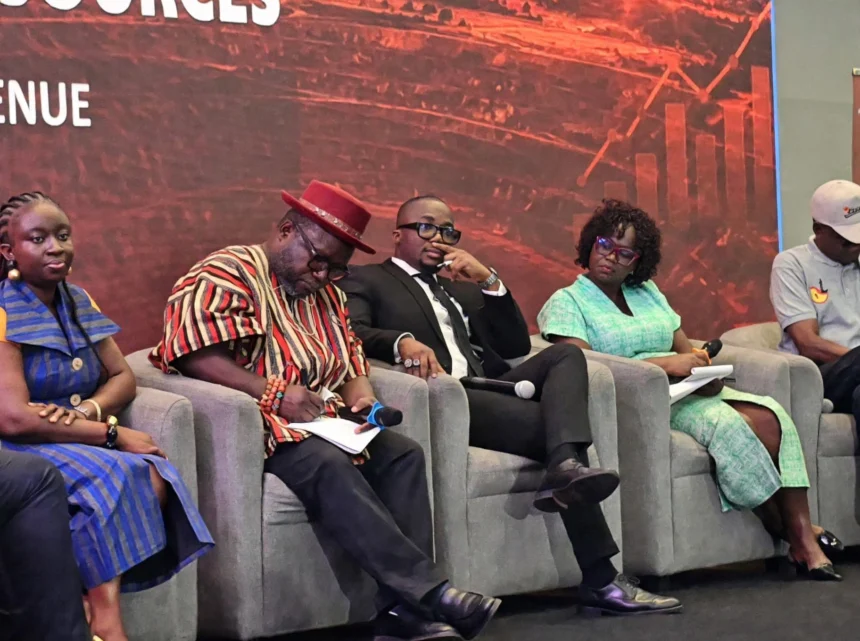
That question framed a civil society dialogue in Accra organised by the Natural Resource Governance Institute (NRGI) and the Ghana Chamber of Mines.
The discussion brought together government, industry and civil society around Ghana’s mining fiscal and revenue governance and the country’s ability to secure broad benefits from its mineral wealth.
The scale of the sector’s public contribution is substantial. Ghana’s large-scale mining companies paid more than GH¢24 billion in taxes to the government in 2025, according to Chamber of Mines Chief Executive Dr Ken Ashigbey. But he challenged participants to look beyond the headline figure: “How is that being used?”
That question exposes a gap in the national debate. A high tax or royalty figure is evidence of revenue collection; it is not, on its own, evidence that mineral wealth has improved livelihoods, built productive industries or created opportunities that will endure after a mine closes.
Chamber of Mines chief Operating Officer Mr Ahmed Dasana Nantogmah described investors, communities and government as the sector’s “mining tripod”.
Each, he said, must gain from mining through fair returns, improved livelihoods and sustainable public revenues. “Squeezing one leg weakens the whole,” he warned.
The image captures a central policy challenge. Ghana has a sovereign right to secure a fair return for its resources and to protect communities affected by extraction. It also needs investment to fund exploration, develop mines, sustain production and create jobs.
A revenue regime that fails to capture adequate public value leaves the country short-changed. A regime that changes unpredictably or makes long-term investment unviable can also weaken future production, employment and revenue.
But balancing those interests should not become a reason to postpone scrutiny. The public needs to know not only what mining companies pay but also how the government collects, allocates and spends the proceeds.
That requires transparent fiscal rules, reliable reporting and clear links between mineral revenues and measurable development outcomes.
Dr Ashigbey proposed a Minerals Revenue Management Act, drawing on Ghana’s experience with the Petroleum Revenue Management Act.
A mining-specific law could establish rules for managing public proceeds, including saving part of the revenue during periods of strong commodity prices and building a fund for future generations.
He also proposed using a portion to develop indigenous mining businesses and increase Ghanaian participation across the sector.
The case for such a framework rest on the finite nature of mineral resources. Gold extracted and sold today cannot be extracted again for tomorrow’s citizens. If a temporary rise in prices lifts revenues, a system that spends every additional cedi immediately risks converting an exhaustible asset into short-lived consumption.
Saving part of the proceeds, while investing another share in productive capacity, could help turn mineral wealth into an enduring national asset.
A law alone, however, would not guarantee better outcomes. Its impact would depend on rules that define how much is saved, where funds are invested, who oversees decisions and how results are reported.
The framework would also need to prevent duplication with existing institutions and ensure that investment decisions are based on public value rather than political convenience.
The second opportunity is to retain more value through procurement. Dr Ashigbey said more than 60% of every US$100 in mining revenue goes into procurement. If a larger share of the goods and services mining companies buy can be produced competitively in Ghana, that spending could support domestic firms, skilled jobs and manufacturing capability.
The Chamber is exploring partnerships between local suppliers and manufacturers to produce items currently sourced from outside the country.
That opportunity demands more than local-content targets. Ghanaian firms need access to finance, technical standards, certification, skills and long-term contracts to supply mining operations reliably. Without those capabilities, procurement rules may shift spending on paper without building firms able to compete on quality, price and delivery.
The test should be whether Ghanaian companies move up the supply chain, develop technology and serve markets beyond a single mine.
Communities must also see a durable return. Mr Nantogmah urged stakeholders to examine the whole value chain, from mineral development and revenue collection to the allocation and use of funds.
The ultimate measure, he said, should be whether mineral wealth translates into better livelihoods, stronger institutions and sustainable development, especially in mining communities.
That means tracking outcomes such as local employment and business growth, access to essential services, environmental rehabilitation and the durability of infrastructure. Communities should be able to see what funds were received, which projects were selected, what was delivered and who is accountable when commitments are not met.
The objective is not to equate mining-company social spending with the state’s public obligations but to ensure both are transparent and effective.
The dialogue also stressed that environmental governance, transparent regulation, responsible gold trading and investment competitiveness should advance together. That is important because value cannot be measured by public revenue alone.
The costs of pollution, land degradation and lost livelihoods can offset gains if they are not prevented, repaired or fairly addressed.
Ghana therefore faces two connected tasks: securing a fairer share of mineral wealth and making that share work harder for citizens.
A predictable fiscal framework can support investment; transparent revenue management can strengthen accountability; stronger local suppliers can keep more economic activity in the country; and community-centred planning can make benefits visible where extraction takes place.
The GH¢24 billion tax contribution provides a strong reason to ask what comes next. The measure of success will not be the amount collected in a single year, but whether those receipts help build productive Ghanaian businesses, capable institutions and communities with lasting opportunities after the ore is gone.

