


- GIPC Urges Ethiopian Investors to Use Ghana as Gateway to West African Market
The Ghana Investment Promotion Centre has urged Ethiopian businesses to use Ghana as a strategic entry point into the West African market, as Accra intensifies efforts to attract intra-African investment and deepen commercial ties under the African Continental Free Trade Area framework.
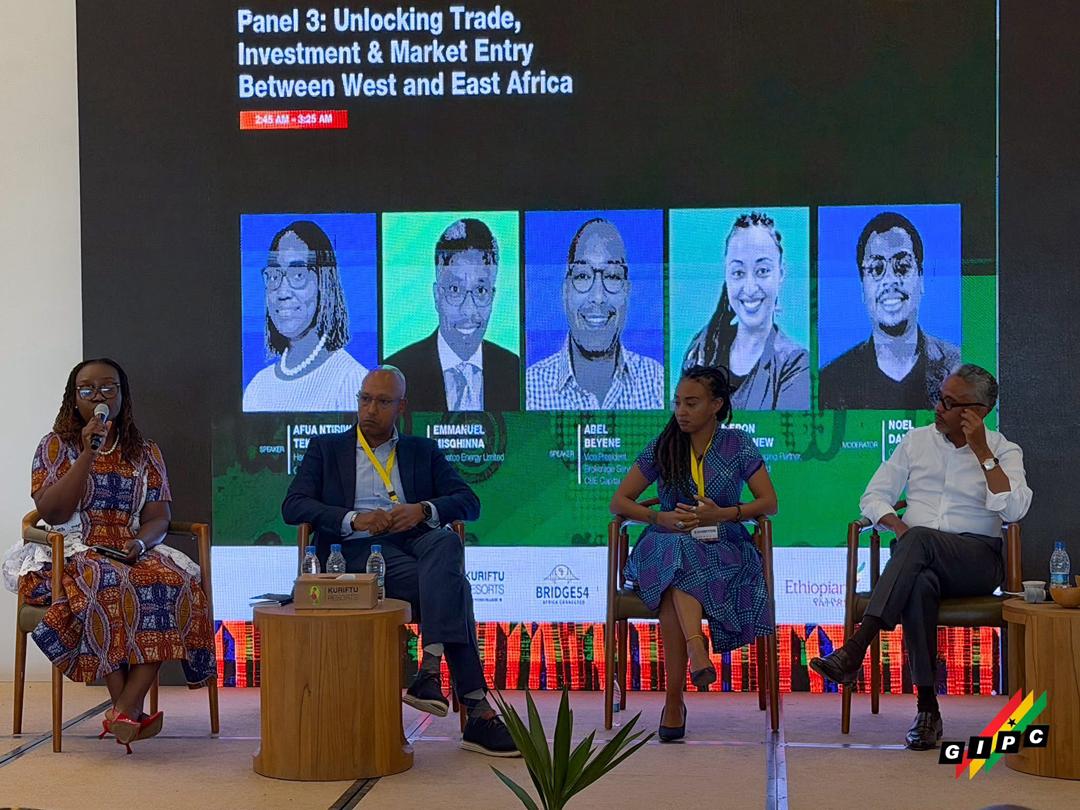
Speaking during a panel discussion at the Ghana Business and Cultural Expo at the Kuriftu Resort Africa Village in Addis Ababa, Ethiopia, Afua Tekyi-Mills, Head of Marketing and Communications at GIPC, said Ghana offers investors access not only to its domestic market but also to the wider ECOWAS and AfCFTA markets.
The event brought together business leaders, investors, policymakers and cultural stakeholders from Ghana and Ethiopia to explore stronger cooperation in trade, tourism, culture and investment.
Addressing participants on the theme, “Creating an Enabling Environment for Cross-Border Investment,” Ms Tekyi-Mills outlined practical steps Ethiopian companies can follow to establish operations in Ghana.
She said prospective investors must first define their business objectives and preferred entry model, whether through trading, manufacturing, joint ventures or export-oriented production.
“At this stage, I would encourage them to engage GIPC early because GIPC can provide investment information, sector guidance, project profiles and advice on relevant incentives,” she said.
According to her, the next step involves formal business registration with the Office of the Registrar of Companies, followed by registration with GIPC for enterprises involving foreign participation. Investors may also need sector-specific licences and approvals depending on the nature of their operations.
Ms Tekyi-Mills said Ghana’s investment framework is designed to support long-term business growth through incentives, legal protections and investor facilitation services.
She noted that eligible agro-processing businesses may benefit from concessionary corporate income tax rates during their first five years of operation, while manufacturing firms operating outside Accra and Tema are also entitled to reduced tax rates as part of efforts to promote regional industrialisation.
Strategic investments valued at $50 million and above may also qualify for customised incentives under Ghana’s Exemptions Act.
Ghana’s investment regime, she added, provides protections against expropriation, access to dispute resolution mechanisms and guarantees for profit repatriation — safeguards that remain important for investors assessing long-term entry into new markets.
GIPC also supports investors through business facilitation, advisory services, technology transfer registration, aftercare support and investor grievance mechanisms.
Ms Tekyi-Mills identified agro-processing, textiles, garments, logistics and specialty food trade as immediate areas for stronger collaboration between Ghana and Ethiopia.
She said Ghana could supply cocoa products, shea butter and processed foods, while Ethiopia could bring strength in coffee, spices, sesame and garment manufacturing expertise.
“This is an opportunity to build a stronger West Africa and East Africa business corridor using sectors where both countries already have complementary strengths,” she said.
The pitch to Ethiopian investors comes as Ghana seeks to consolidate its position as a commercial bridge into West Africa. As host of the AfCFTA Secretariat, Ghana has repeatedly positioned itself as a platform for companies seeking to access regional and continental markets from one base.
For Ethiopian firms, Ghana’s proposition is therefore not only about entering a domestic market. It is about using Ghana as a launchpad into ECOWAS, West Africa and the wider AfCFTA trading space.
The opportunity is particularly relevant as African businesses increasingly look beyond traditional export markets and explore regional value chains in food processing, manufacturing, textiles, logistics and services.
For Ghana, stronger commercial ties with Ethiopia could also help diversify intra-African trade links beyond the country’s traditional West African partners. Ethiopia brings scale, aviation connectivity, coffee, leather, textiles and industrial park experience. Ghana brings political stability, port access, financial services, cocoa, shea, processed foods and AfCFTA positioning.
The challenge, however, will be turning business diplomacy into actual investment flows. Investors will look beyond promotional events to assess land access, tax predictability, power reliability, logistics costs, labour availability, licensing timelines and regulatory consistency.
Still, GIPC’s message in Addis Ababa was clear: Ghana wants to be the West African base for Ethiopian businesses seeking to expand across the continent.
If properly followed through, the Ghana-Ethiopia engagement could become part of a wider shift in African investment one where African capital increasingly builds African supply chains, rather than waiting for external investors to define the continent’s industrial future.

