

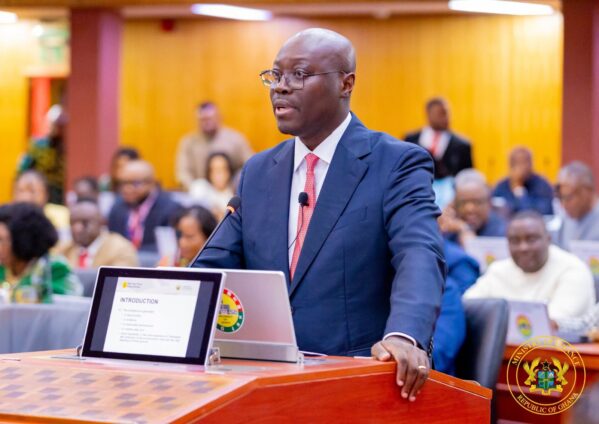

- Government Has Introduced About 22 Laws to Protect Economic Reforms — Ato Forson
Finance Minister Dr. Cassiel Ato Forson says the government has introduced about 22 laws over the past 18 months as part of efforts to give its economic reforms a lasting legal foundation and reduce the risk of future policy reversals.
Speaking at a New Economy engagement at the University of Ghana, the minister said the legislative programme was intended to preserve economic stability and prevent a return to the hardship experienced during the 2022–2024 economic crisis.
His remarks placed the durability of reforms at the centre of the government’s economic agenda, raising a question that extends beyond the performance of the current administration: how to ensure that commitments made during a period of adjustment continue to guide public finances after political leadership changes.
“I try to introduce a lot of laws. In the last 18 months, we have introduced about 22 laws,” Dr. Forson said.
He was responding to Prof. Fred Dzanku, Head of the Economics Division at the Institute of Statistical, Social and Economic Research, who asked how “some of these brilliant policies and agenda” could be institutionalised.
The minister said the government was using a combination of new legislation, amendments and repeals to embed its reforms in the country’s legal framework.
“We are trying to put these reforms into law,” he said.
However, the remarks did not identify all the measures included in the figure of about 22 or distinguish between proposals introduced, legislation passed by Parliament and provisions already being implemented. That distinction will be important in assessing how much of the government’s reform programme has acquired legal force.
Introducing legislation begins a process. The durability of the resulting reform also depends on the final provisions approved, the institutions responsible for applying them and the consistency of enforcement.
Dr. Forson said the government was also pursuing changes intended to require a two-thirds majority in Parliament to alter some of the laws. He presented the proposed higher threshold as a means of making it more difficult for subsequent administrations to dismantle reforms.
“So we are locking in the progress,” he said.
The minister did not specify which laws would be covered by the proposed threshold or explain the legal mechanism through which it would operate. His comments therefore outlined the government’s intention, while leaving the scope and practical application of that proposal to be clarified.
A requirement for broader parliamentary support, if legally established and applicable to the measures concerned, would seek to make changes dependent on agreement extending beyond a narrow majority. Its effectiveness would nevertheless depend on the final legal arrangements.
The proposal reflects the government’s concern that policies adopted to restore stability could be weakened or reversed once immediate economic pressures ease.
For households and businesses that have borne the cost of adjustment, the issue is whether improvements can endure long enough to support more predictable financial decisions. Policy continuity matters when firms plan investment, households assess borrowing commitments and public institutions determine spending priorities.
The minister framed the legislative programme as a response to that need for continuity. He said the economic stability achieved through public sacrifice should be protected against decisions that could return the country to crisis.
His argument was that reform should become part of the way the state operates, rather than remain dependent on the preferences of a particular government.
Dr. Forson said his background in Parliament and economic policymaking had informed that approach.
“I am in a unique position to understand how the issue of sustainability can be tackled because of my parliamentary experience and policy experience,” he said.
He observed that policies without a statutory foundation were easier for an administration to change. Giving reform commitments legal backing, he suggested, would create a more durable basis for economic management.
The minister specifically identified amendments to the Public Financial Management Act as part of the programme.
“So the PFM Act is being amended. Some of the things we are doing are being institutionalised and we are putting it into law to lock in the sustainability,” he said.
The proposed amendments place the management of public resources within the broader discussion about preventing another economic crisis. However, the account of the engagement did not set out the individual provisions being changed or explain how each amendment would address weaknesses identified by the government.
Those details will matter in judging the substance of the reform. A legislative programme can be assessed more clearly when the public can identify the obligations it creates, who must comply and what happens when requirements are breached.
The same applies to the government’s wider claim of introducing about 22 laws. A published account of the measures, their parliamentary status and their intended economic effects would allow businesses, researchers and citizens to evaluate progress against the stated objective.
It would also help distinguish changes designed to improve day-to-day administration from provisions intended to constrain future policy choices.
The discussion at the University of Ghana highlighted the relationship between political commitment and institutional strength. A government may set a direction for reform, but sustaining it requires public bodies to apply the rules consistently and decision-makers to account for departures from them.
Legal backing can support that process by making responsibilities more explicit. It cannot, on its own, demonstrate that implementation will be effective or that future economic pressures will be managed successfully.
There is also a need for clarity about how durable rules would accommodate legitimate changes in economic circumstances. Protecting reform gains and allowing policy to respond to new conditions are both considerations that the eventual legislative framework will have to address.
Dr. Forson’s remarks signal that the government wants the next phase of economic management to include stronger legal safeguards alongside its policy commitments.
The test will be whether the measures he cited move from legislative activity to enforceable obligations that improve public financial decisions. For Ghanaians who endured the recent crisis, the value of the programme will ultimately rest on whether it helps prevent a repetition of that hardship.

