


- Growth Holds at 5.10%, but GSS Warns Agriculture Needs Urgent Attention
Ghana’s economy expanded by 5.10% year-on-year in May 2026, maintaining a relatively strong pace of activity but revealing a more complicated story beneath the headline: services are increasingly carrying the economy while agriculture, one of the sectors most closely connected to jobs, food prices and rural incomes, has slowed sharply.
The latest Monthly Indicator of Economic Growth from the Ghana Statistical Service puts the May index at 121.90, compared with 115.90 a year earlier. The increase means economic activity was 5.10% higher than in May 2025, although the pace has moderated from 6.60% a year earlier.
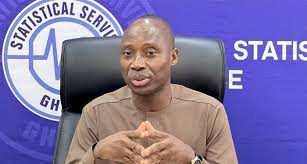
Government Statistician Dr Alhassan Iddrisu, who presented the May release on August 13, offered perhaps the clearest way of understanding the figure: “For every GH¢100 of activity in May last year, the economy produced about GH¢105 in May 2026.”
It is an important distinction. Ghana’s economy has not contracted; it is simply expanding more slowly than it was a year earlier.
But the more consequential question is not whether Ghana grew by 5.10%. It is what produced that growth, how broadly it is distributed and whether its current structure can generate enough jobs, investment and household income to make the recovery durable.
Services expanded 7.20% in May, only marginally below the 7.50% recorded a year earlier, and accounted for a striking 51% of the entire increase in economic activity. Information and communication was the principal driver, with broader momentum coming from activities including trade, transport, banking and other services.
Industry grew 4.20%, broadly stable compared with 4.60% in May 2025, and contributed another 23.80% to overall growth. Mining and quarrying was the principal driver of industrial expansion.
Agriculture, however, presents the more troubling picture.
The sector expanded by only 3.60%, compared with 9.80% in May 2025. Crops and livestock continued to support output, and the statistical service cautions that last year’s comparison reflected an exceptionally strong base. Still, the magnitude of the slowdown makes agriculture the clearest weak point in the May numbers.
In its own interpretation of the data, the GSS is unusually direct: “Growth is holding up, it is narrowing onto services, and agriculture needs attention.”
That may ultimately be more important than the 5.10% headline. An economy can grow rapidly while becoming increasingly dependent on a narrow group of activities. That does not make the growth unreal, but it can make the expansion less resilient.
Services alone generated 51.00% of May’s growth. Industry contributed 23.80%, agriculture 21.20% and net taxes the remaining 4.00%.
The concentration presents both an opportunity and a vulnerability. Ghana’s strength in information and communication is economically significant. Digital services can improve productivity across banking, retail, transport, logistics, government and the wider private sector. They can attract investment, create skilled employment and allow Ghanaian companies to sell services beyond the domestic market.
But a rapidly expanding digital and services economy cannot fully substitute for a weak productive base.
Ghana still needs farms to supply affordable food, manufacturing to convert raw materials into higher-value products and industry to generate the scale of employment required by a growing labour force. If those parts of the economy do not strengthen alongside services, GDP can expand without delivering the structural transformation policymakers seek.
The GSS itself highlights the risk of narrowing growth, warning that when more than half of expansion comes from one sector, the economy effectively has “fewer engines”, increasing exposure if that engine slows.
Agriculture illustrates why this matters. A fall in agricultural growth from 9.80% to 3.60% does not merely reduce one component of national output. It has consequences for food prices, rural incomes and export earnings, all three of which feed directly into Ghana’s broader macroeconomic stability.
When domestic food production struggles to keep pace with demand, shortages can translate into higher prices. When farming incomes weaken, purchasing power declines across rural communities. And where agricultural exports underperform, the country loses potential foreign-exchange earnings.
Agriculture is therefore simultaneously an inflation, employment, trade and poverty issue.
This makes the GSS recommendation significant. The statistical agency says government and the Bank of Ghana should integrate the monthly growth signal into budget execution and monetary policy reviews, while public policy should support agriculture through inputs, irrigation and storage.
The emphasis on storage is especially important. Ghana’s agricultural challenge is not solely how much farmers produce but how much survives after harvest, reaches markets efficiently and can be processed rather than wasted.
Irrigation tackles another structural weakness by reducing dependence on rainfall and allowing production to become more predictable throughout the year.
But the investment argument extends further. Agriculture needs finance suited to production cycles, efficient farm-to-market roads, extension services, mechanisation, better seed varieties and processing capacity capable of absorbing increased output.
Without those connections, Ghana risks creating an economy in which sophisticated digital services grow quickly while basic agricultural supply chains remain vulnerable to disruptions that repeatedly feed into food prices.
Industry presents a different challenge. Its 4.20% expansion was relatively steady, and the GSS describes the performance as “dependable”. But mining and quarrying being the principal driver raises another structural question: how much of Ghana’s industrial growth is being generated by manufacturing capable of creating deep domestic supply chains, rather than extraction?
Mining can generate exports, taxes and foreign exchange. But structural transformation normally requires stronger links between extraction and domestic processing, manufacturing, engineering, logistics and locally owned suppliers.
The May data therefore contain two parallel stories. Ghana has a fast-growing services sector heavily supported by information and communication, while industrial activity is being supported materially by mining. Both are genuine sources of expansion, but neither automatically guarantees the broad employment or domestic value addition associated with a more diversified productive economy.
This is where the usefulness of the MIEG becomes particularly important.
The monthly indicator is designed as an early reading of the economy rather than a replacement for quarterly GDP. It collects monthly volume indicators and administrative data, removes the effects of inflation using the consumer and producer price indices and combines the information into an index based on 2023=100. Wherever possible, it uses the same indicators employed in quarterly GDP compilation.
For policymakers, that means weaknesses can potentially be identified before quarterly national accounts arrive.
The GSS describes the approach as the equivalent of a more frequent economic check-up, arguing that governments, businesses and the Bank of Ghana can make decisions using more current evidence rather than waiting for quarterly data.
There are, however, important limitations. The May estimate is provisional, the MIEG remains classified as an experimental statistic and the series is not seasonally adjusted. This means month-on-month growth should not be calculated from the index. The appropriate comparison is May 2026 against May 2025, not May against April. Figures can also be revised for up to two years as more comprehensive information becomes available and the series is reconciled with quarterly and annual national accounts.
That caution matters because the index itself moved from 113.30 in April to 121.90 in May. It would be tempting to describe that movement as a sharp monthly acceleration, but GSS explicitly warns against such an interpretation because seasonal effects have not yet been removed.
The correct conclusion is more measured: Ghana produced 5.10% more economic activity in May 2026 than it did in May 2025.
The GSS argues that growth at that pace remains above population growth, creating the possibility for average incomes to continue rising.
The more difficult policy question is whether a 5.10% expanding economy is creating sufficient employment, whether productivity is rising, whether businesses are investing and whether household incomes are improving quickly enough for citizens to feel the growth reflected in official statistics.
That is why the composition matters so much. Digital and communication services can become a powerful new engine of Ghanaian growth. The policy error would be to assume that because that engine is performing strongly, the others require less attention.
The opposite may be true. A sustainable economy needs several engines running simultaneously: productive agriculture capable of feeding the country and supporting rural incomes; industry capable of processing raw materials and creating jobs; and services capable of improving productivity and competing internationally.
The May MIEG shows that Ghana has one engine running particularly strongly, another moving steadily and a third losing considerable momentum.
GSS’s own five-point summary captures the position: overall growth is real but moderating; services remain the engine; industry is steady; agriculture has slowed sharply; and policymakers should use the monthly data to respond.
That makes the 5.10% figure neither a reason for complacency nor evidence that Ghana’s recovery is weakening decisively.
It is an early warning about the shape of that recovery. The next test will come with the June MIEG and the full second-quarter GDP release. But the question policymakers should already be asking is more fundamental: can Ghana turn a services-led recovery into a broad-based transformation before the weakness in agriculture becomes a larger constraint on prices, employment and household incomes?
The data say the economy is growing. The policy challenge is ensuring that enough of the economy is growing with it.

