

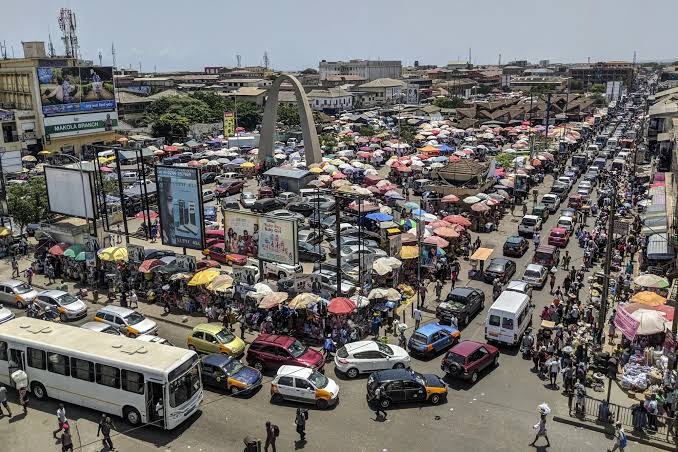

- Traffic Crisis Threatens Productivity as Government Turns to Private Capital
Ghana’s worsening urban congestion is becoming a significant economic constraint, increasing pressure on government to mobilise private capital and accelerate investment in mass transit, rail and other higher-capacity transport systems as rapid urbanisation stretches existing infrastructure.
The Ministry of Transport has received recommendations from the Graphic Business–Stanbic Bank Breakfast Meeting following discussions among policymakers, financiers, academics and transport-sector stakeholders on how to modernise the country’s urban mobility system.
The recommendations focus on congestion, sustainable financing, alternative transport modes, stronger stakeholder coordination and deeper private-sector participation.
The intervention comes as population growth and the outward expansion of cities such as Accra and Kumasi continue to increase commuting distances and place greater pressure on road networks that have struggled to keep pace.
The economic implications extend well beyond inconvenience. Congestion raises fuel and logistics costs, reduces productive working hours, complicates labour mobility and weakens the competitiveness of businesses operating in major commercial centres.
For companies, traffic increasingly functions like a hidden tax. Employees spending hours travelling between home and work represent lost productive capacity, while businesses moving goods through congested corridors absorb higher fuel, maintenance and labour costs.
Those costs can eventually filter through supply chains into consumer prices.
That makes transport reform a competitiveness issue rather than merely an infrastructure one.
Presenting the report to the Ministry, Graphic Communications Group Limited expressed optimism that the recommendations could help move the debate from diagnosis towards implementation.
“Anybody who comes to Ghana must see that Ghana is the flagship of our continent. In other areas we are doing well. Transport, we can do better,” the company said.
“So the report has a lot, and we trust that handing this over to the Ministry will help the ministry to also respond to some of these calls, some of these suggestions.”
Ghana’s transport challenge reflects a deeper mismatch between urban development and mobility investment.
Private cars, taxis and relatively low-capacity commercial vehicles continue to carry a large share of passenger traffic. Without sufficient high-capacity public transport alternatives, additional road construction alone may struggle to keep pace with demand.
The policy question is therefore increasingly about how Ghana transitions from fragmented, road-dominated mobility towards an integrated network capable of moving larger numbers of people and goods more efficiently.
Railways, mass-transit systems and urban transport infrastructure involve large upfront costs and long investment horizons. With public finances under pressure, relying exclusively on the national budget could significantly constrain the speed and scale of investment.
The Ministry of Transport says private-sector participation will therefore be important.
“The kind of transport system that can support the urban development that we are seeing today, talk about the rail systems, talk about the sky trains, talk about the bus systems, routing, and so on and so forth,” the ministry said.
“We also talk about the fact that we have traffic in town. And so our purpose as a ministry is to churn out policies that would address all those things.”
Opening the sector more aggressively to private investment could reduce pressure on government finances while accelerating delivery.
Public-private partnerships, infrastructure bonds, pension and insurance capital and blended-finance structures could potentially provide additional funding channels for commercially viable projects.
But private capital will not enter simply because government wants it.
Investors will require predictable revenue streams, transparent procurement, credible regulation and confidence that contractual arrangements will remain enforceable across political transitions.
Projects that cannot demonstrate how capital will be recovered are unlikely to attract long-term investors without guarantees, subsidies or other risk-sharing mechanisms.
That means bankability will be as important as ambition.
The larger opportunity is to stop treating different transport modes as isolated systems.
Roads, rail and mass transit should complement one another, allowing passengers and freight to move through an integrated network rather than concentrating pressure on a limited number of roads and highways.
Rail investment could be particularly important for freight.
Moving more bulk cargo by rail could reduce heavy-vehicle traffic on major highways, lower road-maintenance requirements and potentially improve travel times for passenger vehicles.
Urban mass transit could meanwhile improve labour mobility by linking residential communities more effectively with employment and commercial centres.
Reliable public transport can generate economic gains well beyond lower congestion.
It can expand the geographical area from which businesses recruit workers, improve access to markets and services, reduce household transport costs and raise the commercial value of locations connected to transport corridors.
Transport infrastructure that is poorly coordinated with housing, commercial development and land use can simply relocate congestion rather than eliminate it.
Future transport policy will therefore require closer coordination between central government, metropolitan assemblies, transport authorities, land-use planners and private developers.
Ghana has debated mass transit, rail development and urban mobility reform for years. Continued urbanisation means the economic cost of delay is becoming progressively larger.
Transport infrastructure should increasingly be treated as productive economic capital.
A project that reduces travel time can generate returns through higher labour productivity, lower logistics costs, better access to jobs and improved business efficiency even where those benefits do not appear directly as fare revenue.
For government, success will therefore be measured less by the number of transport strategies produced and more by whether public and private capital can be converted into functioning rail systems, reliable buses, better routing and infrastructure that materially reduces journey times.
As Ghana’s cities continue to expand, transport efficiency will increasingly determine how much of urbanisation translates into productivity and growth — and how much economic value is lost sitting in traffic.

