


- High Licence Fees Risk Squeezing Investment And Consumers On 5G Auctions – Bandim
Ghana’s transition to 5G is confronting a fundamental policy trade-off between maximising government revenue from spectrum and ensuring that the cost of acquiring those frequencies does not ultimately translate into more expensive data or slower network investment.
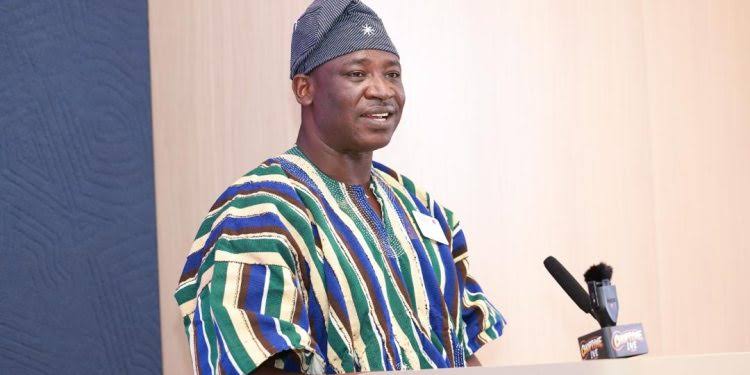
Dr Abed-Nego Lamangin Bandim, Chairperson of Parliament’s Select Committee on Information and Communications, has warned that spectrum and licence costs could become an important component of what consumers eventually pay for next-generation connectivity.
His intervention comes as Ghana moves from designing its 5G framework to actually assigning spectrum and preparing networks for commercial deployment.
The concern has acquired greater significance following the latest spectrum awards. The National Communications Authority assigned two lots in the 700 MHz band to MTN Ghana for a combined licence fee of US$100.9mn, after the operator emerged as the sole qualified and successful applicant for that band.
Telecel Ghana subsequently secured three lots in the 2.3 GHz band as the regulator advances competitive licensing across the 700 MHz, 2.3 GHz and 3 GHz frequencies.
Spectrum is a finite national asset and governments have legitimate reasons to seek value from its allocation.
But it is also a fundamental input into mobile connectivity, meaning the price operators pay for licences enters an investment equation that already includes radio equipment, fibre, transmission systems, towers, power, maintenance and technology upgrades.
“If data becomes too expensive, the digital economy becomes a privilege rather than a platform for national development,” Dr Bandim said.
The economic risk is not necessarily that every cedi spent on spectrum is directly added to a customer’s data bundle.
Operators can absorb part of the expense through lower margins, improve efficiency or spread costs across their networks, but high upfront licence payments can also compete with capital that would otherwise be available for towers, fibre and coverage expansion.
Where commercial conditions permit, some portion of those costs can ultimately influence consumer pricing or the pace at which investment is deployed.
Government has itself acknowledged that tension. Communications, Digital Technology and Innovations Minister Samuel Nartey George said earlier this year that spectrum pricing must deliver value to the state without “choking” investment required to deploy 5G, particularly in underserved communities.
Cabinet had already approved the removal of the previous exclusive 5G arrangement in favour of a competitive national spectrum process while retaining a wholesale route for operators that prefer that model.
The government is targeting 70.00% population coverage for 5G by March 2027, making the affordability and investment equation more than a theoretical debate. The Ministry has also said spectrum assignment and initial deployment are expected to be completed before the end of 2026.
Those ambitions require operators to make substantial infrastructure investments within a relatively compressed period, increasing the importance of how much capital remains available after spectrum acquisition.
The industry is already signalling significant investment appetite. Mr George said MTN Ghana had committed more than US$1.1bn over three years to network expansion and 5G deployment following regulatory reforms, illustrating the scale of private capital required to turn spectrum ownership into actual connectivity. The challenge for policymakers is therefore to ensure that licence revenue does not become so large relative to infrastructure spending that companies delay or narrow deployment outside the most profitable urban markets.
That concern becomes particularly important in rural Ghana. Dr Bandim has previously said approximately 4.5mn Ghanaians remain without network coverage, while the economics of extending advanced mobile infrastructure into sparsely populated communities can be substantially weaker than in Accra or Kumasi.
If licensing costs consume too much of an operator’s investment budget, less commercially attractive areas risk being pushed further down the deployment schedule.
The economic value of spectrum therefore extends far beyond the price paid to the state.
Affordable high-speed connectivity supports mobile financial services, e-commerce, cloud computing, remote work, online education, artificial intelligence applications and digital businesses, while companies can use stronger networks to lower transaction costs and reach customers more efficiently.
From that perspective, government must weigh immediate licence proceeds against the potentially larger tax and productivity gains generated by a deeper digital economy.
The 5G investment equation also requires attention to the design of the licensing framework itself.
A competitive auction can help reveal the market value of spectrum, but licence duration, payment schedules, coverage obligations, service-quality requirements and rural deployment conditions can materially influence whether high winning bids translate into sustainable investment.
Ghana’s objective is therefore not simply to create competition for frequencies but to encourage operators to compete through coverage, service quality and network performance after licences are awarded.
Dr Bandim has framed the debate as part of a wider question about Ghana’s economic participation in the digital age.
“Africa cannot export raw data and import expensive intelligence,” he has argued, linking connectivity with the continent’s ability to own more digital infrastructure, platforms, data and intellectual property.
If households and businesses cannot afford the connectivity required to use cloud services, artificial intelligence and other productivity-enhancing tools, a technologically advanced network may deliver considerably less economic value than its engineering capabilities suggest.
That is why Ghana’s emerging 5G market will ultimately be judged by more than how much government raises from spectrum.
The more important measures will be how quickly operators invest, how far coverage spreads beyond major cities, whether network quality improves and whether consumers can afford to use the additional capacity being created.
“The question for Ghana is not whether we will use AI. The question is whether we will help shape it,” Dr Bandim said a principle that increasingly applies to 5G itself.
The central policy challenge is therefore not choosing between public revenue and cheap connectivity, but structuring spectrum policy so that both remain sustainable.
Ghana can extract economic value from a scarce national resource while still designing payment and coverage conditions that protect investment incentives, but getting that balance wrong could leave government with strong auction receipts and consumers with a network they struggle to afford.
The success of the 5G transition will depend less on the headline price of spectrum than on whether the system converts that spectrum into widespread, reliable and economically productive connectivity.

