


- Humanise Monetary Policy or Risk Losing the Public — Bernard Otabil Tells Journalists
The Bank of Ghana has urged financial journalists to move beyond reporting monetary policy as a collection of rates, charts and technical statements, and instead explain how central-bank decisions affect the everyday choices of households and businesses.
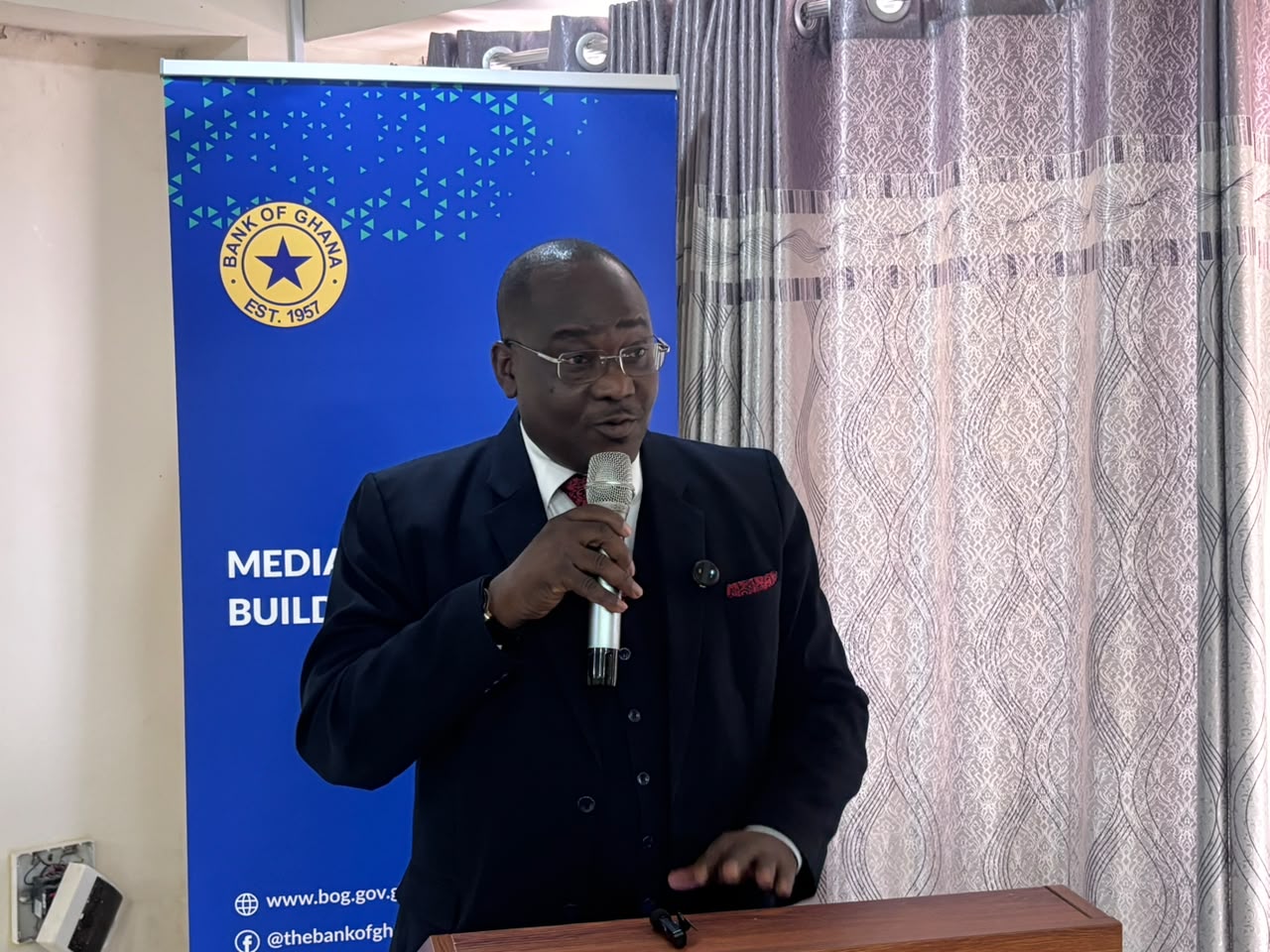
Bernard Otabil, Director of Communications at the Bank, said journalists must “humanise monetary policy” by translating complex decisions into accurate stories that reflect the experiences of Ghanaians.
He made the call on October 19 while delivering the welcome address at the opening of a three-day training workshop for members of the Bank of Ghana Press Corps. The programme, which ends on October 21, forms part of the central bank’s efforts to strengthen the quality of economic and financial reporting.
Mr Otabil’s argument raises a question that extends beyond journalism: can monetary policy achieve its intended effect when the public does not understand what the central bank has decided, why it acted and how the decision should influence economic behaviour?
“We believe monetary policy is most effective when it is understood, trusted and accurately communicated,” he said, welcoming participants on behalf of the Governor, management and staff of the Bank.
The observation places communication at the centre of monetary-policy transmission. A policy-rate decision may be technically sound, but its impact depends partly on how commercial banks, businesses, investors and households interpret it. Confusion can weaken the signal, while sensational reporting can create reactions that the underlying data does not justify.
The public, Mr Otabil noted, may never read a full Monetary Policy Committee report. Many citizens instead rely on headlines, radio discussions, television reports and social-media summaries when deciding whether to save, borrow, invest, adjust prices or hold foreign currency.
“Accuracy therefore is not just a professional virtue, it is an economic asset,” he stressed.
Accurate reporting can help stabilise expectations; inaccurate reporting can distort them.
Mr Otabil warned that “in finance, words move markets”. A misleading headline about inflation, the exchange rate or the policy rate could trigger panic, encourage speculation and impose costs on households and companies.
A change in annual inflation, for example, can be presented as though the general price level has fallen when prices may still be rising at a slower rate.
The Bank’s appeal is therefore not for journalists to soften difficult economic news or act as public-relations agents for monetary authorities. Humanising policy requires scrutiny, but scrutiny informed by evidence, institutional understanding and the lived implications of official decisions.
Mr Otabil encouraged participants to ask questions and challenge the Bank throughout the workshop. That invitation is important because trust is not built when journalists merely repeat central-bank language. It is strengthened when technical claims are tested, assumptions are interrogated and policy choices are explained without distortion.
The training programme covers the ethics of media reporting and accurate reporting, the Bank’s mandate and regulatory responsibilities, the central-bank balance sheet, the Domestic Gold Purchase Programme and developments in the foreign-exchange market.
Participants will also examine inflation dynamics and learn how to interpret MPC statements and submissions by committee members.
Mr Otabil also situated the discussion within a rapidly changing information environment. He said misinformation and disinformation had moved from peripheral concerns to major global risks, citing the World Economic Forum’s assessment of their severity.
“From deepfakes to AI-generated market rumours, from social media amplification to coordinated disinformation campaigns targeting currencies, no central bank and no country is immune,” he said. “This is a global phenomenon.”
Digital platforms have reduced the time between the creation of a false claim and its arrival before millions of users. Artificial intelligence can make fabricated audio, images and documents more convincing, while coordinated accounts can create an impression of widespread panic before institutions have had time to respond.
Currency markets and depositor confidence respond not only to confirmed events but also to what participants believe may be happening.
Mr Otabil described ethical reporting grounded in verification, balance, context and clarity as the first defence against such manipulation. In this environment, the professional discipline of checking a claim before publishing it becomes part of the country’s economic protection.
He argued that credibility had become journalism’s most valuable asset. When journalists maintain ethical standards, he said, they help anchor expectations, protect savings, safeguard stability and enable Ghanaians to make better-informed decisions.
That credibility must be earned by both sides. Journalists require timely access to reliable information, while the central bank must communicate early and clearly enough to prevent information gaps from being filled by speculation. Training can improve reporters’ technical capacity, but institutional openness determines whether that knowledge can be applied effectively.
The Bank has committed to expanding its engagement with the media through the Press Corps, regional press structures, editors’ forums, dedicated WhatsApp communication platforms and the Governor’s Economic and Financial Story of the Year Award.
These initiatives can deepen understanding, but their ultimate value will be measured by the quality of reporting reaching the public. The goal should not be more favourable coverage of the Bank; it should be more accurate, independent and useful journalism about the economy.
Suleiman Mustapha, National Organising Secretary of the Ghana Journalists Association and a member of the Press Corps, also delivered brief remarks at the opening.
The workshop begins at a time when a single headline can travel faster than a policy statement and when falsehood can be produced at industrial speed. Mr Otabil’s message is that monetary policy cannot remain enclosed in specialist language under those conditions.
Humanising it means connecting inflation to the family food budget, exchange-rate movements to the importer’s costs, regulatory decisions to depositor protection and interest rates to the entrepreneur’s ability to expand.
If journalists make those connections accurately, monetary policy becomes more understandable and public debate more productive. If they fail, technical decisions may be replaced by rumour, partisan interpretation and avoidable fear.
For the Bank of Ghana and the journalists covering it, the assignment is therefore shared but distinct: the Bank must explain, the media must interrogate, and both must recognise that the words between them can shape real economic behaviour.

