

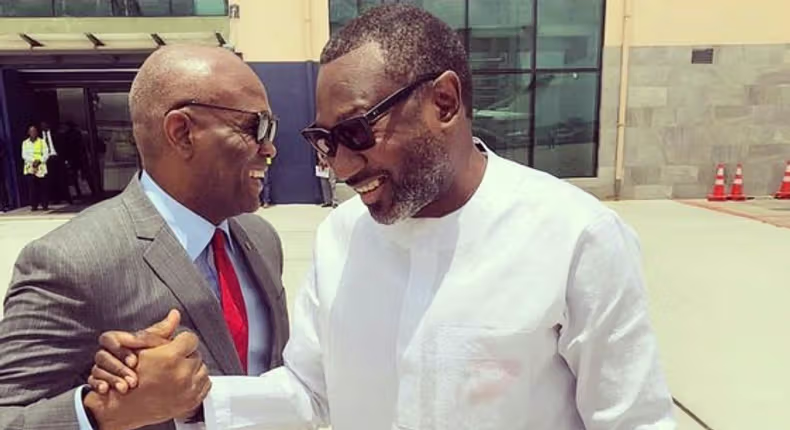

- Inside the Billion-Dollar Playbooks of Tony Elumelu and Femi Otedola
Tony Elumelu and Femi Otedola have emerged as two of Nigeria’s most influential capital allocators, using sharply different strategies to build wealth, expand corporate influence and shape some of the continent’s most important sectors.
Their recent moves across banking, energy, power and listed equities have again placed them at the centre of Nigeria’s corporate landscape, offering a study in two contrasting approaches to investment.
Elumelu, chairman of United Bank for Africa and Transcorp Group, is preparing to assume the chairmanship of Seplat Energy after Heirs Holdings and Heirs Energies acquired a 20.07% stake in the oil and gas producer.
Otedola, meanwhile, has sold control of Geregu Power, increased his exposure to First HoldCo and signalled plans to redeploy part of his capital into the Dangote Petroleum Refinery.
The two men are therefore moving through some of the same strategic sectors, but with different playbooks.
Elumelu’s approach is built around long-term accumulation, institutional control and interconnected assets. Otedola’s strategy is more rotational: enter a sector, restructure the asset, build value, exit when the opportunity is right and redeploy capital into the next major bet.
Their methods reflect different origins and different lessons from crisis.
Otedola was born into a prominent Nigerian family. His father, Michael Otedola, was a businessman and former governor of Lagos State. The younger Otedola began in the family’s printing business before entering petroleum trading, eventually building Zenon Petroleum and later taking control of African Petroleum, which he renamed Forte Oil.
His business history has been marked by both aggressive expansion and painful reversals. The 2008 financial crisis reportedly wiped out more than US$1.2 billion of his wealth, driven by falling oil prices, naira depreciation, high interest costs and a stock market crash.
That experience appears to have shaped his later investment style. Otedola is prepared to move decisively, but he is also willing to exit when an asset has matured or when a stronger opportunity emerges.
Elumelu’s story follows a different arc. He began as a photocopier salesman before entering banking, rising from analyst to branch manager by the age of 26. His defining early move came in 1997 when he led investors to acquire the distressed Crystal Bank, renamed it Standard Trust Bank and later merged it with United Bank for Africa in 2005.
That transaction placed him at the centre of one of Africa’s major banking platforms. UBA subsequently expanded across 20 African countries and major global financial centres, with reported total assets of ₦33.2 trillion, equivalent to about US$24.3 billion, in 2025.
Rather than exit banking after leaving the chief executive role in 2010 under Central Bank of Nigeria tenure rules, Elumelu built Heirs Holdings as a vehicle for wider sectoral expansion.
Today, his interests cut across banking, power, oil and gas, hospitality, insurance, healthcare and entrepreneurship. The strategy is not simply to own assets, but to connect them. UBA provides financial reach, Transcorp provides exposure to power and hospitality, while Heirs Energies gives the group a stronger position in oil and gas.
Otedola’s path has been more concentrated and transactional.
After building his fortune in commodities and petroleum distribution, he shifted from downstream oil into power generation. He restructured Forte Oil, expanded its power interests and then sold his 75% stake in the company in 2019 for ₦66.25 billion, about US$215 million at the time.
His attention later moved to Geregu Power, which became one of Nigeria’s most visible listed power assets. In 2025, he sold control of Geregu in a transaction valued at about US$750 million.
He has since indicated that part of the proceeds would be redirected into the planned offering of the Dangote refinery.
The sequence captures his philosophy: capital is not sentimental. It should be moved from one opportunity to another where timing, value and influence are better aligned.
Banking is where the influence of both men most clearly converges.
Elumelu’s banking power base is UBA, where he has long combined operating experience, ownership influence and board-level control. By the end of 2025, he directly and indirectly held about 6.31 billion UBA shares, equivalent to roughly 14.28% of the bank.
Otedola entered banking differently. He approached First HoldCo as an investor and shareholder rather than as a career banker. He began accumulating shares in FBN Holdings, now First HoldCo, in 2021 and became chairman in January 2024.
By the end of 2025, his direct and indirect holdings had reportedly reached about 18.12%, before a further ₦43.4 billion, equivalent to about US$31.7 million, share purchase in May 2026.
The contrast is instructive. Elumelu rose through the banking system before becoming an owner and chairman. Otedola bought his way into strategic influence and then used boardroom power to shape direction.
Their business interests briefly collided in 2023 when Otedola acquired a 6.3% stake in Transcorp, the conglomerate chaired by Elumelu.
Elumelu publicly welcomed the investment, but the move triggered wider interest in Transcorp’s ownership structure. Elumelu’s HH Capital later increased its holding to 25.58%, while Otedola exited his roughly 6.3% stake.
Otedola later remarked that he believed in competition but that “two captains cannot man a ship.”
The episode illustrated how quickly alignment can turn into rivalry when strategic control is at stake.
Energy and power provide another point of contrast.
Otedola moved from petroleum marketing into electricity generation, developed Geregu into a listed power company and later sold control as he prepared to re-enter oil through the Dangote refinery.
Elumelu moved in the opposite direction. He entered power through Transcorp’s acquisition of electricity assets, including the Ughelli power plant, before expanding into upstream oil and gas through Heirs Energies.
In late 2025, Heirs Holdings and Heirs Energies acquired Maurel & Prom’s 20.07% stake in Seplat Energy for about US$496 million, making the group the company’s largest shareholder. Around the same period, Otedola was exiting Geregu Power in a deal valued at about US$750 million.
The timing underlined the difference between the two men: one was deepening exposure to oil and gas, while the other was freeing capital for the next move.
Their public philosophies are equally distinct.
Elumelu frames his strategy around Africapitalism, the idea that Africa’s private sector must make long-term investments that create both profit and social value. His model favours patient capital, institution building and investing through difficult cycles.
Otedola’s model is more closely tied to timing, resilience and reinvention. His experience of losing significant wealth during the 2008 crisis appears to have reinforced a willingness to reassess positions and move capital when market conditions change.
Their philanthropy also reflects these differences.
The Tony Elumelu Foundation follows a broad-based entrepreneurship model, providing training, mentorship and US$5,000 in seed funding to selected entrepreneurs across Africa. The foundation says it has funded more than 24,000 entrepreneurs.
Otedola’s giving has tended to be more targeted and large-scale. In 2019, he donated ₦5 billion through the Cuppy Foundation to support children affected by conflict in northern Nigeria.
Both men also remain highly visible beyond business, with their families playing public roles in philanthropy, enterprise and social life. Yet neither has publicly presented a detailed succession plan showing whether family members will eventually assume operational control of their principal companies.
For investors and entrepreneurs, the lesson from both men is not that one model is superior to the other. Rather, it is that corporate power can be built in different ways.
Elumelu shows the power of accumulation, institutional architecture and long-term control. Otedola shows the power of timing, restructuring and disciplined exit.
Together, they represent two models of African capitalism: one that builds platforms and holds them, and another that enters, transforms and moves on.
In a continent where capital is scarce, markets are volatile and strategic sectors remain politically sensitive, both approaches continue to shape how wealth, influence and enterprise are built.
The question now is how their latest moves in banking, energy and infrastructure will define the next phase of corporate power in Nigeria and across Africa.

