

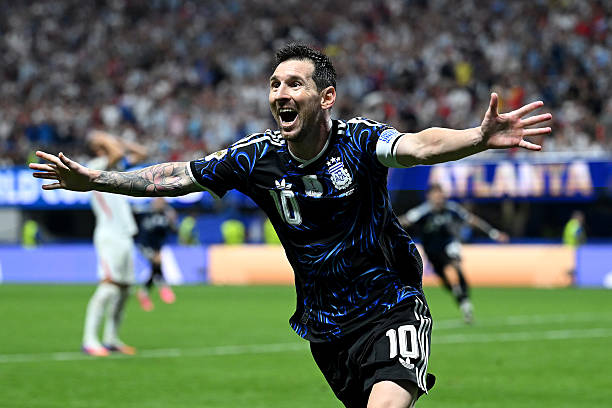

- Lionel Messi Retires from Argentina Duty After 20-Year International Career
Lionel Messi has announced his retirement from international football at the age of 39, bringing an end to a two-decade career with Argentina that transformed him from a player once criticised for falling short with his country into its most decorated modern football icon.
The Inter Miami forward confirmed the decision on August 31, weeks after Argentina’s 1-0 defeat to Spain in the 2026 FIFA World Cup final and following the death of his father, Jorge Messi, earlier in August. Messi said he had been considering retirement since shortly after the World Cup final and that his father’s death reinforced his belief that it was time to step away.
“It was a decision that hurt and still hurts in my soul, but I understand that this is the moment,” Messi said in an emotional statement announcing his departure from the national team.
His retirement closes one of the most consequential international careers in modern football. Messi made his senior Argentina debut in 2005 and went on to become the country’s record appearance-maker and leading goalscorer, ending his career with 207 caps and 125 goals, according to Reuters.
The numbers tell only part of the story. For much of the first half of his international career, Messi’s extraordinary success at Barcelona was contrasted with repeated disappointments for Argentina, particularly defeats in major finals and persistent comparisons with Diego Maradona.
That narrative changed dramatically in the second half of his career. Messi led Argentina to the 2021 Copa América, followed by the 2022 Finalissima and the 2022 FIFA World Cup, before adding another Copa América title in 2024.
The 2022 World Cup triumph in Qatar became the defining moment of his international career. Having lost the 2014 final to Germany and endured repeated continental disappointments, Messi finally lifted the trophy that had long been used as the principal measure against which his Argentina career was judged.
By the time Argentina reached another World Cup final in 2026, Messi’s relationship with the national team had been transformed. He was no longer viewed as the outstanding club player struggling to reproduce his success internationally, but as the leader of one of the most successful periods in Argentine football history.
The final against Spain, however, denied him a perfect farewell. Argentina lost 1-0, and Messi later revealed that he had written his retirement statement on July 21, just two days after the defeat, but had held back from publishing it.
His father’s death on August 8 added a deeply personal dimension to the decision. Jorge Messi, who had played a central role in managing his son’s career for decades, died aged 68 in Rosario after being admitted to hospital.
Messi subsequently acknowledged that the loss had made him question how much longer he wanted to continue playing. “These words I wrote on July 21, two days after the final. Today, after what happened to my dad, I am more convinced than before,” he said.
The timing also reflects Messi’s recognition that Argentina is moving towards a new generation. He said younger players were emerging who deserved an opportunity to take greater responsibility within the national team.
“There are very great young players coming up who deserve to be here,” Messi said.
That transition will now become one of the defining challenges facing Argentina. For more than two decades, virtually every version of the national team was constructed in some way around Messi’s presence, whether as its principal attacking threat, creative hub, captain or emotional reference point.
Replacing that influence will be impossible through one player alone. Argentina will instead have to build a collective identity capable of preserving the standards established during a period that delivered two Copa América titles and a World Cup.
Messi’s departure also ends a relationship with the national team that was not always straightforward. He briefly announced his retirement following Argentina’s defeat by Chile in the 2016 Copa América Centenario final before reversing the decision and returning.
What followed became arguably the most important phase of his international career. His performances and leadership during his 30s radically reshaped his legacy with Argentina and turned years of frustration into an era of sustained success.
Messi said he had always given everything to the national team, including during the difficult years before Argentina began winning major trophies.
“I swear I always gave everything, not just the last few years when everything was won, and I always fought and gave everything for this jersey, for giving them joy and making them proud to be Argentinians through football,” he said.
His retirement from international football does not mean an immediate end to his playing career. Messi remains with Inter Miami in Major League Soccer and has not announced his retirement from club football.
That distinction means supporters will still have opportunities to watch him play, but the sight of Messi in Argentina’s blue-and-white shirt has now come to an end. His final appearance was the 2026 World Cup final, bringing his international journey to a close on the biggest stage in the game.
Messi thanked his family, coaches, teammates, officials and supporters who shared the journey with him over the past two decades. He said he would now experience Argentina matches from the same position as millions of supporters who had followed him through years of disappointment and eventual triumph.
“Thank you for all the love over these 20 years. I will miss hearing from you from the inside a lot. Now I will be one of you, always cheering and supporting from the outside,” he said.
His retirement therefore closes more than the career of Argentina’s leading scorer and appearance-maker. It ends a footballing era that stretched from the final years of the Maradona comparisons through repeated heartbreak and eventually to a period in which Messi became the central figure in Argentina’s return to the summit of world football.
The final defeat to Spain means his international career did not end with another trophy. But after 20 years, a World Cup, two Copa América titles and a transformation in his relationship with Argentine supporters, the broader judgment on Messi’s international career had already been settled long before his final announcement.
He leaves the national team not as the brilliant player who could not win with Argentina, but as the captain who eventually won almost everything that had once seemed beyond his reach.

