

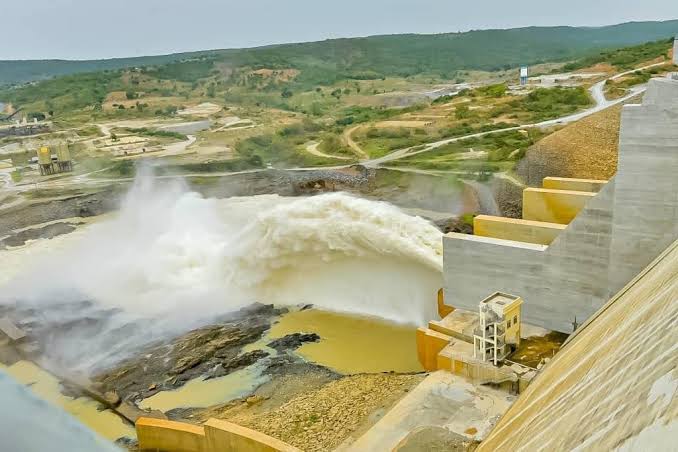

- Nigeria Reviews US$1.3bn Zungeru Plant as Output Remains at Half Capacity
Nigeria has opened a regulatory review of its US$1.3bn Zungeru Hydroelectric Power Plant after the facility was reported to be supplying approximately 350 megawatts to the national grid half of its 700MW installed capacity.
The Infrastructure Concession Regulatory Commission has convened the plant’s operator and relevant government institutions to identify the contractual, legal and operational constraints limiting performance.
The review brings together Penstock Limited, the Ministry of Power, the Ministry of Water Resources and the Bureau of Public Enterprises, which acts as the government’s grantor under the public-private partnership.
Zungeru, located on the Kaduna River in Niger State, has four generating units with an installed capacity of 175MW each. The China-assisted project was designed not only to produce electricity but also to support flood control, irrigation and water supply.
Its current output raises an immediate question for Nigeria: why is one of the country’s newest and most expensive power assets delivering only half the electricity it was built to produce?
ICRC Director-General Jobson Oseodion Ewalefoh said the review would assess the responsibilities of both the government and the private operator while seeking to improve service delivery and secure value for public investment.
“Signing a concession agreement is only the first step; implementation of the terms in the PPP agreement is what delivers results,” he said.
“In PPP, risks are shared and no party is doing the other a favour. Our duty is to ensure sustainability, return on investment is achieved, services are delivered, and value for money is secured in the interest of the Nigerian people.”
The reported 350MW output represents 50% of Zungeru’s installed capacity. But installed capacity does not necessarily indicate how much electricity a power plant should produce continuously.
Hydropower generation can fluctuate with water levels, reservoir management, seasonal conditions, maintenance requirements and grid instructions. Transmission limitations can also prevent an otherwise functional plant from dispatching its full available power.
The ICRC has not clarified whether the 350MW figure represents output at a specific time, a sustained operational limit or an average over a longer period.
It has also not identified how much of the shortfall is caused by the plant itself and how much may arise from weaknesses elsewhere in Nigeria’s electricity system.
That distinction is critical.
If turbines or other plant systems are unavailable, the problem lies primarily with operations and maintenance. If sufficient electricity can be generated but cannot be evacuated, the constraint may be transmission capacity. If the grid is unable to absorb the available power, running additional generating units may not improve supply to consumers.
The review will therefore need to establish whether Zungeru’s underperformance is technical, hydrological, contractual or systemic or a combination of all four.
Penstock Limited, a subsidiary of Mainstream Energy Solutions, operates the plant under a public-private partnership arrangement.
The structure was intended to combine state ownership of a major national asset with private-sector operating expertise and commercial discipline.
But PPPs do not eliminate public-sector risk. Their success depends on clearly allocated responsibilities, enforceable contracts and government agencies fulfilling their own obligations.
A concessionaire cannot deliver full performance if required transmission connections, regulatory approvals or payment arrangements are absent. Conversely, a private operator cannot rely on public-sector failures to excuse weak maintenance, delayed investment or failure to meet contractual targets.
The ICRC said the review would examine the obligations of both sides. That is important because public debate over infrastructure performance often begins by searching for a single institution to blame, even where failures arise from multiple agencies.
Mr Ewalefoh stressed that the commission is responsible for monitoring compliance and is not itself a party to the concession.
The review must consequently move beyond convening meetings. It should determine which obligations have not been met, identify the responsible parties and establish deadlines for corrective action.
Without that level of disclosure, the exercise risks becoming another administrative review that acknowledges underperformance without producing additional electricity.
Nigeria continues to experience chronic electricity shortages despite investing heavily in generation infrastructure.
The economic cost is borne by households and businesses that depend on diesel and petrol generators to compensate for unreliable grid supply. Manufacturers face higher production costs, while smaller businesses often lack the capital to maintain private power systems.
In that context, restoring unused capacity at an existing power station could be faster and less expensive than developing an entirely new facility.
If Zungeru can safely produce and dispatch an additional 350MW, that electricity could strengthen grid supply without another multibillion-dollar construction project.
However, the regulator has not said how much additional output the review could unlock or when any improvement should be expected.
The absence of a timeline weakens accountability. A plant producing below capacity requires an operational recovery plan with measurable targets, not merely an agreement among stakeholders to meet again.
The ICRC intends to extend similar compliance reviews to the Kainji, Jebba, Shiroro, Dadinkowa and Kashimbila hydropower plants.
A final report will be submitted to President Bola Tinubu.
Expanding the review could help identify whether Zungeru’s problems are unique or part of a wider pattern affecting Nigeria’s hydropower concessions.
If several plants face similar issues involving maintenance, transmission, contract enforcement or government obligations, the problem would point to structural weaknesses in the country’s power-sector governance rather than isolated operational failures.
Nigeria’s electricity challenge has never been simply the absence of installed generating capacity. The country has repeatedly struggled to convert nominal capacity into stable power delivered to consumers.
Generation plants may be available while transmission lines are constrained. Electricity may reach distribution companies but fail to produce adequate revenue because of losses, weak collections or tariff deficiencies. Payment shortfalls then move backwards through the value chain, weakening the ability of power producers to invest and maintain facilities.
Zungeru therefore sits inside a system in which one functional asset cannot correct failures across the entire electricity market.
The regulatory review is a necessary first step, but it will be meaningful only if it answers several unresolved questions.
Authorities must clarify whether the 350MW figure is a temporary dispatch level or a persistent operational ceiling. They must identify unavailable generating units, water constraints, transmission bottlenecks and unmet contractual obligations.
The government should also disclose the performance standards contained in the concession, the capital commitments of the operator and any penalties or remedies available when targets are missed.
For a US$1.3bn project, the public interest cannot be satisfied by reporting installed capacity alone.
The true measure of the investment is dependable electricity delivered to the grid, the economic value created and the additional benefits realised through irrigation, flood control and water supply.
Zungeru was built as a 700MW plant. If half that capacity remains consistently unavailable, Nigeria is not merely losing 350MW of electricity. It is failing to realise a substantial portion of the economic return expected from one of its largest power-sector investments.
The ICRC review now has an opportunity to determine whether the constraint lies in the dam, the operator, the contract or the wider grid.
Its eventual report must do more than distribute responsibility. It must provide a credible path for converting Zungeru’s installed capacity into electricity Nigerians can actually use.
The available report does not establish whether the 350MW figure is a momentary dispatch level or a sustained average, an important qualification when assessing a hydropower plant’s performance.

