

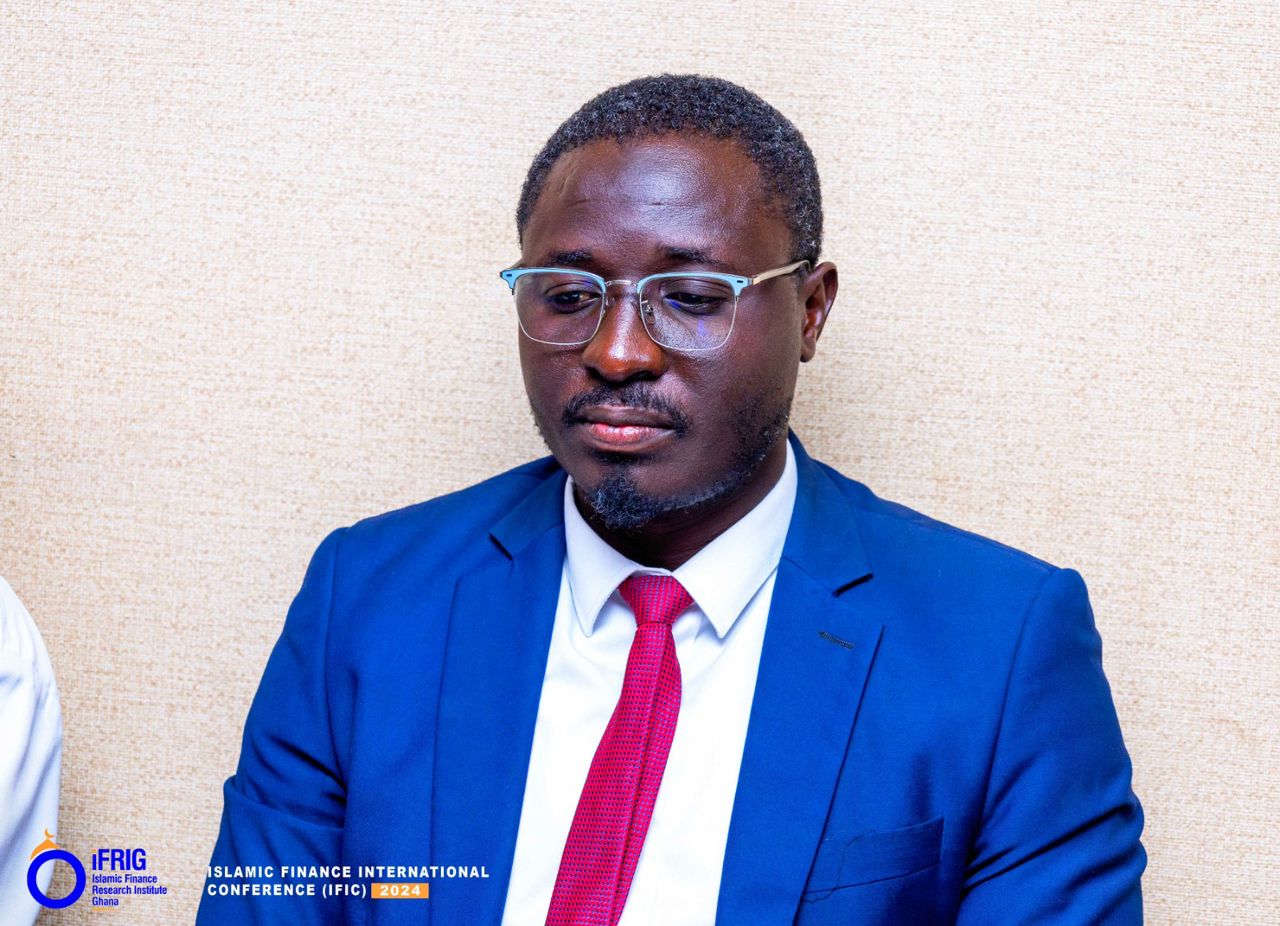

- Non-Interest Banking Could Bring More Ghanaians Into Formal Finance and Fund Infrastructure — Musah Maiga
Ghana should treat non-interest banking and finance as a mainstream market opportunity capable of attracting new capital, widening financial inclusion and supporting investment rather than as a specialised product reserved for a particular religious community, according to Musah Ismaila Maiga, Director of Audit and Governance at the Islamic Finance Research Institute of Ghana.
Speaking at the iFRIG National Dialogue on the theme, “Does Non-Interest Banking Belong Only to a Particular Group? Understanding Non-Interest Banking as a Financial Opportunity for All,” Mr Maiga said the commercial potential of the model extends far beyond its religious origins and could give Ghana an additional architecture for mobilising savings and investment.
“Indeed, to the question you posed, when you look at non-interest banking and finance, it represents a strategic market expansion opportunity,” he said.
His argument goes to the heart of how Ghana chooses to position the emerging segment. If non-interest finance is marketed principally as an alternative for customers unwilling to use conventional interest-based products, its potential market may remain narrow. But if it is presented as an additional financing model capable of mobilising domestic savings, attracting international capital and supporting businesses and infrastructure, its relevance could extend across the wider economy.
Financial inclusion is one of the areas Mr Maiga believes could benefit most. He cited an estimate that 42% of Ghana’s population remains unbanked, arguing that non-interest finance could help draw part of that population into the formal financial system. “That’s the first strategy,” he said, describing the opportunity as one that could help “monetize this unbanked population.”
The opportunity, however, is not limited to bringing individuals into banking. Ghana’s persistent financing constraints mean businesses and government also require instruments capable of mobilising longer-term capital for productive investment.
Mr Maiga pointed to Sukuk, an Islamic capital-market instrument, as one such option, particularly for infrastructure. He referenced Nigeria’s experience, where contributions at the dialogue noted that Sukuk financing had been used to support road projects. “Again, it serves us an opportunity because it provides a new tool for infrastructure financing,” he said.
For Ghana, that argument comes at a time when infrastructure development remains central to the country’s economic ambitions. Mr Maiga said additional capital-market instruments could diversify the sources available to finance projects and reduce dependence on a limited range of conventional borrowing channels.
He also argued that non-interest finance could connect Ghanaian businesses to international investors operating in a global industry with substantial pools of capital.
“It also connects our local market to direct foreign investments,” he said. “We know that research has established that this particular industry is a multi-trillion-dollar-driven industry, and so it has opened up the door for other investors from other countries to also come in as well.”
That international dimension could be significant for Ghana if the country can build products and institutions capable of attracting patient capital into infrastructure, enterprise development and productive investment.
But Mr Maiga acknowledged that commercial opportunity alone will not determine whether non-interest finance gains wider acceptance. Public perception remains an important obstacle, particularly where the model is understood primarily through a religious lens.
He said some of that perception is linked to terminology. In a country where religious identity is deeply embedded in public life, references to “Islamic finance” can immediately create an association with one faith even where the underlying financial principles may have broader application.
“For every change, of course, there is an anxiety to every change,” Mr Maiga said. “And so, it’s not about the anxiety, but how do we strategically approach it?”
He said the terminology “non-interest banking and finance”, developed with the involvement of the Bank of Ghana and other stakeholders, was intended to make the concept more accessible to the broader population and reduce the perception that participation depended on religious identity.
Mr Maiga also argued that misunderstandings around the term “Sharia” continue to shape public attitudes, obscuring what he described as a broader framework of laws and principles. For the financial sector, he suggested that overcoming those misconceptions will require more than a change in terminology. It will require sustained public education, transparent products and evidence that the system can serve customers regardless of their faith.
The most immediate commercial test may be Ghana’s small and medium-sized enterprise sector.
Many SMEs continue to face financing constraints linked to high borrowing costs, collateral requirements and weak balance sheets. Mr Maiga argued that non-interest financing structures could provide another route to capital for businesses struggling under those conditions.
“When you look at the business arrangement, the financial models of this particular financial alternative, those struggling businesses who are normally burdened with high conventional borrowing costs and also collateral requirements, this will ease their burden,” he said.
The potential distinction lies in financing structures that can be built around productive assets, partnerships, leasing and forms of risk sharing, potentially linking finance more closely to the underlying economic activity of the business.
“That’s why I’m thinking this is a great opportunity for not only big businesses but also small startup businesses as well,” Mr Maiga said.
The debate, therefore, is increasingly about whether Ghana can develop the regulation, institutional capacity, market confidence and public understanding required to make non-interest finance commercially viable at scale.
For Mr Maiga, the central message is that the model should not be defined by who it excludes.
“Everyone has to come,” he said. “And they don’t also say that because you are not a Muslim, you are not part of the client base. It opens to all.”
If that broader positioning succeeds, non-interest finance could become less a debate about religious identity and more a discussion about expanding Ghana’s financial market bringing in new pools of capital, widening financing choices and creating additional channels for funding both major infrastructure and the smaller businesses operating at the foundation of the economy.

