


- Power Demand Is Outrunning the Grid, Exposing A New Energy Investment Gap
Ghana’s electricity market is entering a more demanding phase, with power consumption and peak demand rising faster than earlier projections and exposing a widening gap between the country’s economic ambitions and the infrastructure needed to support them.
The trend is partly a sign of growth. Expanding businesses, rising household appliance ownership, increased industrial activity, population growth and plans to extend economic activity beyond conventional working hours are all contributing to higher electricity consumption.
But the same trend is also a warning. A stronger economy requires more power, yet supplying that power reliably depends on generation, fuel, transmission and distribution infrastructure that Ghana has struggled to expand at the same pace.
The country’s system peak demand reached about 4,280MW in 2025, according to analysis by the Institute for Energy Security, more than double the roughly 1,933MW recorded in 2015. That implies average annual growth of more than 8.00% over the decade.
The significance extends well beyond the power sector. Electricity is a basic input into manufacturing, mining, telecommunications, logistics, retail and increasingly digital services, meaning rising demand can be a useful indicator of greater economic activity.
The difficulty arises when infrastructure cannot keep up. If the grid cannot move sufficient electricity to the places where it is needed, stronger demand can quickly turn from evidence of growth into a source of operational risk for businesses.
That is why Ghana’s immediate energy challenge is no longer simply whether enough generating capacity exists. The more important question is whether electricity can be transmitted and distributed reliably at the moment and location where consumers require it.
Earlier projections by the Energy Commission show how quickly demand assumptions are being overtaken. Its 2025 outlook projected system peak load at 4,125MW, following a peak of 3,952MW in 2024, while electricity consumption was expected to rise 4.70% to 25,836GWh.
An actual peak of about 4,280MW would therefore suggest that demand pressure was stronger than anticipated. That matters because installed generation capacity can create a false sense of comfort if significant parts of that capacity are unavailable because of maintenance, fuel shortages, water constraints or transmission bottlenecks.
Thermal generation has also become increasingly important to Ghana’s electricity mix. The Energy Commission projected that thermal plants would account for about 65.80% of generation in 2025, compared with 33.10% from hydropower.
That makes power security increasingly dependent on natural gas availability and the cost of thermal generation. But even adequate generation will not solve the problem if the transmission network cannot evacuate power efficiently.
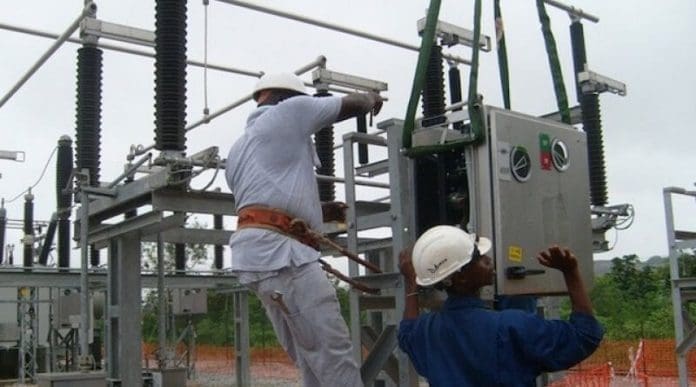
IES has warned that demand growth has not been matched by comparable investment in transmission infrastructure. Congested corridors, overloaded equipment, technical losses and ageing assets are increasingly becoming part of the constraint.
This distinction is critical. Ghana can commission additional power plants and still face localised shortages if the transmission network lacks the capacity to carry the electricity to high-demand centres.
For businesses, the consequences can be severe. Manufacturers need predictable supply to run production lines, mining companies depend on stable high-voltage electricity, while data centres and telecommunications infrastructure require uninterrupted power.
Smaller companies face the same problem in a different form. When grid reliability weakens, businesses are forced to spend more on generators, fuel, batteries or other backup systems, effectively creating an additional cost of doing business.
The transmission gap therefore has direct implications for competitiveness. Every cedi spent by a company on self-generation because the grid is unreliable is money that could otherwise have gone into wages, expansion, technology or productivity improvements.
Closing that gap will require substantial capital. Reinforcing high-voltage lines, expanding substations, replacing transformers and modernising system-control infrastructure are expensive projects with long payback periods.
Ghana’s fiscal constraints make it increasingly difficult for government to finance all of those investments directly. That is why IES has advocated alternative financing structures, including public-private partnerships, supported by regulatory arrangements that provide credible cost recovery.
The issue becomes even more pressing in the context of Ghana’s proposed 24-hour economy. Encouraging factories, logistics centres, commercial businesses and processing plants to operate for longer periods will increase electricity demand beyond traditional daytime patterns.
The policy cannot therefore be treated separately from energy investment. If the economy is expected to operate around the clock, the electricity system must be capable of supporting round-the-clock production.
That means generation, transmission and distribution need to expand together. Building additional power plants without strengthening the network would leave the underlying constraint unresolved.
There is also a case for diversifying the way demand is managed. Distributed solar generation, battery storage and energy-efficiency measures can help reduce pressure on the national grid, particularly for commercial and industrial consumers.
Demand-response programmes could also allow large electricity users to shift non-essential consumption away from peak periods. Combined with better data and smarter grid management, such measures could make the system more flexible even before large new transmission projects are completed.
But renewable energy cannot substitute for transmission investment. Solar plants still require grid connections, battery systems need suitable market and regulatory frameworks, and distributed generation requires technical standards that protect system stability.
The objective should therefore be a more flexible electricity system rather than simply a larger one. Ghana needs enough generation, but it also needs the infrastructure and technology to move that generation efficiently across the country.
The investment opportunity is substantial. Transmission lines, substations, grid automation, smart meters, battery storage, solar systems, industrial captive power and energy-management technologies are all likely to become increasingly important as demand continues to rise.
But investors will require a credible commercial environment. Financially sustainable utilities, predictable tariffs, transparent procurement and dependable payment arrangements will be essential if private capital is expected to finance part of the next phase of infrastructure development.
The alternative could be more expensive. Ghana risks paying for generation capacity that cannot be efficiently delivered while businesses simultaneously spend additional money securing their own electricity supply.
That would leave the country with the worst of both worlds: substantial investment in power generation without the full productivity benefits of reliable electricity reaching consumers.
The rise in electricity demand should therefore not be interpreted only as an energy crisis. It is also evidence that Ghana’s economy is becoming more electricity-intensive.
The challenge is ensuring that the infrastructure supporting that transition expands at least as quickly as demand itself. Ghana has moved from an era where adding generation capacity dominated the energy debate to one where the entire electricity value chain must expand together.
The next phase of energy policy will consequently be judged less by how many megawatts Ghana can claim on paper and more by how reliably those megawatts reach factories, mines, businesses and households.
That makes transmission, rather than generation alone, one of the defining economic infrastructure priorities of the decade.

