

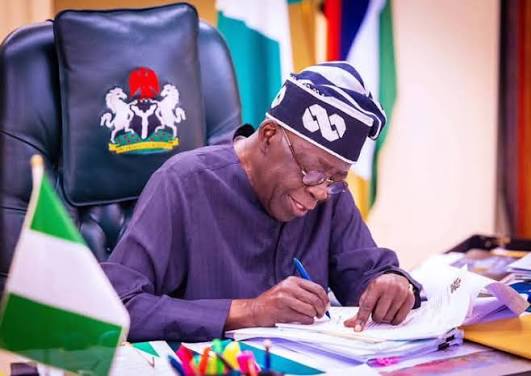

- President Tinubu Launches US$552 Million Education Drive to Tackle Nigeria’s Learning Crisis
Nigeria has launched a US$552 million basic education reform programme backed by the World Bank and the Global Partnership for Education, signalling a renewed attempt to address chronic learning deficits and strengthen the human capital base of Africa’s largest economy.
President Bola Ahmed Tinubu unveiled the HOPE-EDU initiative in Abuja, describing it as part of a broader national strategy to improve learning outcomes, widen access to schooling and strengthen the public education system. The programme is expected to directly benefit about 29 million children, more than 500,000 teachers, 65,000 public schools and 10,000 non-formal learning centres across the country.
The financing structure reflects both domestic reform ambition and external development support. The World Bank had earlier approved US$500 million for the Hope for Quality Basic Education for All programme, with an additional US$52.18 million in co-financing from the Global Partnership for Education Fund.
For Nigeria, the education programme is more than a social-sector intervention. It is a direct response to one of the country’s most serious economic constraints: a large and youthful population whose productive potential is weakened by poor learning outcomes, inadequate school infrastructure and uneven access to quality basic education.
The World Bank says HOPE-EDU will focus on improving foundational learning, expanding access to basic education and strengthening education systems in participating states. The programme will support structured approaches to literacy and numeracy, create learning opportunities where overcrowding limits participation and improve the decentralised management of Universal Basic Education Intervention Funds.
That focus is critical. Nigeria’s long-term economic prospects will depend not only on macroeconomic stabilisation, tax reforms, foreign exchange adjustment and private-sector investment, but also on whether millions of children acquire the basic skills needed to participate in a modern economy.
Tinubu framed the education drive as part of a wider package of initiatives designed to reduce poverty, develop human capital, strengthen healthcare and build community resilience. “These programmes are not separate efforts,” he said, describing them as one coordinated national strategy.
The launch comes as Nigeria attempts to convert recent economic reforms into more visible improvements in living standards. Since taking office in 2023, Tinubu’s administration has pursued sweeping reforms, including fuel and electricity subsidy changes, naira devaluation and tax system reforms aimed at strengthening public finances.
Those reforms have been praised by some investors and development partners for addressing structural weaknesses, but they have also imposed heavy costs on households through higher prices, pressure on real incomes and rising living expenses. The political and economic test for the administration is whether reform pain can be translated into jobs, productivity, better services and improved household welfare.
Education is central to that test. A stronger basic education system could improve workforce productivity, widen employment prospects and support the industrial, digital and service-sector growth Nigeria needs to diversify beyond traditional economic drivers.
The HOPE-EDU launch also aligns with the World Bank’s broader engagement with Nigeria. In June, the World Bank Group endorsed a new Country Partnership Framework for Nigeria covering 2026 to 2032, with a strategy focused on creating more and better jobs by unlocking private sector-led growth.
As part of that framework, the Bank approved a US$1.25 billion Nigeria Actions for Investment and Jobs Acceleration Development Policy Financing operation to support reforms in capital markets, digital regulation, power-sector reforms, trade facilitation, agricultural productivity and domestic revenue mobilisation.
The connection between education reform and private-sector growth is important. Investors need infrastructure, stable regulation and access to finance, but they also need a skilled labour force. Weak literacy, numeracy and technical foundations limit productivity, reduce employability and constrain innovation.
By targeting 29 million children and 500,000 teachers, HOPE-EDU operates at a scale that could matter if implementation is disciplined. Teacher quality, classroom conditions, basic learning materials, school governance and reliable funding flows will determine whether the programme produces measurable results or becomes another underperforming public-sector initiative.
The implementation challenge will be substantial. Nigeria’s federal structure means education delivery depends heavily on coordination between federal authorities, state governments, local education bodies and school-level administrators. Funds must reach the right institutions, reforms must be monitored, and outcomes must be measured beyond enrolment numbers.
The programme’s emphasis on public primary schools and school-based management committees suggests an attempt to strengthen the delivery chain at the point where learning actually happens. But success will require transparency, state-level accountability and regular publication of progress indicators.
For development economists, the programme reflects a broader shift in how Nigeria’s growth challenge is being framed. Macroeconomic reform may stabilise the economy, but human capital reform determines whether stabilisation produces broad-based prosperity.
Nigeria’s population gives it a potentially enormous demographic advantage. But that advantage becomes meaningful only if children stay in school, learn effectively and transition into productive employment or enterprise.
The HOPE-EDU programme therefore represents a bet on Nigeria’s future labour force. If implemented well, it could improve learning outcomes, strengthen public schools, raise teacher effectiveness and support the country’s long-term competitiveness.
The stakes are high. For Tinubu, the initiative offers a route to show that difficult economic reforms can be matched by investments in people. For Nigeria, it is a reminder that the foundation of national competitiveness begins not in oil fields, ports or capital markets, but in classrooms.

