


- Russia Agrees to Work with Ghana on 2,000MW Nuclear Power Plant
Russia has agreed to work with Ghana towards developing a 2,000-megawatt nuclear power plant, Foreign Affairs Minister Samuel Okudzeto Ablakwa has said, outlining an energy partnership intended to support industrialisation and strengthen electricity security.
The announcement followed discussions at the Russia-Africa Summit and forms part of a wider package of cooperation between the two countries. The proposed plant would represent a substantial addition to Ghana’s power infrastructure if developed. However, the announcement does not establish that construction financing has been secured or that a final investment decision has been taken.
The Reuters account did not disclose a project cost, financing structure, construction timetable, selected site or reactor configuration. Those details will be central to assessing how the political commitment can translate into an operating power station.
For Ghana, the significance of the proposal lies in its stated connection to industrial development. The commercial value of additional generation would depend on whether it delivers dependable electricity at a cost businesses and households can afford.
The distinction between an agreement to cooperate and a fully financed construction project is therefore important. The next stages would need to clarify what Russia would provide, what obligations Ghana would assume and how the proposed investment would fit into the country’s wider electricity plans.
The announcement came a day after Russia’s state nuclear corporation, Rosatom, said it was discussing large nuclear power projects with four African countries, including Ghana. That places the Ghanaian proposal within Moscow’s broader effort to deepen energy relationships across the continent.
A project of this scale raises questions extending beyond its announced generating capacity. Financing terms, ownership arrangements, electricity purchase commitments and the allocation of construction risks would shape its economic implications.
For policymakers, the eventual assessment would need to consider the full cost of delivering electricity rather than the size of the plant alone. A proposal can offer substantial generating capacity while still requiring careful examination of how its costs will be recovered.
The government would also need to explain how a new nuclear partnership relates to existing work on Ghana’s nuclear programme. The latest announcement, as reported, does not set out whether it advances an existing procurement process or introduces a separate development arrangement.
Clarity on that point would help businesses, investors and the public understand the project’s status and the decisions still outstanding.
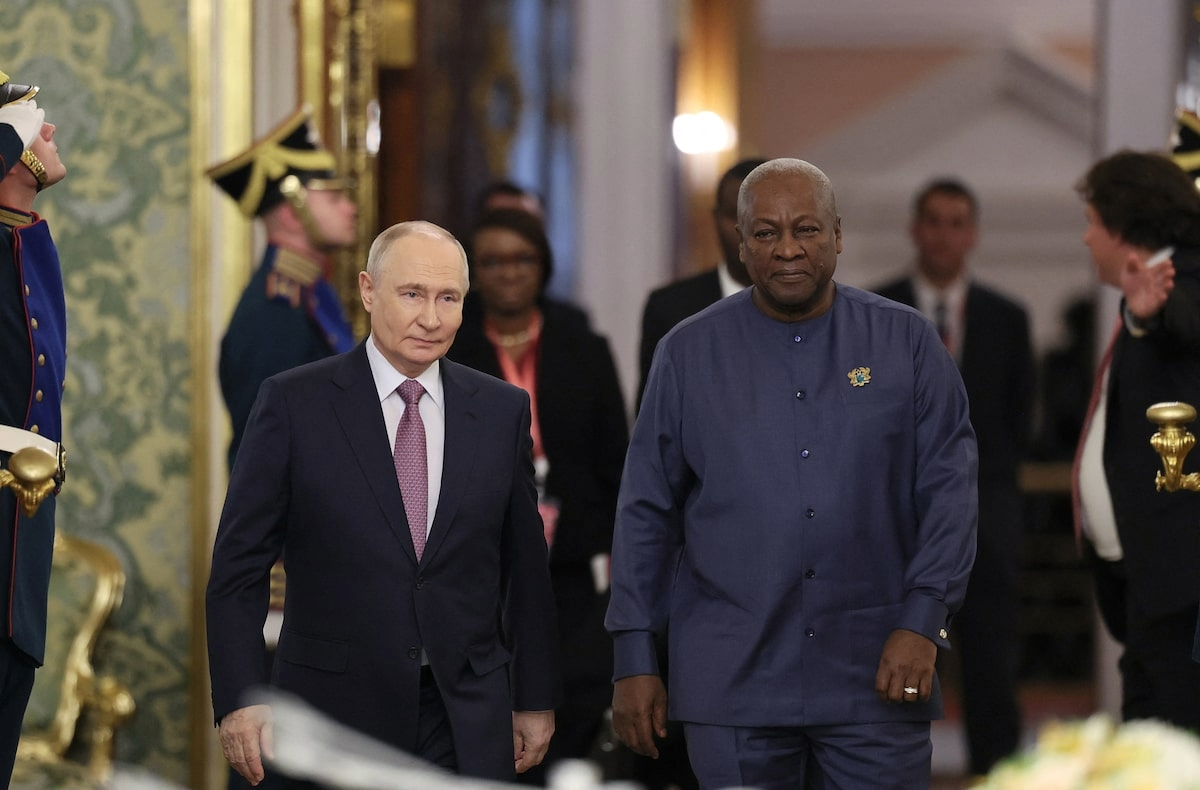
The energy proposal emerged from a wider diplomatic engagement between President John Dramani Mahama and Russian President Vladimir Putin on the sidelines of the summit in Moscow.
According to Ablakwa’s account, the discussions also produced commitments covering defence, agriculture, education and bilateral coordination. The two countries intend to revive their Permanent Joint Commission for Cooperation, with Russia expected to host its next meeting.
That mechanism could provide a forum for turning broad commitments into specific programmes, although the reported announcement did not identify a detailed implementation schedule for the nuclear proposal.
In agriculture, the cooperation is intended to support grain production and improve access to fertilisers. Russia also agreed to expand scholarship opportunities for Ghanaian students, according to the minister’s statement.
These commitments broaden the economic relationship beyond electricity generation. Their practical value will depend on the programmes subsequently agreed, the resources allocated and the institutions responsible for delivery.
The defence component concerns a new cooperation arrangement aimed at helping Ghana acquire strategic military equipment. Ablakwa also said Putin had agreed that Ghanaians would no longer be permitted to participate in Russia’s war in Ukraine, including through irregular recruitment or voluntary enlistment. The reported assurance was attributed to the Ghanaian minister.
For the nuclear project, the immediate priority is greater detail. An announced capacity of 2,000MW provides a headline objective, but does not show when electricity could become available or what consumers would ultimately pay for it.
A financing proposal would need to identify the balance between any government commitments, external borrowing and private investment. It would also need to establish who bears the financial consequences of delays or cost increases.
These are questions for the next stage of project development rather than shortcomings that can be resolved by a summit announcement alone.
The government’s energy security objective similarly requires a wider assessment of how the proposed plant would operate within the electricity system. Generating capacity has value when it can be delivered reliably to customers and matched with demand.
For manufacturers considering long-term investment, the most useful outcome would be greater confidence in both electricity availability and pricing. Whether the proposed partnership can provide that will depend on its final technical and commercial arrangements.
The commitment nevertheless gives renewed political attention to Ghana’s nuclear ambitions and identifies a potential international partner for a project of considerable scale.
The next measure of progress will be the publication of concrete development milestones: the scope of cooperation, the responsible project entities, the financing approach and the approvals required before construction can proceed. Until those emerge, the announcement is best understood as a commitment to work towards the plant, with the investment terms still to be established.

