

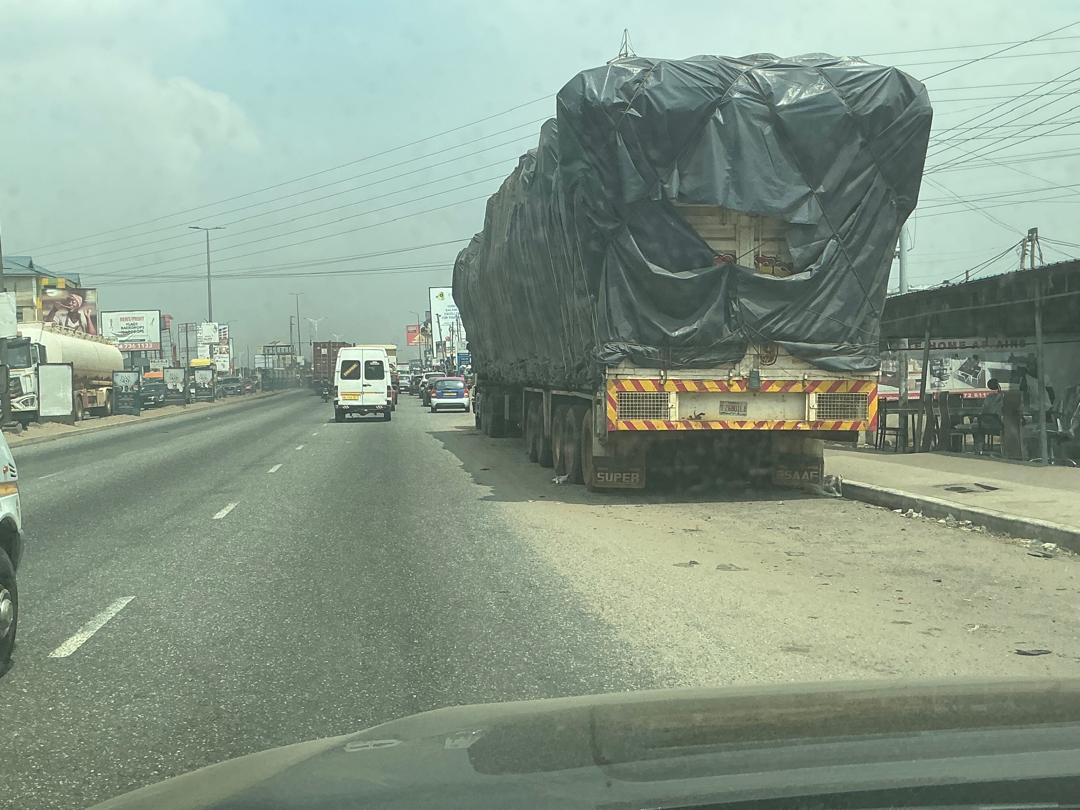

- Truck Parked Near ABC Junction Raises Safety Concerns — CUTS
CUTS International Accra has called for the immediate inspection and removal of a loaded articulated truck it says has remained beside the Accra–Nsawam road for more than a month, questioning why an obstruction close to routine police traffic operations has been allowed to persist.
In a statement issued on November 2, the policy think tank said the Nigerian-registered vehicle, bearing registration number T-26001LA, was parked along the Achimota stretch just before ABC Junction, worsening rush-hour congestion and raising questions about road safety, cargo supervision and institutional accountability.
The organisation wants the Ghana Police Service, National Security, the National Road Safety Authority and the relevant municipal assembly to establish ownership, verify the cargo and arrange safe removal.
Its security concern centres on the absence of verified information about the load. CUTS explicitly makes no allegation that the vehicle contains explosives or other hazardous materials, and says it does not know whether authorities have inspected it.
Appiah Kusi Adomako, Director of CUTS International’s West Africa Regional Centre, said he photographed the vehicle on October 8 after observing it at the location for several weeks.
“I photographed this truck on 8 October after seeing the vehicle parked there for weeks. The truck continues to occupy road space while motorists struggle through congestion. The responsible agencies owe the public an explanation for this prolonged inaction,” he said.
The account places the vehicle at the location at least 25 days before the release, in addition to the preceding weeks described by Adomako. That duration is central to CUTS’ criticism: an obstruction initially associated with a temporary breakdown can become a persistent public hazard when no effective clearance follows.
The organisation said the truck stood less than 100 metres from the point where police officers regularly direct traffic at Neoplan Junction. It questioned how a stationary vehicle so close to routine enforcement activity could remain unresolved for weeks.
That proximity sharpens the accountability issue. Directing vehicles around an obstruction may ease immediate congestion, but it does not remove the source of the problem. CUTS argues that traffic management should include identifying hazards and ensuring that the responsible institutions act on them.
“The owner must take responsibility for the truck. State agencies must also fulfil their enforcement responsibilities. Road users should not continue to bear the consequences of this neglect,” Adomako said.
The organisation’s demands extend beyond towing. It wants agencies to explain the delay, investigate any neglect of duty and apply appropriate sanctions, including recovery of towing and storage costs where legally permitted.
The release does not include a response from the truck’s owner or the agencies named. It also does not establish why the vehicle has remained stationary, whether a breakdown occurred or whether any removal arrangements are already in progress.
Those unanswered questions matter. An inspection and an account of previous official action would help distinguish between a vehicle awaiting recovery, a dispute over responsibility and a failure to respond to a known obstruction.
CUTS cited the Road Traffic Regulations, 2026, L.I. 2519, as providing grounds for intervention. Ghana’s Ministry of Transport has confirmed that Parliament approved the regulations on May 28, 2026, as part of a wider road safety and enforcement framework.
According to CUTS’ interpretation, Regulation 235 restricts parking on roads and hard shoulders except in emergencies, while Regulation 127 addresses the removal of broken-down vehicles and intervention where they are dangerously positioned.
The organisation also pointed to provisions covering hazardous-goods transportation. It said those requirements should be applied if an inspection establishes that the cargo falls within that category.
The sequence is important: identify the contents, assess the actual risk and determine the appropriate safeguards. The truck’s registration and loaded condition alone do not establish that its cargo is dangerous.
“A loaded truck left beside a busy road for weeks should attract official attention. The Police should establish ownership, verify the cargo and assess the circumstances. Public safety requires active supervision and timely intervention,” Adomako said.
To underline the consequences of inadequate safeguards, CUTS referred to the January 20, 2022, Appiatse disaster involving a truck carrying mining explosives, and the August 2020 Beirut port explosion involving stored ammonium nitrate.
The organisation presented those incidents as lessons in risk prevention, rather than evidence about the Achimota vehicle. Their relevance to its argument is the need to establish what cargo is present before an unattended load is treated as an ordinary roadside inconvenience.
CUTS said no visible cordon had been observed. That observation does not establish whether an official assessment has taken place, but strengthens the case for authorities to communicate what they know and what action they intend to take.
The immediate economic concern is congestion. A large vehicle occupying usable road space can constrain movement along a busy corridor, with potential consequences for commuters, commercial drivers and deliveries.
The statement provides no traffic counts, measured journey-time increases or estimate of financial losses. Its claim that the truck worsens congestion should therefore be understood as the organisation’s assessment, rather than a quantified finding.
Nevertheless, the persistence of the obstruction raises a broader management question: who takes ownership of a roadside hazard when several institutions have related responsibilities?
Police may encounter the vehicle during traffic operations, local authorities may receive complaints, and road safety officials may assess the danger. Without a clear reporting and escalation process, awareness can fail to produce action.
CUTS consequently wants routine checks and defined reporting arrangements for stationary trucks on major roads. Such arrangements would need to identify who records the vehicle, contacts the operator, assesses the cargo and authorises recovery.
Safe removal also requires planning. The condition of the truck, its load and the surrounding traffic must inform the choice of equipment and any temporary controls.
For the Achimota case, the organisation’s request is specific: inspect the vehicle, establish responsibility, provide appropriate warnings and clear the obstruction safely. An explanation of why it remained for so long would then allow the public to assess whether the failure was operational, institutional or attributable to the owner.

