

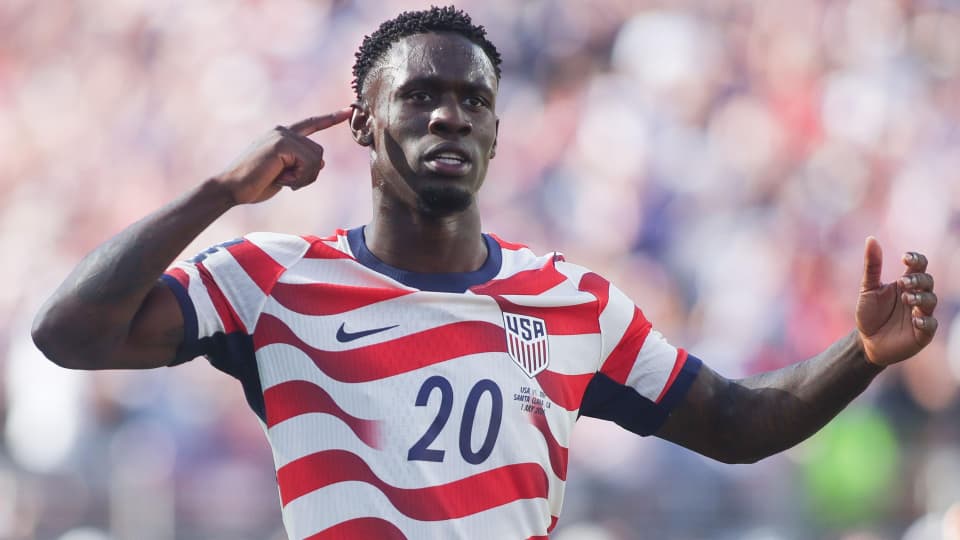

- Trump Lobbying Claim Throws FIFA Into Crisis After Balogun Ban Reversal
The 2026 FIFA World Cup has been plunged into a major governance controversy after FIFA overturned the one-match suspension imposed on United States striker Folarin Balogun, triggering an unusually sharp rebuke from UEFA and a formal challenge from Belgium ahead of their Round of 16 clash with the co-hosts.
The decision has moved far beyond a disciplinary dispute over one player. It has become a test of FIFA’s independence, transparency and credibility at a tournament already under intense global scrutiny.
Balogun had initially been suspended after receiving a straight red card during the United States’ Round of 32 victory over Bosnia and Herzegovina. Referee Raphael Claus dismissed the striker following a VAR review which concluded that he had stepped on the ankle of Bosnian defender Tarik Muharemovic.
Under FIFA’s disciplinary framework, a red card normally carries an automatic one-match suspension. But FIFA announced on Sunday that Balogun’s punishment had been suspended under Article 27 of its Disciplinary Code, placing the player on a one-year probationary period and clearing him to play against Belgium.
UEFA described the ruling as “unprecedented, incomprehensible and unjustifiable,” warning that FIFA had weakened one of the basic certainties of the game: that a sending-off carries an automatic sporting consequence.
“When the certainty of rules is no longer guaranteed by its guardians, the integrity of the game is at stake,” UEFA said.
The strength of UEFA’s statement reflects the wider concern now surrounding the case. The controversy is not merely that Balogun has been made available for a knockout match. It is that FIFA appears, to its critics, to have created an exception in the middle of the World Cup without sufficiently explaining why this case deserved special treatment.
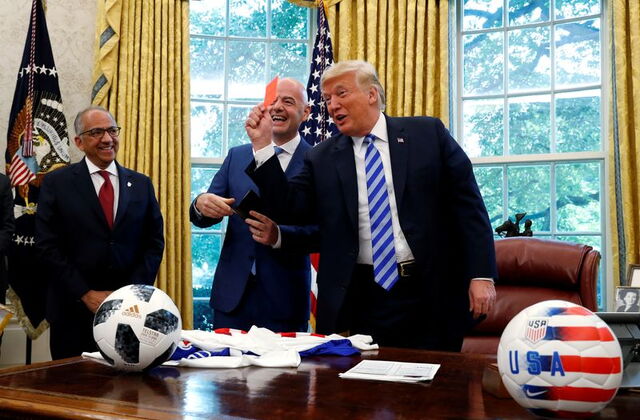
That perception has been sharpened by reports that US President Donald Trump personally contacted FIFA officials three times after Balogun’s dismissal to argue that the red card was unfair.
Following FIFA’s decision, Trump publicly welcomed the reversal on Truth Social, writing: “Thank you to FIFA for doing what was right, and reversing a great injustice!”
For critics, that message poured fuel on an already volatile issue. Even if FIFA insists its decision was taken independently, the appearance of political pressure has become impossible to ignore.
The timing is also sensitive. The United States are co-hosts of the tournament, Balogun has scored three goals in three World Cup appearances, and his availability significantly strengthens Mauricio Pochettino’s team ahead of a high-stakes meeting with Belgium.
Belgium’s football federation has formally appealed FIFA’s ruling and expressed astonishment that the decision was taken without, according to the federation, the provision of detailed reasoning before the appeal process began.
Belgium manager Rudi Garcia mocked the ruling at his pre-match press conference, saying it felt as though “5 July had become 1 April,” a pointed reference to April Fools’ Day.
The Royal Belgian Football Association is reportedly considering further legal options if FIFA does not provide satisfactory grounds for the decision.
The case has also drawn political reaction across Europe.
Belgium’s Foreign Minister, Maxime Prévot, a former referee, warned that any political influence over sporting disciplinary decisions would represent a serious breach of football’s principles.
European Commissioner for Sport Glen Micallef also stressed that decisions involving sporting rules must remain in the hands of football authorities, not politicians. In the United Kingdom, Prime Minister Keir Starmer’s spokesperson said World Cup disciplinary matters should remain fully under FIFA’s authority in order to preserve the integrity of the competition.
The political dimension has made the controversy especially dangerous for FIFA.
World football’s governing body has frequently defended its autonomy from political interference. Yet in this case, it now faces questions over whether its disciplinary process was influenced, or at least appeared to be influenced, by pressure from the leader of a co-host nation.
That distinction matters. In governance, perception can be as damaging as proof. A competition’s credibility depends not only on fair decisions, but on decisions being seen to be fair.
The United States camp has pushed back against the criticism. Head coach Mauricio Pochettino said Balogun’s original dismissal was unfair and argued that FIFA had simply corrected a bad decision.
“We were punished enough against Bosnia and Herzegovina by playing with 10 men,” Pochettino said.
“I think everyone who loves the sport and trusts ethics and integrity should celebrate this decision.”
US captain Christian Pulisic also supported the outcome, saying the reversal “just feels right.” Defender Chris Richards said the players first learned of the decision through social media before receiving official confirmation from US Soccer officials.
Balogun himself had taken a measured tone after the sending-off, urging young players to respond to disappointment with maturity even when they believe a decision is harsh.
If FIFA can suspend an automatic red-card ban in this case, UEFA and Belgium are effectively asking why similar leniency is not applied more broadly. If the answer is that the original decision was clearly wrong, critics will ask why FIFA has not published a detailed explanation strong enough to justify departing from standard practice.
Knockout football is built on fine margins. A suspended striker being cleared to play can materially affect a match. Belgium’s concern is therefore not abstract. It is competitive.
For FIFA, the safest path now is transparency. The governing body must explain the disciplinary reasoning in detail, clarify the application of Article 27, and address whether any external representations were made or considered.
At the heart of the dispute is a simple governance question: are football’s rules applied consistently, or can they bend under pressure when the stakes are high enough?
The answer will matter beyond one match, one striker or one World Cup host nation.
If Belgium’s appeal fails and Balogun plays, the United States will celebrate the return of one of their most important attacking players. But FIFA may still face a longer reputational battle over how the decision was reached.
If the appeal succeeds, FIFA will be accused of mishandling the process from the start.
Either way, the episode has already damaged the clean sporting narrative of the tournament.
The World Cup is supposed to be decided by players, coaches, tactics and moments of brilliance. Instead, one of its biggest knockout fixtures is now being overshadowed by claims of lobbying, accusations of inconsistency and a renewed debate over whether football governance can truly remain independent when political power enters the room.
Balogun may yet line up against Belgium. But the larger question will remain long after the final whistle: who, in the end, really controls the rules of the game?

