


- Argentina Could Face FIFA Sanctions Over Political Falklands Banner After Dramatic World Cup Win Over England
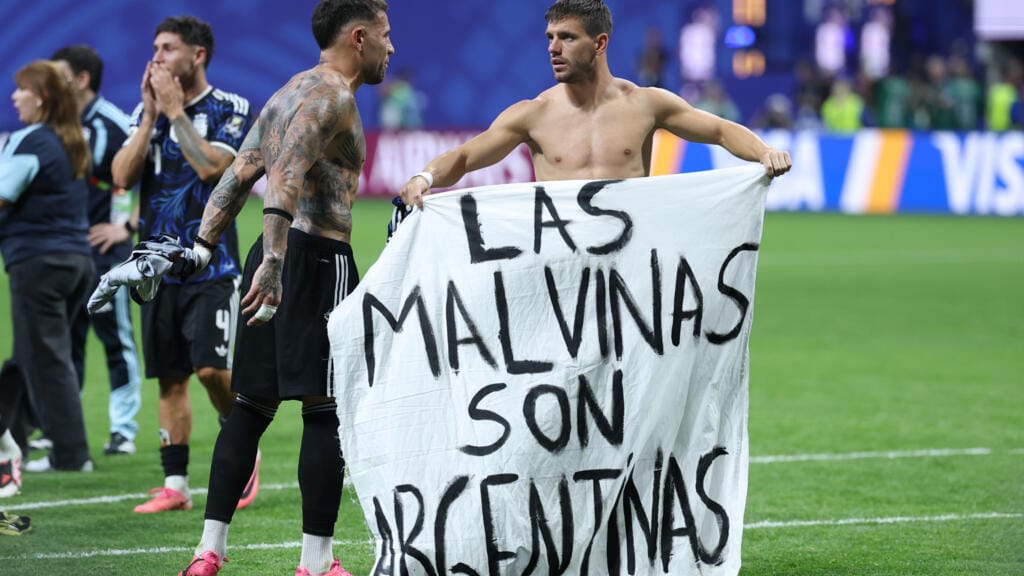
Argentina’s place in the 2026 FIFA World Cup final has been overshadowed by the possibility of disciplinary action after several players displayed a political banner supporting the country’s claim to the Falkland Islands following their dramatic semifinal victory over England.
The defending champions staged a remarkable late comeback in Atlanta on Wednesday, scoring twice in the closing minutes to secure a 2-1 victory over England and book a mouth-watering final against European champions Spain. Enzo Fernández levelled the scores in the 85th minute before substitute Lautaro Martínez headed home Lionel Messi’s cross in stoppage time to send Argentina into a second successive World Cup final.
However, the celebrations quickly sparked controversy.
As jubilant players celebrated on the pitch, several members of the Argentine squad unfurled a banner bearing the words “Las Malvinas son Argentinas” (“The Falklands are Argentine”), a slogan linked to Argentina’s long-standing sovereignty claim over the Falkland Islands, a British Overseas Territory in the South Atlantic.
The display is likely to come under scrutiny from FIFA, whose Stadium Code of Conduct prohibits the display of political, discriminatory or offensive messages inside tournament venues. Article 34.3 of the FIFA World Cup regulations also forbids players from displaying political slogans before, during or after official matches.
While FIFA had not issued an official response at the time of writing, precedent suggests Argentina could face a financial penalty rather than sporting sanctions.
In 2014, the Argentine Football Association was fined 30,000 Swiss francs after players posed with an identical “Las Malvinas son Argentinas” banner before an international friendly against Slovenia. That previous disciplinary case has fuelled expectations that FIFA could once again impose a fine if it determines the latest incident breached its regulations.
The incident has also drawn political reactions in both Argentina and the United Kingdom.
Argentina’s Vice-President, Victoria Villarruel, celebrated the team’s victory on social media, declaring, “The Falklands are Argentine,” while insisting the issue remains deeply rooted in the country’s national identity. Before the semifinal, she had described the match against England as more than just a football contest.
British officials, meanwhile, urged FIFA to uphold its rules separating politics from sport, with calls for the governing body to investigate the post-match celebrations.
The controversy comes against the backdrop of one of football’s fiercest rivalries, shaped not only by iconic World Cup encounters but also by the 1982 Falklands War. The 74-day conflict claimed the lives of 655 Argentine military personnel, 255 British servicemen and three Falkland Islanders, leaving a legacy that continues to influence relations between the two nations.
Despite the political symbolism displayed after the match, Argentina head coach Lionel Scaloni had attempted to distance football from politics in the days leading up to the semifinal.
“The reality is that this is a football match. I can’t mix things up, especially out of respect for what happened so many years ago,” Scaloni said before the game.
“It was a very sad period in our history. We certainly remember those people, but it is a football match—we shouldn’t confuse the two.”
Ironically, the semifinal had been played under heightened security because of the historical sensitivity surrounding meetings between Argentina and England.
For now, Argentina remain fully focused on Sunday’s World Cup final against Spain as they chase a historic second consecutive world title. Although FIFA is expected to examine the post-match celebrations, disciplinary experts believe any punishment would most likely take the form of a fine or formal warning rather than any sanction affecting Argentina’s participation in the final.

