

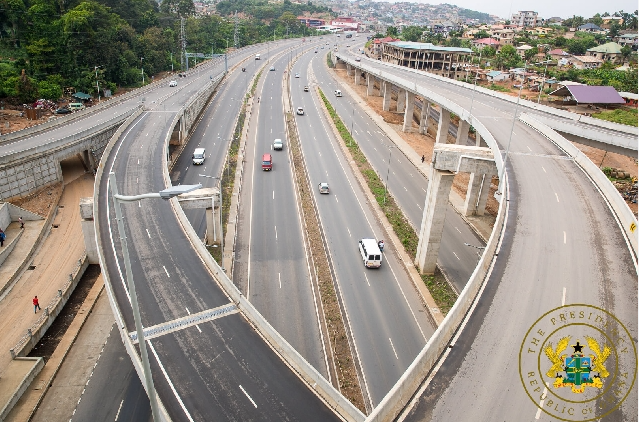

- Ato Forson Targets Full Expressway Funding by December as Ghana Balances Investment and Debt Discipline
Ghana is seeking to assemble the full financing required for the proposed Accra–Kumasi Expressway by December without resorting to additional borrowing, setting up an important test of whether the government can pursue large-scale infrastructure investment while preserving post-restructuring fiscal discipline.
Finance Minister Dr Cassiel Ato Forson says US$1.70 billion had already been deposited in a dedicated Accra–Kumasi Expressway account at the Bank of Ghana as of July 22, 2026, with the funds ring-fenced until the main construction contract is awarded. The government expects to complete the project’s financing arrangements before the end of the year.
“As of 22nd July 2026, US$1.7 billion had been deposited into the dedicated Accra-Kumasi Expressway Account at the Bank of Ghana,” Dr Forson told Parliament. “The funds have been ring-fenced and will be used only after the main construction contract is awarded.”
The financing model is potentially as consequential as the road itself. Ghana has historically relied heavily on external loans, syndicated facilities, bilateral credit and government-backed borrowing to finance large infrastructure, leaving major projects closely tied to the sovereign balance sheet.
The government is attempting a different proposition under its Big Push Infrastructure Programme: mobilise and dedicate resources to strategic capital projects without adding fresh debt. If successful, the approach could demonstrate that major public investment does not necessarily have to recreate the borrowing pressures that contributed to Ghana’s recent fiscal crisis.
But the US$1.70 billion should not automatically be treated as the final cost of the expressway. The credibility of the no-borrowing commitment will depend on the eventual contract value, associated compensation and infrastructure costs, the source and timing of additional resources and whether government can protect the dedicated funding from competing fiscal pressures.
The planned expressway is expected to cover about 176 kilometres and operate as a six-lane bidirectional highway between Accra and Kumasi. Government expects the project to reduce travel time between Ghana’s two largest commercial centres to roughly two hours while improving safety, congestion management and freight movement.
Its strongest economic case lies in logistics. Accra and Kumasi sit at the centre of Ghana’s commercial geography, and a faster connection between them could reduce vehicle operating costs, improve delivery reliability and strengthen the movement of agricultural produce, manufactured goods and imported inputs.
The benefits could extend beyond the two cities if the corridor is integrated properly with Ghana’s ports, industrial zones, northern production centres and regional transport links. In that sense, the project has the potential to operate as economic infrastructure rather than simply a faster road between Accra and Kumasi.
That distinction is critical because infrastructure financed from scarce public resources needs to generate measurable productivity benefits. Reduced travel time alone is not enough; the real return must come through lower logistics costs, improved market access, stronger investment and more efficient movement of goods and people.
Government says the expressway will incorporate major interchanges, intelligent transport systems, electronic tolling, emergency-response facilities and rest areas. Those features could improve reliability and safety, but they will also add to construction and maintenance requirements.
The financing structure therefore has to be matched by strong procurement discipline. Cost overruns, frequent contract variations, compensation disputes or poorly controlled consultancy costs could erode the advantage of having substantial resources already ring-fenced.
Preparatory work has moved forward, with the Ghana Armed Forces reported to have cleared about 122 kilometres of the required right-of-way within 12 weeks. That represents approximately 69.32% of the 176-kilometre corridor.
Feasibility studies and detailed engineering designs were expected to be completed before procurement of the principal construction contract moved forward. The sequencing will matter because the government’s ability to keep the project within its available financing envelope depends heavily on the quality of the design, tendering process and risk allocation before construction begins.
The expressway is also competing for fiscal space with another major government priority: rebuilding Ghana’s debt-service buffers. Dr Forson has said the Sinking Fund had accumulated GH¢15.60 billion by July and is targeted to reach GH¢30.00 billion by the end of 2026 to meet approximately GH¢30.00 billion in domestic debt obligations due in February 2027.
That parallel accumulation highlights the difficult balancing act confronting the Finance Ministry. Government is attempting simultaneously to fund infrastructure, rebuild buffers, service debt and restore investor confidence without returning to unsustainable borrowing.
The opportunity cost therefore cannot be ignored. Every dollar dedicated to the expressway is capital that cannot be deployed elsewhere unless government revenues or other financing sources expand sufficiently.
That makes project selection as important as project financing. A highway of this scale must generate economic returns high enough to justify committing billions of dollars while other infrastructure, health, education and social demands remain substantial.
The ring-fenced account nevertheless provides an important governance advantage if properly protected. Separating project resources from ordinary government cash management can reduce the risk that funding is diverted to recurrent expenditure or unrelated obligations before construction begins.
It can also strengthen the government’s position during procurement because contractors and investors have greater confidence where committed financing already exists. But that advantage depends on transparency around the balance, the source of the funds, permissible uses and the controls governing disbursement.
The December deadline will therefore be watched closely. If government succeeds in mobilising the entire financing requirement without fresh borrowing, the expressway could become an important demonstration of how Ghana intends to finance infrastructure after debt restructuring.
If the financing target slips, or if the final project cost materially exceeds available resources, questions will emerge about whether the original no-borrowing assumption was realistic.
There is also a broader policy issue. Borrowing for productive infrastructure is not inherently problematic if projects generate economic returns greater than their financing costs and debt remains sustainable. The danger arises when borrowing is poorly structured, project economics are weak or investment does not generate sufficient growth to service the obligations it creates.
The government is effectively trying to avoid that risk altogether by prefunding the expressway. That could strengthen fiscal credibility, but only if the resources are genuinely available without creating hidden liabilities elsewhere in the public sector.
For Ghana, the project is consequently becoming one of the clearest tests of the Big Push philosophy. The government must demonstrate that ambitious infrastructure and fiscal restraint can coexist.
The US$1.70 billion already deposited at the Bank of Ghana gives the project an unusually concrete financial foundation. What matters next is whether that foundation produces a competitively procured, efficiently built and properly maintained transport corridor.
The real measure of success will therefore not simply be whether the Accra–Kumasi Expressway is constructed without new borrowing. It will be whether Ghana can build it without weakening fiscal stability and generate enough productivity, trade and investment gains to justify the resources committed to it.

